
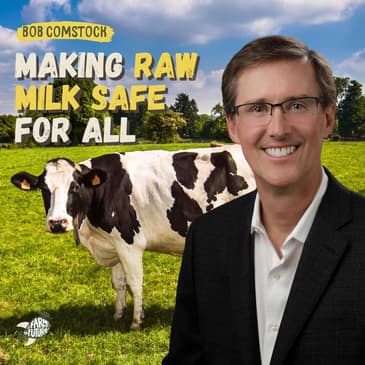
What if we could have all the immune-boosting benefits of raw milk without any of the safety risks? That's the promise of today's episode.
Bob Comstock is the CEO of Tamarack Biotics and inventor of a revolutionary UV pasteurization technology that just received FDA approval after 12 years of development. Unlike traditional heat pasteurization that destroys up to 70% of milk's beneficial compounds, Bob's "cold pasteurization" process preserves 93-100% of bioactive proteins while eliminating dangerous pathogens.
European studies have consistently shown that children who consume raw milk are protected from developing asthma, hay fever, eczema, and food allergies – conditions that now affect nearly half of all children. But the scientific community has confirmed that heating milk destroys this protective effect. Bob's UV technology could be the key to making these health benefits safely accessible to everyone.
Bob shares the fascinating origin story of how he discovered this technology while living in Singapore, the hundreds of pathogens they had to test against for FDA approval, and why a regulation from the 1970s nearly derailed the entire project. He also discusses their clinical trials showing elderly participants had 120% more antibodies after consuming UV-treated milk protein compared to traditional whey protein, and their upcoming studies on allergy prevention in children.
This technology could revolutionize not just the dairy industry, but potentially help address America's chronic disease epidemic by making truly nutritious milk widely available for the first time in over 150 years.
About Bob Comstock
Bob Comstock is the founder and CEO of Tamarack Biotics, a food‑tech company based in Fresno, California. With a Mechanical Engineering degree from UC Berkeley, Bob launched Tamarack in 2011 to pioneer healthier dairy solutions. Before starting Tamarack Biotics, he started Compass Foods, which developed the world’s most water soluble food grade emulsifier.
Under his leadership, Tamarack developed TruActive®, the first FDA‑accepted UV‑based milk treatment that kills pathogens while retaining enzymes, proteins, and immune‑boosting bioactives—without traditional pasteurization.
Discounts
- Get 10% off delicious local farm-fresh food delivered to your door with my link for FarmMatch: https://farmmatch.com/jane
- Get 15% off high-quality Italian olive oil with code FARMTOFUTURE: https://shop.vignolifood.com/FARMTOFUTURE
- Get 40% the CircleDNA’s Premium DNA test with code JANEZHANG: https://circledna.com/premium
Connect with Jane Z.
- Instagram: @farm.to.future
- Email: jane@farmtofuture.co
- Website: farmtofuture.co
[00:00:00] Mother's milk, whether from a human or a cow, is a very complex biofluid. There's thousands of proteins, thousands in milk. Children that consume raw milk at a young age are protected from developing asthma, hay fever, eczema, atopic dermatitis, and food allergies. The promise of using cold pasteurization, if you will, or using UV protects these bioactive proteins that are believed responsible for the protection from developing allergies.
[00:00:31] I'm Jane Z, and this is Farm to Future, the podcast all about eating better for the planet. So I've been drinking raw milk on and off for years now after learning how magical it can be for our immune systems and our gut health. But when I got pregnant this year, I decided to take a break. There's a higher risk of infection when you're growing a tiny human, and I just wanted to play it safe.
[00:00:55] But as soon as the weather cools down and baby's out, I am looking forward to getting back on that raw milk train. Here's the thing though. I've talked to many friends about raw milk, and people tend to fall into two camps. Some are totally on board, and I have a friend who now drives out every weekend to a farm to pick up her raw milk, and others just aren't willing to take the risk. And I get it. There is real risk involved. Cows can get sick. The milk doesn't always stay cold on the way to your fridge.
[00:01:25] And even when it does, it can go bad much quicker than pasteurized milk. There's a ton of studies, mostly from Europe, that show that kids who drink raw milk are protected from developing asthma, hay fever, eczema, and food allergies. But in the U.S., only 13 states allow the sale of raw milk in retail stores.
[00:01:46] Now, what if I told you that in the next 10 years, we could all have access to raw milk at every grocery store without the safety risks? That's exactly the future that Bob Comstock and his team at Tamarack Biotics are building.
[00:02:02] Bob is the inventor behind a new UV light technology that can pasteurize milk without heat, so it can keep up to 98% of the bioactive compounds that make raw milk so nutritious while getting rid of all the dangerous pathogens. After 12 years of development and testing, they just received FDA approval this May for their technology, which they're calling TrueActive.
[00:02:26] Today, Bob walks us through how this TrueActive UV technology works, why it took over a decade to get approved, and how it could transform not just the dairy industry, but potentially address the chronic disease epidemic we're seeing in kids and adults in America today. If you're new here, welcome, welcome. Be sure to subscribe on Spotify or Apple Podcasts, and you can find me, Jane Z, on Instagram at farm.to.future. Let's dive in.
[00:02:57] We are here. We're live with Bob Comstock, who is the CEO of Tamarack Biotics and I believe the inventor behind a new UV light technology for treating raw milk. Welcome to the podcast, Bob. Thank you, Jane. Did you have your raw milk this morning? I did not. I had some milk, though, in my coffee. Do you drink raw milk regularly now? No. No.
[00:03:24] I've been friends for a very long time with Mark McAfee, the owner of Raw Farm, or before that, Organic Pastures. Yes. But I'm not a believer in raw milk because of the safety issues, but I do think it's quite nutritionally superior to pasteurized milk. Oh, that's so interesting. And yet you're working in the industry now. Would you drink the milk that's treated with your UV technology?
[00:04:17] I do. So can powdered milk contain bioactives? Well, actually, this maybe is a great segue for us to talk about how this all started. So I lived in Singapore with my wife and two sons for 20 years. And while I was there, I invented the world's most water-soluble food grade emulsifier. And we built a big factory to produce this. And the company is still doing very well. It's named Compass Foods.
[00:04:44] And one of the biggest challenges of that product was drying it into a powder because it became very sticky at low temperatures. So I scoured the world to find a technology to do very low temperature drying. And through some connections, I met this Russian man in Israel that spoke no Hebrew and no English. But he had invented a fascinating technology for drying at very low temperatures.
[00:05:14] And I built a pilot system in Singapore. And then just out of curiosity, there was one cow in Singapore to demonstrate milking to schoolchildren. And I got some raw milk from that cow, put it through this drying process, and then sent a sample to Bruce German at UC Davis. And he came back and said, it's remarkable because there are many fragile compounds, thermally fragile compounds in milk that are very quickly destroyed by normal spray drying.
[00:05:42] Things like lactoferrin and immunoglobulins, IgGs, maybe people are familiar with that term. So that started Tamarack. And I moved back from Singapore to Fresno, California, be right near the dairy industry. And we started pursuing this and then found that there was no future drying raw milk. We had to find a way to pasteurize it without damaging these thermally sensitive compounds. And Bruce German used to tell me a very famous quote that stuck with me all these years.
[00:06:12] It's mother's milk, whether from a human or a cow, is a very complex biofluid. And there's thousands of proteins, thousands in milk. And so plant-based milks like oat milk or almond milk or whatever else have no bioactive proteins in them. It's quite fascinating and important to protect these nutrients that milk provides us. Right.
[00:06:41] Yeah. It's a bit of a misnomer to call plant-based milks milk because really they're more like almond juice or almond water, really. If you think about how it's made, it's crushed up almonds and water and you, you know, add some fillers and gums to make it tastier. To stabilize them. Yeah. Well, otherwise it would all settle to the bottom. But yeah, that's. Yeah. It is unfortunate because it's confused a lot of the public that think they're getting milk and don't really appreciate the nutritional value of milk.
[00:07:12] Can you talk about how this true active technology is different from heat pasteurization? Just walk us through kind of the process. Is there any heat involved at all? How did kind of the two processes compare? Well, certainly. So in, in pasteurization at a large dairy plant, it's making dairy ingredients, whether it's making liquid milk or making yogurt or cottage cheese or regular cheese.
[00:07:37] Milk is required in the United States and most developed countries to be treated with what's usually called HTST, which stands for high temperature, short time. So that's heating milk to 161 degrees Fahrenheit for 15 seconds. So it ramps up to that temperature. You steam to generate enough heat to get it to that temperature.
[00:08:02] And then you cool it back down with lots of electricity, back down to like just above freezing, 39 degrees or so. And in that process, you will kill all the bacteria and viruses and some of the spores that could be in milk. But unfortunately, you cause enormous damage to these bioactive compounds and, and many of them are entirely eliminated.
[00:08:31] In fact, there's a compound in milk that is thought to be involved in, in allergies and other gut health issues. It's called alkaline phosphatase. And the requirement of the FDA is that you totally destroy alkaline phosphatase, this very important compound to ensure pasteurization was effective. So that's, that's the height of irony, if you can. Yeah.
[00:08:56] You must confirm damage to the food to ensure your process was effective. Right. That is so ironic. You're literally killing the thing that is supposed to protect our gut and our immune system and the benefit that we get from milk. Right. So UV is very different. It's entirely cold. In fact, going through the bank of UV cylinders that we do, we call them turbulators.
[00:09:22] So we process the milk through these two turbulators and very thin films. And it very highly turbulent flows. It means it's constant and very vigorous mixing. And in doing so, the milk goes up about two degrees after the entire process. So it's, it starts very cold and it ends very cold.
[00:09:43] And we keep the milk way below the cow's body temperature through the entire process, including drying, so that it, it isn't damaging these compounds. So when you're, when you're creating these powdered milk products, are you using the UV to, to treat the liquid milk or the, the powder once it's been dried? No, it took the liquid milk. So. Okay.
[00:10:09] The process we use is very similar to any dairy process. We just use UV instead of heat. So in a normal dairy plant, the milk will come in from the farm and it is usually separated immediately into cream and skim milk. And we treat skim milk. And then it goes through different filtration steps, membrane filtration. Then it goes into drying. Okay.
[00:10:35] And maybe in the middle of those processes, you could also do an additional UV step to ensure the milk has remained clean through all the processing. Can you use the UV to treat the whole milk? My understanding is most of the bioactives live in the butterfat cells. No, that's really not true. There are particular proteins in what's called the milk fat globule membrane, but most of those proteins are not unique. They're in the skim milk fraction, if you will.
[00:11:05] So we have treated whole milk and we haven't seen any taste impact. Everybody in the lab tasted it. And these are not my employees. These are university staff tasted the whole milk and said, you know, it tastes perfectly fine and fresh to me. I note your comment you had in the past that earlier UV systems could damage the milk and cause lipid oxidation or damaging the fat and make it taste bad.
[00:11:34] But we've done so much optimization of the system that we use. In fact, in 2023, not that long ago, we did some computational fluid dynamics studies of our system with skim milk and found we needed to modify one of the dimensions. And in doing so, we actually doubled the effectiveness.
[00:11:55] So we halved the number of these tubulators you needed to get the effective dose to kill all the bad bugs. And the equipment became much smaller and delivered the UV process much more effectively.
[00:12:11] So just for context, for listeners, when you and I had spoke last time, I had brought up that, you know, earlier in countries like India and South Africa, they have been using UV treated or UV treatment for milk for a while. But there's reports that that milk tastes burnt. But it sounds like your technology gets around that. Yeah, we don't subject the milk to quite such long treatments, if you will.
[00:12:36] We're much more efficient at delivering the dose to kill the pathogens, including bacteria and viruses than the earlier systems. So you had to do a bunch of testing for the FDA to prove that, you know, each one of these pathogens is removed. What are some of those pathogens? How many are there like total? And how did you go about testing for each one?
[00:13:05] Yeah, so that was one of the requirements is the FDA has a requirement that you eliminate or destroy the pathogens that are likely to occur in milk of public health significance. So we had to agree with the FDA many years ago, actually, at what that list included. And some of those pathogens are very dangerous pathogens that are treated as select agents by the CDC.
[00:13:33] So just getting access to them, that took years of our effort with different universities to make that happen. But we tested every pathogen that could possibly occur in milk that met that definition. God. And how many of these are there that you had to test on? Hundreds. Okay. Literally hundreds. Wow. Because there's so many, even for an individual pathogen, there's what's called many serotypes.
[00:14:01] So different strains of these individual pathogens that we had to confirm for each one that it was completely inactivating these pathogens. And you've been working on this technology for a while, over 10 years, right? What kind of took the most amount of time? Was it testing for those pathogens? Yeah. And we had some bad advice, to be very honest.
[00:14:25] We started off in a regulatory consulting company, told us to obtain a GRAS, which is generally recognized as safe certification for our product. And we did that. And it involved lots of analytical testing. We tested our product in rats. This was a milk protein concentrate powder. We did an enormous amount of work to show that it was safe. But the FDA said, no, no, no.
[00:14:51] The FDA treats radiation as a food additive, which is completely illogical. And it's some legislation and regulations that really needs to be changed because it's inhibiting the use of UV for many other applications, which it would provide safety benefits. Yeah. I mean, UV technology is not new in itself. And we use it to treat drinking water, for example.
[00:15:17] What would you say to someone who's concerned about the potential unknown risks that come with, you know, health risks that come with UV treatment?
[00:15:28] Yeah, it's interesting you bring that up because in the 1920s and 30s, a researcher out of the University of Wisconsin named John Steenbach invented a process to UV treat thin films of whole milk to increase the vitamin D content. Because at that time, rickets was a real problem in the northern climates here in the United States and in Europe.
[00:15:55] And rickets is basically a vitamin D deficiency that leads to poor absorption of calcium. So they came up with, as it was called back in the day, irradiated milk. And virtually every dairy in the United States licensed these patents that John Steenbach had filed. And millions upon millions of children consumed UV treated milk in the United States, Canada and Europe in this time.
[00:16:24] And clinical trials were done that showed no harm to the children. And in fact, it did cure rickets until vitamin D was synthetically created. So it could be added to milk. So you go to your carton of milk at the grocery store today, it'll say vitamin D added as required by the U.S. law. But in those early days, they cured rickets by using UV. Wow.
[00:16:50] And also UV has been approved in Europe for many years to extend the shelf life of thermally pasteurized milk. And Europe did a very thorough analysis and showed there was no change in the nutritional profile of the milk and no degradation of any of these helpful compounds that milk contains. No harmful byproducts were created. Why did we stop using UV here in the States?
[00:17:18] Well, the Steenbach process was expensive and it made the milk at that time. It used mercury arc lamps to generate the ultraviolet light. So if you think of Frankenstein, there was very primitive technology back then. And we didn't even have any good way of measuring the UV light output. So they actually used the taste of the milk to make sure it had been, it's achieved its anti-ricetic or anti-ricets values.
[00:17:48] So they used actually how bad the milk tasted to ensure that it was effectively treated. So that wasn't a very good solution in the long term. And once we were able to add vitamin D to fresh milk, that taste issue was eliminated. Gotcha. Okay. So at the time, this was like, was used as a stopgap for rickets before the synthetic vitamin D was developed. Correct. Yep.
[00:18:13] Whereas in your case now, you have a different goal in mind, which is to preserve these bioactives that are really beneficial in raw milk, but to make that milk safer to drink. What are your thoughts on, you know, you had mentioned Mark McAfee, who we've had on the podcast. He's, he's amazing. Such a character. Um, but farmers like Mark McAfee and my family will source raw milk from an Amish farm here in the Northeast.
[00:18:40] But we, you still got to be very careful, right? To source from a farm that's trustworthy. And you know that all of their processes are sanitary and they keep the milk cold and all of that. What are your thoughts on traditional raw milk production methods of, you know, keeping things cold and clean? Yeah. Well, you still can't tell if a cow gets mastitis and, and the milk is infected. You only learn that later.
[00:19:08] So milk contains antibacterial proteins and helps suppress the growth of pathogens or bad bugs that could be in the milk, but it's dangerous. And, you know, Mark, uh, I love the guy. He's, he's a very enthusiastic raw milk supporter, but recently he killed four cats because somebody gave his milk. He killed him to his cats and they died from bird flu.
[00:19:34] So yeah, it's not entirely safe, particularly in modern distribution channels where it goes from the farmer to a store and it sits on store shelves. And then it gets picked up and the homeowner gets it at home and may not keep it as cold as it should be. So you just can't tell. And you can, you can get sick by drinking raw milk. And certainly the FDA is, and CDC are very much against raw milk and being advocated.
[00:20:03] So the, the milk that your UV treatment goes through, would that still be considered raw milk? No, actually the FDA approval that we just received a few weeks ago, our process is now considered in the United States legal pasteurization. So now when we use our, our particular process, uh, the milk can be considered pasteurized even though no heat is involved.
[00:20:32] Oh, interesting. So was that your goal? Are you looking to kind of be in the same category as pasteurization? Well, I mean, one of the things that we, we, we can see very easily is the analytical results. And then we have clinical trials that we have completed and that we are, are working on right now, several clinical trials. But eventually we expect to be in liquid milk.
[00:21:00] And I think, you know, over the next 10 to 15 years, the entire dairy industry is going to convert to UV pasteurization because it's safer. We kill the bad bugs more effectively than heat, particularly for one pathogen known as mycobacterium avium paratuberculosis, which has been linked to Crohn's disease, which still continues to increase in the U S. But map as it is known is, is a bad bug that is not killed very well by heat.
[00:21:31] So Europe is much more aware of map than the United States. And so they actually use higher temperatures to pasteurize milk in Europe than they do in the U S. Huh. It's interesting. You mentioned Crohn's. Another guest I've had on the show is Max Kane. He's a farmer in Wisconsin, and he was diagnosed with, with Crohn's as a very young person and, you know, had to take medications for a long time.
[00:21:58] And then he discovered raw milk and also just kind of eating whole, you know, locally sourced foods. And he was able to essentially heal his gut and, and cure himself from Crohn's disease by drinking raw milk. Uh, but you're saying there's a, a pathogen in traditionally pasteurized milk that is linked to Crohn's. If it is present in the milk, uh, from the cow, heat doesn't kill it very effectively.
[00:22:26] So it could be there, but I do support the fact. It's pretty well documented now that there are compounds in raw milk that we do not damage that are very important for gut health. And as you know, there's an enormous amount of chronic disease in the United States that is related to your gut's health. And it is likely that our UV pasteurized milk will improve gut health and a lot of these chronic diseases that we currently have.
[00:22:57] Right. I want to get to the studies y'all have done in a moment. Um, but I read in your press release that the treatment maintains about 71% of the bioactives in the milk. But when we spoke last. Unfortunately, that's not correct. I don't know where you got that. You know, we have different studies all the time looking at the analytical properties. And one of our production partners just did some analysis of, of their three batches that they produced.
[00:23:25] And of those three batches, one was a hundred percent retention. The next one was 93. And the third one was 98% retention of these markers that they use the thermally sensitive compounds like lactoferrin or immunoglobulins. So it's much more, way more than 71%. Okay. That's really promising. Was that on skim milk or whole milk? Skim. Okay. We just haven't done much work on, on whole milk.
[00:23:53] It is not used much in dairy processing. So making yogurt and whatever else. You typically pasteurize the cream and the skim milk separately. And then you may recombine the fat at a later stage. But that's just how dairy plants operate. Oh, interesting. So when you buy whole milk from the store, are you saying that is actually like recombined? Often, yes.
[00:24:23] Particularly in dairy processing, like making yogurts or cheeses or those things. They're standardized so that the amount of fat, which changes seasonally with cows and what they're eating and things, they're standardized at a particular fat content before they're sold. Interesting. Interesting. Yeah. I could see that for needing to meet the requirements on the label that, you know,
[00:24:50] if you say something is 2%, it's got to be exactly 2%. And so there's just a lot of cream. And cream is very valuable in milk making butter. So it's often added back to standardized. I didn't know that. I want to hear about the clinical trials you all did. Walk us through the UC Davis trial you did with elderly patients. What exactly did you test and what were the results? Yeah.
[00:25:15] So UC Davis had done some work previously looking at giving elderly people whey protein, pasteurized whey proteins, and then giving them a tetanus shot and then looking at how many antibodies they develop. It's very well known that as people age, their immune systems weaken. And the best way to measure someone's immune health is to give them a vaccine and see how many antibodies they develop in response to the vaccine.
[00:25:44] And, you know, we went back through our raw data. And I believe a lot of older people that got the COVID vaccine probably didn't benefit at all because their immune systems were too sleepy, if you will. So UC Davis did this trial on whey proteins. And then some years later, they compared to a soy protein. And years later, we did the same trial with our UV-treated milk protein concentrate powder.
[00:26:11] And in that trial, we demonstrated that on average, the group that had taken our protein had 120% more antibodies than the control group. Whereas in the UC Davis earlier trial on the whey protein, they only saw 17% difference. So nearly 10 times more antibodies.
[00:26:35] And this shows that these bioactive compounds that are in milk are able to restore immune function in older people. And it makes sense kind of because a baby is born entirely sterile and gets the vast majority of its immune system through mother's milk. And that's why breastfeeding is so important compared to formula.
[00:27:01] And that same mechanism by which a mother imparts immunity to her infant works to restore immune function in older people whose immune systems have been compromised by maybe antibiotics over their lifetime by just not eating as healthy as possible or just getting old. This is probably a good time to bring back my original question, which was, can you have bioactive still in powdered milk? So powdered milk may not be a great name.
[00:27:30] So when the products that we initially will be producing will be milk protein concentrates or whey protein concentrates that are dried at lower temperatures. One of the benefits of UV treatment is we don't denature the proteins.
[00:27:48] And denatured proteins are the exact opposite of making a gummy bear where you try and, or, you know, cotton candy in the old days where you try and make the proteins so denatured that they will become sticky and viscous. So because we use no heat in these membrane filtration processes that are used in the dairy industry to separate minerals and lactose and other compounds from the, from the milk itself.
[00:28:19] In those processes, we've noticed that the efficiency of those membranes goes up. And for example, in a, in a process called reverse osmosis or an RO, many homeowners might have an RO system on their water. But in an RO membrane, the rate at which the water goes through the membrane and the extent to which you can remove the water before drying in a spray dryer is much higher.
[00:28:44] So because of that, we can dry at lower temperatures because there's less water to remove. So that enables us to protect these bioactive compounds. The numbers I was sharing with you earlier, the a hundred percent, 93 and 98%. Those were in the powder comparing to the raw milk feed. I didn't know that things like IgG could exist. Oh, actually, no, I know that. Well, you can buy it at a vitamin shop. You can buy IgGs and things.
[00:29:14] Those are often freeze dried to protect the bioactives because it's hard to do that. So that's quite expensive. And things like lactoferrin is sold at very high price. And, you know, that we're going to totally revolutionize the dairy industry because when you process lactoferrin in a dairy industry, about 70% of it is killed during the pasteurization step. So we don't kill it at all.
[00:29:40] It will make a very big yield improvement for guys that make lactoferrin. So this first product, this milk protein concentrate or whey protein concentrate, are your plans to kind of sell and distribute as a powder for other companies to put into different products? Or are you selling this direct to consumer? No, we won't sell direct to consumers.
[00:30:04] So I expect this will be used in a broad range of formats and even in ready to drink beverages like Ensure or Boost for older people. But you can't put it in the bottle because the bottles are then heated to very high temperature in a process called retorting. And that would damage all the compounds that you've worked very hard to protect. So you would retort the bottle as it is now with everything except the True Active,
[00:30:30] which is our brand name for our powders or anything made with our UV system. And then you would cover the bottle with a foil seal and then screw on, after the bottle cools, screw on a cap that contains the powder. And then the cap would twist by the consumer. The powder would fall in and you'd shake it. And that way the powder would never be exposed to high temperature. Oh, that's okay. Interesting. That's really innovative.
[00:30:59] Is that one of the products y'all are working on right now? I don't want to make it sound like we're doing that. There are companies that make these caps. They're partnering with. And they have. Yeah. Yeah. So there's several. And one of them that has done a very good job, I think, is called B-Caps out of Belgium. And their cap works very well in these kind of applications. And the companies that make these ready-to-drink beverages often know about these solutions. They just haven't found a good reason to use them.
[00:31:26] Because there's not that many bioactives left in milk protein concentrates today. We retain, compared to traditional milk protein concentrates, thermally pasteurized versions, we contain 10% to 20% more. Not percent. I'm sorry. Times. Times more of these compounds. So it's a big difference, not a little difference. So how soon can we see products on the shelves that contain TrueActive?
[00:31:56] Well, good question. So the FDA has one further hurdle for us to go through. So it's kind of a silly hurdle, but Congress in the 1950s after World War II was very concerned about radiation. And we've been through all the congressional record and the subcommittee transcripts. And they talk about radioisotopes, gamma rays, and x-rays in food.
[00:32:23] And they wanted to regulate that because they were concerned that you could cause damage or change the properties of the food. So they created some laws that say that these sources of radiation, like radioisotopes, gamma rays, and x-rays, should be treated as food additives and go through additional safety checks before they're approved. Well, unfortunately, in the 1970s, for a reason I still have not discerned, the FDA created
[00:32:53] a regulation that governs the allowed uses of ultraviolet light. And ultraviolet light and infrared and microwaves, like your microwave oven at home, are non-ionizing radiation. And to lump them in the same classification as ionizing radiation is just, it's ignoring science because we really can't change the food. There's not enough energy to do so.
[00:33:21] So we're negotiating with the FDA right now about what we have to do to prove the safety through this food additive process. And we'll see where that ends up. As you know, RFK, who's head of health and human services, is a real big fan of raw milk. And this is a pathway to safe raw milk that may get finally some attention at the UV to improve human health. Right.
[00:33:46] We were talking about clinical trials earlier, but I think one of the most important clinical trials today is Europe knows very, very well through many epidemiological studies that children that consume raw milk at a young age are protected from developing asthma, hay fever, eczema, atopic dermatitis, and food allergies.
[00:34:10] And this is a huge problem for society today because basically half of children born today will develop some form of allergy. And the scientific community has confirmed very clearly that heating the milk destroys this protective effect. And the promise of using cold pasteurization, if you will, or using UV protects these bioactive
[00:34:37] proteins that are believed responsible for the protection from developing allergies. And there's a very large clinical organization here in the United States that is currently testing our whey protein concentrate powder to confirm its ability to protect juvenile mice from developing allergies. And this is a precursor study to a study that we wish to do in Europe.
[00:35:05] We've already written the protocol to do a study out of the University Hospital in Munich to look at post-weaning children consuming our whey protein, our true active WPC-80. Wow. I think that's just such a value to society that we could clearly show some benefit. It's a huge opportunity. I just ran an episode with a culinary medicine expert we have on the show, Chef Dr. Mike, and
[00:35:34] we just went over the recent Maha reports that RFK Jr.'s team at HHS released about a month or two ago. And the focus was on childhood chronic disease. And the first thing we talk about is ultra-processed foods and getting them out of the system. But I think this angle of, you know, well, what do we replace that with? And I feel like raw milk could be a big part of the answer here. And that could be a big opportunity. If we could, you know, get... Well, I think UV pasteurized milk.
[00:36:04] I don't think too many mothers are enthusiastic about giving their infant raw milk because that's, you know, when they're most vulnerable too. So I think this opportunity for children to be protected from developing allergies is very real. And it needs to be expedited through the FDA approval process to make sure that happens. I think we need a better term for it. Is that what you're planning to call it? UV-treated milk? We're going to use the True Active brand.
[00:36:32] I think that's going to be descriptive of retaining the activity of these proteins in milk and not destroying them with heat. I'm just trying to think of what's the generic or maybe like scientific, like the technical term that you would use to describe this. Because it's not fully raw, like you said, because it has been treated by UV, but it does contain those bioactives, which you want to, you know, message across.
[00:37:00] Well, one of the things it's useful to understand is how UV works. And the only thing it can do, because it really isn't a very powerful treatment, if you will, is it can, let's say, inactivate DNA of bacteria and RNA of viruses. So it doesn't have enough power to cause substantial changes in the food.
[00:37:26] And if people often don't know how microwaves work, but they work by heating the water in the food, by resonating the water molecules to warm them up, if you will. And so they, a microwave is a fascinating device and people don't really understand it, its function, but it can't really change food because all it can do is really excite the water molecules. So when people say like heating up your food in a microwave, like denatures the proteins
[00:37:55] or something like that, is that just not true? It depends on what temperature. So the microwave itself won't, but if you heat the food enough to reach a temperature at which you're starting to damage proteins, which is around 55 degrees centigrade, at that point, the bioactive components could be degraded. There's lots of enzymes and other proteins. Gotcha. Okay. Back to the rollout of True Active, because this is really exciting.
[00:38:23] So my understanding is you all are starting with these milk concentrate sort of powdered formulas. When we spoke a while ago, you were waiting for this regulatory window around something called the pasteurized milk ordinance that governs interstake milk shipments. What is the latest on that? So we had a meeting with our regulatory consultants who are all senior ex-FDA staff.
[00:38:52] And the PMO includes provisions for alternatives that have been approved by the FDA to be used as pasteurization. And we were not quite aware of all of the meaning of that. We were under the impression we would need to amend the PMO, but they clarified that's not necessary. So we will be able to, as soon as we clear this final food additive petition hurdle with
[00:39:17] the FDA, be able to roll out all of the products we intend to produce, which will include all the powdered concentrates, yogurts, cheeses, and liquid milk. Oh, wow. That's exciting. How soon can we see those products rolling out? I'm not really sure, but we have a meeting with the FDA on July 17th to go over our plan for our food additive petition.
[00:39:43] And we're hoping the FDA will prioritize this petition because it's so consistent with the current administration's efforts to make America healthy again. And making milk healthy again is very consistent with what I think the administration is trying to do and the secretary of HHS. Right. Yeah. Thanks to Bobby Kennedy for that. Yes.
[00:40:10] So removing this extra hurdle, does that change your rollout strategy at all? Or does that just kind of help expedite the process? I think it will expedite our focus on liquid milk because it's been important, but we thought it would take us longer to get this rolled out. And if we can roll it out with the rest of our production, it certainly makes sense. Because that's a very common and popular way of consuming dairy ingredients, not just cheese
[00:40:40] on our pizzas, but having liquid milk and getting this to children would be very effective and helpful in their health. Do you have a sense of a general breakdown of how much of the dairy industry by revenue consists of liquid milk products versus other products like yogurts, cheese, et cetera? Yeah. I think the current statistic is that liquid milk only accounts for 9% of all milk that comes from dairy.
[00:41:09] So yogurts and cheeses and all the other ingredients, ice cream, yeah. So the products are certainly much more popular than just liquid milk. Huh. That's interesting. Are we going to see the True Active kind of logo mark on packages? Is that something I should expect? I think you should expect that. Okay. We'll be the intel inside of bioactive proteins. Oh, very cool. That'd be something to look forward to.
[00:41:37] So who's knocking on your doors these days? I bet the dairy industry is very excited. Like, you know, do you have like Hood and Nestle or who are you talking to these days? Well, I wouldn't want to get into individual names, but yeah, we're talking to basically every single dairy company in the United States and Europe. We're working very hard already on our European approval. The regulations in Europe are not quite so complicated, if you will, and illogical.
[00:42:05] So European approval will be much more straightforward. So they don't have a regulation that governs allowed uses of UV. So I'm curious where that came from, that change that was made in the 70s of grouping UV with these other forms of radiation. Do you know where that came from? I don't. And I've never been able to find somebody at the FDA who can explain it to me how this exists because there's so many foods that would benefit.
[00:42:34] And we hear every year about recalls of foods because Listeria, E. coli, or Salmonella, these bacteria are very easy to kill with UV. So it would be very easy to make food safer without changing the nutritional value in the food. But this regulation that the FDA wrote in the 1970s, it prohibits those until you complete
[00:43:01] an entire food additive petition, the generally recognized as safe approval route, which is used for 99.9% of all food ingredients, is not available for UV use on any food. Yeah, it seems like one of those weird legacy things. But assuming you can get that approved for milk, could you see this kind of opening up a new opportunity either for Tamarack or other companies to apply UV to other food products?
[00:43:33] Yeah. If the FDA rationalizes or even deletes 179.39, as the regulation is known, I think food would be safer. But that's my opinion. And we'll see what this current administration can encourage the FDA to modernize its regulations. And then I'm curious also with the dairy companies that y'all are speaking to, what are they most excited about, one? And what kinds of concerns have they brought up?
[00:44:02] Well, I think everybody wants to validate what everything that we've already proven to the FDA in their own labs and their own production. And so many of these big dairy companies are very conservative for good reason. And they want to see. So we have companies that are already, many companies have already ordered our equipment for their own validation use and pre-production studies and those kinds of things. You know, you asked the question of what gets the most excited.
[00:44:32] There's really three factors that gets the dairy industry so excited. One is UV is safer than heat. So it's not a compromise in safety. It's actually more effective at killing the bad bugs in milk than heat. The second is it's much more sustainable. It uses so much less energy compared to steam and then electricity for refrigeration because it stays at a constant temperature through the entire UV process. And the UV lamps only use a very small amount of energy.
[00:45:02] And the third reason and most important is you retain all this nutritional value in milk. That is the reason why people drink milk is because it is so nutritious. Right. We think the dairy industry will eventually adopt this once it's proven in large-scale production. I think they will rapidly adopt it because of those three reasons. Is the true active technology, is it patented technology? Or is this like kind of generic UV tech and, you know, there's like some components that y'all have worked on?
[00:45:33] No, it's entirely patented globally. There's just an awful lot of proprietary information also about how to do this that's even more sophisticated than the patent describes. But, yeah, the FDA approval is very specific to our equipment and our process conditions. Got it. I feel sorry for anyone that wants to go through this process like we have been. It's taken 12 years. Wow.
[00:46:01] I'm sure companies will want to do this and get approval for their different UV process. But it's been very painful and expensive and time-consuming to work with the FDA to make this happen. Yeah, 12 years. Wow. Are you where you, you know, thought you would be 12 years ago when you started building this technology? No, not at all. We thought we'd be in production many, many, many years ago. Well, better late than never. I mean, it's all very exciting.
[00:46:31] The FDA approval, I mean, that's a huge, huge milestone. So kudos to you and the team. I'm excited to see where you all take this. As we wrap up, is there anything else you would like to share with listeners, either about where True Active is going or kind of your thoughts on the future of dairy? I think this will be broadly adopted for those three reasons we brought up.
[00:46:54] And I'm very excited to see many additional trials proving the benefits of these compounds that have been lost in our dairy production for over 150 years. Pasteurization was invented before the Civil War in the United States. And we've just followed down this road, if you will, and not innovated. And better technologies for pasteurizing milk have never been approved. So we're the first in the United States to gain regulatory approval for an alternative to heat.
[00:47:22] And, yeah, I'm very excited about the opportunities this leads to clinical trials in sports nutrition, more trials on allergy prevention and elderly nutrition and gut health. There are so many chronic diseases in the United States that we believe True Active will have a powerful impact on reducing these things often related to gut health.
[00:47:48] People hear of leaky gut, which is unfortunate. The name isn't very descriptive, but it's a very real issue. And there's a lot of work going on in that area about how our True Active product will protect people from that condition. We talk about gut health a lot on this podcast. I've been through my own journey with IBS and have had folks on with leaky gut and Crohn's. And we've all kind of got through our own experiments on our own bodies.
[00:48:18] But, yeah, I mean, having all these immune compounds in milk that we can drink every day, I mean, that would be huge. So I'm very looking forward to this future that y'all are bringing to us with this UV technology. I look forward to it, too, Jane, and wonderful speaking with you today. And that's a wrap. Thank you so much for tuning in. Remember to nourish your body, and I'll talk to you next time.