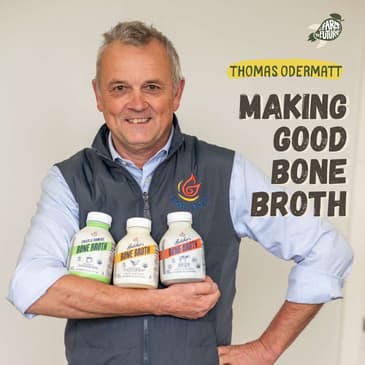
Growing up in his family’s award-winning butcher shop in San Gottardo, Switzerland, Thomas Odermatt learned the foundations of traditional butchery and the art of succulent, tender rotisserie. From his father, Otto, a Metzgermeister (master butcher), he learned the importance of selecting the right cuts for the right purpose and sourcing only high-quality, free-range meats from trusted family farms. From his mother, Maria, he inherited the family’s cherished rotisserie recipes, a Saturday specialty that drew loyal customers to the shop.
Thomas went on to earn a master’s degree in organic farming in Zürich before moving to the United States to continue his studies at the University of California, Berkeley. Immersed in the Bay Area’s emerging gourmet food scene, he became inspired to bring his heritage and craftsmanship to a new audience. In 2002, that vision led to the launch of Roli Roti, America’s first gourmet rotisserie food truck, created from a singular pursuit: making the best rotisserie chicken possible.
As the business grew, Thomas found himself with excess bones and trimmings from the truck. Guided by his butchery roots and a nose-to-tail philosophy, he put every part to use. Thirteen years later, that approach culminated in the creation of Butcher’s Bone Broth, an organic, fresh bone broth that reflects his enduring commitment to time, attention, and care in feeding others. Like his rotisserie, the broth is crafted to be healthy, deeply flavorful, and satisfying.
Today, Butcher’s Bone Broth is available in more than 10,000 locations nationwide, including leading retailers such as Costco, Sprouts Farmers Market, Whole Foods, and Publix.
- Website: https://www.butchers.co/
- Instagram: @butchersbonebroth
Discounts
- Get 10% off delicious local farm-fresh food delivered to your door with my link for FarmMatch: https://farmmatch.com/jane
- Get 15% off high-quality Italian olive oil with code FARMTOFUTURE: https://shop.vignolifood.com/FARMTOFUTURE
- Get 40% the CircleDNA’s Premium DNA test with code JANEZHANG: https://circledna.com/premium
Connect with Jane Z.
- Instagram: @farm.to.future
- Email: jane@farmtofuture.co
- Website: farmtofuture.co
Look, bone broth collagen is not a beauty product. Like a lot of people say, it makes you beautiful and looks a good skin and everything. It's really not. 30% of our body is collagen. We're producing collagen to the age of 17. If you have a 3-year-old daughter when she falls down they can quickly Go on. my grandmother, if she misses the step she breaks her leg because they don't have anymore this elasticity,
JaneHello friends and welcome back to Form to Future. I am officially back from maternity leave quick life update. I gave birth to Beautiful Baby Nico back in October and I have just been savoring motherhood more than I thought I ever would. And as you'd expect, some days are exhausting. But honestly, most of the time it has just been so wonderful. This journey of witnessing my baby, grow every day and discover the world for the first time. And food wise, I've been eating better than ever. We've been very lucky to have support from both sets of grandparents. And we've got some amazing chefs in the family. So I've been eating wonderful home cooked meals, a lot of soups, a lot of, fresh fish and vegetables and chicken and all kinds of yummy, yummy dishes. So anyway, I could talk about baby Nico and motherhood all day and maybe one day I'll do an episode on that if y'all are interested. But now let's get into our first episode of the year with Chef Thomas Derma. So you know how there's certain foods that your parents and grandparents lived on and swore by, and now science is just catching up to prove them. Right? Well, bone broth is one of those things. I feel like in the last few years, bone broth has been all the rage, now you see influencers chugging bone broth in the morning. Thomas grew up as a third generation butcher in Switzerland, and he absolutely would drink bone broth or have soup with bone broth every single day. He then went on to become an organic farmer, a chef, and now the founder of Butcher's Bone Broth, which is now the category leader in fresh bone broth. In today's episode we get into why fresh bone broth is so different from the shelf stable stuff, what collagen actually does in your body. And a brief history on butchery in America. Welcome to the Pod Thomas. We are in the studio here with Chef Thomas Derma. Welcome to Farm to Future.
ThomasThank you so much. Uh, Jane, I'm very looking forward to have a conversation
Janeyes, yes. I'm excited to get back into it. So we, have been enjoying your butcher's bone broth this week, my husband is actually sick, unfortunately, but fortunately we've got some of the, good stuff in the fridge. So we've been trying the Turkey bone broth, and you've got a great, chicken bone broth with, turmeric and ginger and that's, perfect for this season. It's winter, stuff is always going around. And bone broth is like the thing is bone broth kind of part of your daily rituals? Do you drink it every day?
ThomasYeah, I either drink it or I eat a soup. It's part of my DNA, it looks like. That's what
Janegrew. Yeah. Well, let's, let's start there, because you grew up in a award-winning butcher shop, I hear mm-hmm. In Switzerland. Mm-hmm. What was your food like growing up?
ThomasYeah, so I'm a third generation butcher from Switzerland, on the term site, really close to the Alps, but my parents moved outside of Zurich on the lake, beautiful lake there. But it's a farming community, a very big farming community. What that means is that my father decided to open a butcher shop as he is a master butcher. And what does a master butcher means? It means he goes to school. It's like you go through college, but you're learning the cuts, you're learning the whole thing, and his specialty is nose to tail butchering. When I talk about nose to tail, that means nothing goes to waste. Everything has been used. Knuckle bones, neck, bones, head meat, everything will is used for a purpose. My mother happens to be a very, very good cook. She cooked everything up, collagen, knuckles, and there's all the good stuff that. We could not eat with the fork and knife because it's too tough. But when you cook it for hours, beef tends to be 30 to 48 hours. Chicken up to 24 hours, pork maybe 24 to 36 hours. So all different, temperature at different times. And as kids, we had a soup for lunch. Lunch was our main meal of the day. Dinner was very sparse. Not big lavish dinners, simple light dinners to sleep well. Breakfast, little bit hardier with the workers, with everybody on a big communal table that shaped. My upbringing that shaped my food, that shaped the way I think. And unfortunately, for years and years I was alone with the mentality of nose to tail. Today I'm still a nose to tail practitioner. What I have learned from my parents. Yes, I'm a gen third generation butcher, but in the reality by trade, I'm actually a farmer. I'm actually an organic farmer. I went to school at uc. At uc, Berkeley? No, no, no. That comes later actually to school at ET ov, which is an agro education. So I have an agro education, farming is deep to my heart. Butchering is what I learned is what I know, what I've been eating, what I've been enjoying. Sometimes it was not nice to say to other peers when they ask what you had for lunch, well, we had a soup. Hmm. Poor man's food, but it's not the poor man's whole food. When you're looking today, we are healthy people. We have what it takes. Yeah.
JaneYeah. One of my, roommates back in college was Swiss. Funny side story, her family is very involved in, the Swiss community in Canada, and I got to go to Swiss National Day. They did a big festival. Yeah. And ate a lot of cheese and, you know, there was a lot of beer going around. And I learned this one phrase from her dad. It's the only Swiss German I know. And it's, uh. I'm probably nurturing the pronunciation, no pun intended.
ThomasNo, no, no. Um, what that, yes. Basically everything has one ending, but the sausage has two ending, and that's actually what. Drove us as well. We never make a decision just once we make a decision that's a lasting moment. Mm-hmm. So that's what I'm driving today as a business owner as well. So my upbringing really shaped me who I am. I, mm-hmm. You know, what I do in life, how I behave as a human, what I eat, it's. Greatly. Greatly important for me to eat healthy, eat whole foods, eat simple, cook, enjoy, I would love nothing more than everybody would make their own bone broth at home. Mm-hmm. Because my goal is to. Educate people take the fear factor away of cooking. When I have to rank well, which bone broth is the best, Jane, guess what? Your bone broth, your mother's bone broth, your grandmother's bone broth is by far better than what I do, but I'm number two. There's no other number two. And why? It's because our practice knows to tell. very, very, very focused on what I use in the bone broth.
JaneYeah. Well, let's, dig into that I love what you mentioned earlier too about, eating with a knife and fork, you can't always get all the parts of the animal and you know who else eats, similarly is in China, which is where my family is from, and we definitely eat all parts of the animal correct. And you know, sometimes it's a little much and our way doing it, sometimes it's in soup. But oftentimes you'll just like be gnawing a piece of bone and getting all the cartilage and, when we make fish, for example, my parents will usually make a whole fish and me and my siblings will fight over who gets the fish eye.
ThomasYep.
JaneIt's, I think the food culture in China is very much that, you know, I think originally it came from this concept of no waste and mm-hmm. You know, eat, eat everything. And to your point, I think like our western maybe Americanized, way of eating is not so conducive to eating all the parts of the animal, but there are ways, and I think people are waking up to that maybe you can talk a bit more about, nose to tail versus the traditional kind of butchery here in the United States
Thomasso the traditional United States classically butchery, it was the same, it was a European butchery, but around. Mid-century 1950s, 1960. It's the start of the, uh, industrialization of food manufacturing where we started to basically saying, okay, we no longer have local butcher, local arbitrages, uh, slaughter houses. We have to decentralize everything and we get bigger and more efficient, uh, manufacturer and everything was basically. Model T based like Ford.
JaneMm-hmm.
ThomasLast production railings. And with that became boxed meat. Boxed meat is no longer a carcass was delivered with a tractor and trailer where it's hanging and then you. Push it into a retail store, and there you have the butcher who cuts the carcass on the rail and break it down. The breaking down is gone out of the retail or of the butcher shop locally. It's everything is now boxed meat. Industrialization of processing with the boxed beef program has also become what is known today. Primal cutting. So we are using a lot of words of primal processing, meaning the ribeye, the whole ribeye is a primal. The New York is a primal, the shoulder is a primal, the brisket is part of the primal. The height is less of a primal, so a lot of things is primal, and then it's grinded a lot of process. Is grind, grind meat, ground meat, burger, meat, what have you, right? This is, I can
Janefit into a
Thomasbox, correct. It's all as long as it fits in a box. That's what it's easier for the retailer to open a box and, and arranged need, but it has taken away nose to tail butcher. We can't get this back. Our food system is way too advanced for, bringing the old school butcher back. We don't have education programs. We have one university in Texas that's really strong in teaching people how to cut the, uh, animal from the carcass, but that's just a, a raindrop, but. What is really critical is that we lost that. We lost that moment of the nose to tail butcher. You got a few strugglers you got that you can read today in in a magazine. Very famous magazine, Hey, let's go and buy a half a cow or a quarter cow. Well, it's all easy set and done. The infrastructure may be there, may not be there. You need to have. An arbitrary who is willing to just cut one cow. And then you need a butcher who does cotton wrap. That butcher may know how to cut and wrap a meat, but he's also trained based on R in the United States and partially in Europe as well. It's coming that system of boxed meat.
JaneSo a conventional, butcher will, make the primal cuts. And then you said the other parts, like the hind parts, maybe the legs and things like that. Do they all get ground up or do some parts just get thrown away?
ThomasNo, I think meat is way too valuable. Throw away, especially cost structure today where we have a life animal cost a lot of money and then it gets processed cost even more money. Right. I think we're not talking at throw away culture here they are as focused to use everything off the bonus any way shape performs usable. But. Besides the primal there are some sub primals, but this is hand labor. This is butcher skills again, but then there's a lot of ground meat. But when you have a shoulder, a shoulder cut, shoulder cloth, you could cut six, seven different muscles out of it and you could get six different. Eating experience like the terrace major, which is the muscle right underneath the shoulder, which moves the animal forward backward, which is an extension technically from the tenderloin. Once you cut the silver skin off is as tender as a tenderloin. That's the butcher cut. But you have to find somebody who really is willing to do that and takes time and spends time to really cut, out of those shoulder clots, a valuable product. So that's the skillset, right? And I really hope we don't, forget the skillset. And then there is me, who is an artisanal way of thinking? Who comes in and says, okay, I make bone broth. Like your parents, Jane, your parents used everything. My parents used everything. There's no shame to nibble on a bone because that's where the good stuff is now. I go a step further. I take that good stuff and I pack it into a bottle, and the result is that Chile. That Chile is collagen. That collagen is basically amino acid. Amino acid forms into glycine. It's good for your stomach, good for your skin, good for your health, and very good for your sleep your parents are significant. My parents were significant, healthier. In fact, my father passed away when he was 99.
JaneOh, wow. He
Thomasfell down from a haystack.
JaneOh, oh
Thomasgeez. Yeah.
JaneOh my gosh.
ThomasExactly. But that's
Janetough, man. But he lived a long life.
ThomasHe lived a long life, and my mother is 95, so I start to think what DNA do they have and what do I have? I can tell you that they lived stressful life. They had stress like everybody else, but they ate everything. They ate what is now the American food pyramid on top. In my personal opinion there's nothing wrong with the food pyramid, but what is now important is, is also soup. We need to use the bones, we need to cook down the bones and we need to eat vegetable. And here is what I say. We should eat less meat. We should eat
Janecontroversial coming from a butcher.
ThomasYep. We should eat better quality meat. In my perspective, a stake of 12 ounce is a thing of the past. A stake of 12 ounce we share it with three to four people, but we buy the past quality. We buy if possible, grass fed, grass finish we need to chew a little bit around that meat. It's not as soft. It's a little bit chewier, but those amino acids, that gelatin, those glycine go straight in our blood the healthy tomorrow is eat wholesome food. Eat it. Look, bone broth collagen is not a beauty product. Like a lot of people say, it makes you beautiful and looks a good skin and everything. It's not. It's really not. What is bone broth? What is actually bone broth? We all know it's cooked for 18 to 20 hours, 24 hours to 48 hours, slow and low process. How I got in here is I'm a third generation butcher, but I have also a food truck business, and I started to cut. Chickens for the Silicon Valley, Google Tech companies, they want the quality that Thomas can deliver as a butcher. At the end of the week, I was sitting five, six, 7,000 pounds, bones, no way. I had nobody who wants to take them. So I started to put them in a tank cooking in a big vet and the vet. Was big, but I wanted to even put more bones in it because I want to get rid of it, but I don't wanna throw them away. I don't want to waste food at all. That is not how I grew up. How I grew up is we make something out of it. Great. So my formula today is bones. Water and carrots, much more bone than anybody else out there. That is why I have the jiggle. The jiggle also comes from the chicken feed. Your parents will tell you, make sure that you eat chicken feet because it's healthy for you, Jane, and for your skin. It's good for your stomach. So they are not wrong. They are actually right.
JaneI always avoided eating the chicken feed. Just'cause the, it's logistically, it's, hard. Oh. But I, I know now, like it's the best collagen you can get.
ThomasIt's practice.
JaneYeah. Yeah. Have you had chicken feed?
ThomasOh yeah. Oh yeah.
JaneYeah.
ThomasIs it my favorite thing? No, it's not. But if I look at the healthy spectrum.
Yeah.
ThomasYeah. And so I use a lot of chicken feed in my bone broth, US human, we are collagen producing machines. When we are growing. We're producing collagen to the age of 17. When we stop growing slowly, our collagen production facility in our body stops slowly, is not stopping, but it's gradually less and less so it explains. When you have a 17-year-old boy riding his bicycle and he missed a corner and he fells down, he stands up and shakes himself up a little bit and he just does his business. Go on. Why? Collagen is an elastomere. We have the skin, we have the bone, we have the cartilage, and we have all those connective tissues. That's collagen. 30% of our body is collagen. Wow. So then the next one is I Thomas. Rides, the bicycle falls down. Basically I'm shattering in about a thousand pieces. I need to go and grab the shovel and push myself together and glue myself up again because I have no longer as elasticity in my body. Mm-hmm. If you have a 3-year-old daughter mm-hmm. When she falls down or a boy fall down, they can quickly break their leg or the arm. Mm-hmm. The thing is up with my grandmother, if she misses the, the step on her, uh, going up to her bedroom, she breaks her leg easily because they don't have anymore this elasticity, the young 3-year-old will.
JaneYeah.
ThomasAnd the older we get, we are using less. So what should we do? Synthetic collagen, tablets, and all this thing? Eh, not really.
JaneMm,
Thomaswhy not? Because it doesn't go necessarily into your blood because when you get it in, it goes through your stomach. And in your stomach it's gonna go through your blood and it gets the amino acid and then it goes into glycine and goes straight into the blood.
JaneMm.
ThomasSo food becomes, again, the essential for our health. We must create food intake to become healthier. Mm-hmm. So collagen, rich food, vegetables, grains. Ancient grains, uh, we don't need a lot of gluten. But a ball of rice every day. Mm-hmm. Oh, why not?
JaneYeah.
ThomasAs long as it is not over eaten.
JaneMm-hmm.
ThomasYou should have thousand grains, thousand little white grains. Not much more, but that's healthy fish? Bones. Healthy, healthy, healthy. So this is my little conversation about what I do. I do every day. I drink a cup of prof or I even drink a soup.
JaneI love that. Okay. There's so many things I wanna follow up on. I didn't realize that your co, your body stops producing collagen at 17. Yeah. I mean, it makes sense. Like kids are very rubbery. Mm-hmm. And as you get older, your body just becomes more brittle in ways. Um, but I didn't know about that cutoff point for collagen.
ThomasWell, it's not a hundred percent. I mean, some people grow with 19 still, but it's. Technically right around that 17, 18, that's also scientifically proven. Yeah.
JaneMm-hmm. I see, I see. In Chinese, we have a name for the, um, the jiggle and we basically call it jelly. So Ong is chicken jelly and Ong is fish jelly. And um, I always thought it was like a, such a funny thing, we'd have leftovers put it in the fridge, and the next day you would have the jelly around, the fish or the, chicken and we would make it into a soup too. Mm-hmm. So you would eat it alone, heat it up with your rice, I don't know if it's just my family that does this, but when you're done with your bowl of rice and your. Meat and veggies, you then, add whatever leftovers. Maybe there's some veggie left and some like fish jelly and you add some hot water and that's your soup. So we would have that all the time.
ThomasPerfect. It's exactly what I believe in. Nothing goes to waste, use everything, there's so much bone broths out there and they're typically in the shelf stable side. They're frozen.
JaneMm.
ThomasI focus on fresh. only fresh. And why is fresh? Why not frozen? Very simple answer. Collagen is a very sensitive. Medium. It doesn't really like too much heat and it doesn't like freezing because of its amino acid splits. So think about collagen. It's like a chain, but if you disrupt this chain, it's gone broken. That explains when you are going to the store and you buy a shelf stable bone broth, it's like water. Why is it like water? Because it has been cooked over 212 for stabilization process, therefore it becomes similar to water. The collagen is broken, the collagen is liquified. Same as when it's frozen. It's a little bit disrupt. The chain links. In the DNA of the protein. So I always say, you want a good broth, you're gonna look at it and you charge it by the Chile. Mm-hmm. Same as you do your parents put it in the refrigerator. And it better be Chile my mother said If it's not Chile ain't good. Yes.
JaneYeah, no. Typically, when I go to the grocery store, I will see all the boxed bone broths and they're all in the soup aisle, right? Do you sell your bone broths to supermarkets? I'm so curious about how the logistics works and, how you keep your bone broth fresh.
Thomasso I'm an entrepreneur I want to be the same as Chobani eat Greek yogurt because it's the real deal. I want to be like Chobani, eat fresh bone broth. because of my upbringing. In the butcher shop. I know a few things about the meat. I know a few things about cooking, but I'm no chef. I am a cook, I'm a butcher, I'm a farmer. And I combine that one as my circle. For me, and no discussion, is how we make the bone broth. Bone broth making is a brewing process, and that is a hand skilled labor process. No machine, just the tank steam, and never boiling. Just rolling. Boil gently. Every batch is being tasted. We are drinking them, we are tasting them, and we know this is good, and then it gets put in a filling machine from there on automation. I have no problem with automation on the packaging side, but. The authenticity lays in the cooking process. Hand done. No robot. No computer, no ai. My AI is called authenticity Innovation, a AI.
JaneI love that.
ThomasThanks Sam.
JaneYeah, right. That's so funny. Are you still based in uh, in the Bay Area?
ThomasYeah, yeah, yeah, yeah. Oh
Janewow.
ThomasSan Leandro.
JaneOkay.
ThomasAnd then so chain, and then it goes in the cold chain, it goes into nationwide distribution. I'm no longer a small player in the bone broth. I'm the category leader in fresh bone broth. I mean close to 10,000 stores, but every bottle you see is crafted by us, no co-packer, and we do not buy what a lot of people do. Concentrated bone broth that is made by manufacturers. We don't. We use carcasses, we use backbone. Frames. Feet, necks, head, everything.
JaneAnd those bones, are you sourcing them from your rotisserie chicken business or are you kind of sourcing from different places? Now?
Thomasthe rotisserie chicken business is a separate business. Yes. At did start with that. But we don't use leftover products. We use. Suppliers. Mary's Chicken is one of the largest supplier to us. We use only organic in the chicken organic carrots as well. And then when it comes to the beef, it's E River. And full transparency here. I have nothing to fear because that's who we are. We have relationship, partnership, no contract. My hand is the farmer's hand. The beef is grass fed, grass finish. And it is very, very important to me because when you are consuming this product, it takes a little bit longer to cook them down, to break the gelatin, the collagen, to break it we don't use. High heat over 212 over boiling, because we need those chiles, those jelly. Yes. Correct.
JaneYeah. The chain links to be intact. I am learning so much. I've done a couple episodes about raw milk. I don't know where you stand on that, but there's also a very specific temperature that the milk cannot go above to, you know, keep all the stuff alive.
ThomasMy grandfather had a farm. We have D house. I grew up with raw milk. I know how it tastes. Beautiful. Yeah. Beautiful.
JaneSo creamy.
ThomasMy dream is that one day we will have a retail store where you have a glass. Mm-hmm. Behind that glass is a cow who gives milk. And we can just drink it right in the front.
JaneI like that. All right. Great goal to work towards. Oh, what are your thoughts? Okay, I, I think I know what you're gonna say here, but powdered bone broth, is that legitimate? Is that not, not the real thing?
ThomasYou know, it comes with very much convenient. All those companies who make the powdered. They are here for a purpose, but is, is it really that essentially much better or good? It's not. And the reason why, again, collagen does not like heat.
JaneMm-hmm.
ThomasIf you need to spray dry bone broth or dehydrate meat and grind it and call it bone broth, those are not the real. Chain links that you would get. It'll never get you to the level of a collagen rich, nutritional, dense food. Then you are making it at your house again. Your house made bone broth is by far the best bone broth you can ever consume. I am going to be the number two. I'm totally fine with that position. Mm-hmm. Because my goal is to have people cook more.
JaneI did recently order some, it's marketed as a bone broth, hot cocoa. And essentially it's like protein powder, but made of, collagen. But why I like it, is, Winter. I like my warm drinks. I try to follow also traditional Chinese medicine and it says to drink warming foods. And so to me the bone broth, hot cocoa is like a hot protein drink. But it sounds like from this conversation, a better version of that would be to make your own bone broth and then, add the in other ingredients to it.
ThomasPlease do so. Look, the convenience factor is there. I get it. It's travels well. It's at your disposable when you need it. Mm-hmm. And it might be slightly cheaper than. Anything other than that? Not necessarily, but it could be. But my goal and my journey is less, is more. So I practice three ingredients, water, carrots, and bones, respectively, bones, water, carrot, I drive this ingredients list to the minimum I can. I don't want a big ingredient list. I also wanted to provide something that is a cooking ingredient. It's not just a drink, it's to consume. And coco. Being Swiss is extremely healthy. What is not healthy is the sugar or the salt. We must avoid those ones. The salt. No, we can't avoid salt. Our body needs salt. Our body doesn't necessarily need that much sugar. We can get sugar in a form of a very, very high quality honey. Something that the bees have not been. Fat, sugary water. I think to live a a healthy lifestyle, it's not complicated. What it does, it needs some sort of common sense, and if an ingredients list is over a finger white. Maybe not that great for you.
JaneYeah. Oh, that's a good rule of thumb or rule of finger, I should say. Rule of finger. I'd love to hear from your perspective as an entrepreneur, because I'm sure you're so busy you've got your hands in all these pots, not just. Physical pots, and eating real food does require time, you know, to prepare and, source your ingredients How do you balance it all? What's your, any kind of tips around your routine to eat well while you're busy?
ThomasYes. Discipline. It's discipline. You do need three meals. No matter what, you do need three liters of water no matter what. You do need seven to eight hours of sleep no matter what. Those are pillar of health. Those are pillar of us going through life longevity. I'm fully aware that we all are busy and I certainly, I am one of them who signed up for that and I'm busy, but. The discipline around food, the discipline around liquid consumption. And again, no coke, I'm not here to downgrade Coke. once a year I drink a Coke. But not more. Sugary water is not good for us. Quite frankly. To me, what's most important is in that four elements I talked about it, water, food, three meals, sleep. The fourth element to me is conversation. Have a conversation, walk and talk. Because when you walk, you exercise. When you talk, you breathe in oxygen and you feel a healthier life. And oxygen creates your body to digest your body, to burn calories, and so you feel way healthier that way and. Yes, we don't have time. We don't have time to cook, so there's a few techniques we can do. One is pre-cook on a Sunday or Saturday. Cook a little bit something, pack it up, make sure it's cold enough and pack it and just have a week or until Thursday, have some great meal prepared. But that's when I come in as number two. I am. Making something that is like you at home, but you are better than me, so therefore just use me when you are too busy or you just don't have time to make your own food.
JaneMy friend who's a physician in Canada was telling me she was just at a conference talking about lifestyle medicine it's a term that I think we'll see more.
ThomasMm-hmm.
JaneBut it's also kind of funny that it's branded this way because to me this is just kind of common sense, but essentially there's, uh, six pillars or so. And you mentioned most of them. It's eat whole foods, get quality, sleep, social, and healthy relationships. Exercise one was around, reduce or like no alcohol on drugs or reducing. There was one more, but, these are all very common sense, our mothers tell us. And it's interesting that now. Doctors are starting to, actually legitimize these things. And I think the idea is for them to be able to prescribe, like, hey, go on a forest walk, you know, eat real food, that sort of thing. It always boggles my mind that, in medical school, they don't teach anything about
Thomasfood and nutrition. So what is call it is preventative medicine. Right. And the big pharma industries do not want that because mm-hmm. When do we go to the doctor? When we are hurt, when we are sick? Mm-hmm. We don't go to have a conversation with our doctor. Yeah. We go there to tell'em, Hey, gimme some drugs. Mm-hmm. That's when the money rolls, that's when the cash flow or the ROI return on investment comes back. Mm-hmm. Right, but preventative medicine is exactly the six pillar. You can never avoid having some sort of a issue with your body, but what you can avoid is prolonging it and knowing your body better. So drink and eat are your pillar. You are really essential and I always walk a fine line of pointing out that all those chemical brothers out there, but there's too many chemical brothers out there.
JaneYeah.
ThomasWho, it's not the band, the music, we can have a lot more of that. Mm-hmm. But the people who make these drugs, the meek people who make this really nasty food, I mean, gosh, I mean, I didn't grow up with. chips, I didn't ever eat, I eat chips. Mm-hmm. I went to McDonald's the first time. I was about 22, 23, and I'm like, okay, well what's the hype?
JaneMm-hmm.
ThomasI now cool. Am I now trendy? And I think this is what it is, Jane, you know, it's common sense, live life with a little bit more common sense. Rocks, no alcohol, cigarettes? No. No. Good for you?
JaneMm-hmm.
ThomasA gloss of wine from time to time. Why not? Hard liquor, pure sugar, not so good.
JaneAs a testament to the, the kind of soup diet, after I had my baby the first week or so, so I ended up having an emergency C-section. In the hospital, unfortunately the food was pretty bad, which is ironic being in a hospital. And not to knock them because. I had an amazing, medical team. They're awesome. But coming home, my parents and my in-laws cooked for us and cooked for me and gave me all kinds of soups and, there's all these Chinese recipes like pig knuckle with papaya or, all these things. So I was eating a lot of collagen and a lot of broth. And my recovery skyrocketed from there because I was nourishing my body.
ThomasThat is good stuff. My body needed it.
JaneI've been very impressed with butchers, by the way, and, would love to know where to get it. Are you guys in Whole Foods yet?
ThomasAnd, and where are you located? In the Midwest? Uh, east Coast.
JaneI East coast? Yeah, I'm in Boston.
ThomasOh, beautiful. Beautiful. Yeah, so, primarily we are in Whole Foods Sprouts. We are in a few market baskets up there. Okay, and right now we are in Costco. And obviously, Costco happens to repeat the best deal. All the time.
JaneYeah. Okay. Wow. So you can get your bone broth in bulk then
Thomasin two bottles. In two bottles, in bottles two, it's the same quality. It's. Just the best value you can get.
JaneYeah. Oh, I love it. Okay. Well, thank you so much, Thomas, for coming on the show and being my first guest, back from maternity leave. I hope our listeners enjoy it.
ThomasThey will. They will. Because you ask such beautiful questions and thank you.
Speaker 2I am Jane Z, and this is Farm to Future, the podcast all about eating better for the planet. I am Jane Z, and this is Farm to Future, the podcast all about eating better for the planet.