
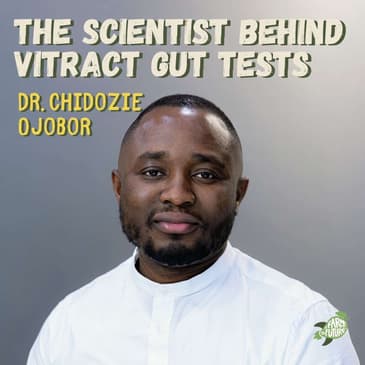
Chidozie Ojobor is a scientist-entrepreneur and is the cofounder and Chief Science Officer at Vitract, a microbiome company providing comprehensive and accessible gut testing to clinicians to improve the gut health of their clients/patients. Chidozie started his academic career in virus research, where he studied rotaviruses that cause gastroenteritis in children under the age of 5.
Afterwards, he completed his PhD in Molecular Genetics at the University of Toronto where he was genetically engineering bacteriocins as novel therapeutic tools against bacterial pathogens. Chidozie developed interest in the microbiome during his doctoral research when he realized that the therapeutic entity he was developing had the potential to manipulate complex biological ecosystems such as the gut microbiome.
After his PhD, he then cofounded Vitract, a microbiome company that provides insight into gut health based on the composition of gut bacteria in stool samples. Chidozie and his team are leveraging molecular sequencing techniques, AI and the robust body of scientific evidence associating the gut and overall health, to build comprehensive gut health solutions for Canadians and Americans.
Get 25$ off your Vitract gut test with code FARMTOFUTURE at https://vitract.com/
Scientific studies:
- Experimental mouse study on maternal glyphosate exposure and ASD: https://pubmed.ncbi.nlm.nih.gov/32398374/
- Epidemiological study on antibiotic use in infants and ASD: https://www.ncbi.nlm.nih.gov/pmc/articles/PMC10164008/
- C-section births and ASD
- Human cohort study involving 5 million births https://pubmed.ncbi.nlm.nih.gov/28017932/
- Experimental study in mice https://pubmed.ncbi.nlm.nih.gov/33903690/
Connect with Vitract:
Discounts
- Get 10% off delicious local farm-fresh food delivered to your door with my link for FarmMatch: https://farmmatch.com/jane
- Get 15% off high-quality Italian olive oil with code FARMTOFUTURE: https://shop.vignolifood.com/FARMTOFUTURE
- Get 40% the CircleDNA’s Premium DNA test with code JANEZHANG: https://circledna.com/premium
Connect with Jane Z.
- Instagram: @farm.to.future
- Email: jane@farmtofuture.co
- Website: farmtofuture.co
[00:00:00] Between 1955 to date, the use of life-os-settlers has exponentially increased.
[00:00:05] Within that same time frame, ASD has positively correlated in increment in children in U.S. schools.
[00:00:14] And 70% of children with ASD actually have severe gastrointestinal problems.
[00:00:19] And as we speak, there is no single treatment option that caters to the gut microbiome in conventional treatment for these children.
[00:00:26] It's just time to start asking these very pointed questions because definitely there's something happening there.
[00:00:33] I'm Jane Z., and this is Farm to Future, the podcast all about eating better for the planet.
[00:00:41] Dr. Chidosi Ojibor is one of the smartest people I've ever met and had on the podcast.
[00:00:47] He has a PhD in molecular genetics and he is the founder and chief scientific officer at Vitracked,
[00:00:53] which you've probably heard me talk about already.
[00:00:56] Vitracked is an at-home gut microbiome test that gives you a report on your gut bacteria,
[00:01:01] as well as food recommendations to improve your overall digestive health, metabolism, immunity and even mental health.
[00:01:08] Today, Chidosi is here to walk us through scientifically what constitutes a healthy gut microbiome.
[00:01:15] We also talk about some of the biomarkers behind things like IBS and gut issues.
[00:01:20] Why eating only animal products is maybe not so good for your gut and the link,
[00:01:26] honestly the disturbing link between gut health and autism spectrum disorder.
[00:01:32] So I've done the Vitracked test on myself.
[00:01:34] I thought it was super helpful.
[00:01:36] I think the test is worth doing if you deal with chronic symptoms like bloating, constipation, diarrhea,
[00:01:43] or even things like migraines, mood swings or anxiety.
[00:01:48] If you have these constant symptoms and you haven't been able to find relief on your own
[00:01:54] or working with a regular doctor, using the Vitracked test can be a great way to get a picture of your gut microbiome
[00:02:01] and pinpoint exactly what might be causing your symptoms.
[00:02:05] And the nice thing about the test is that Vitracked is not affiliated with any supplement or probiotic companies.
[00:02:11] So they just give you the peer test results and you can either take that and make adjustments yourself
[00:02:18] or work with one of their practitioners on a nutrition plan.
[00:02:21] And as a special gift for you guys, Chidozie has gifted us with the code FarmToFuture for $25 off your test at vitract.com
[00:02:34] and they do ship to the US, Canada and Puerto Rico.
[00:02:38] Welcome to the podcast Chidozie.
[00:02:42] Dr. Chidozie Ojibor, welcome to the podcast.
[00:02:46] Thank you very much Jane.
[00:02:47] It's nice to be here.
[00:02:48] Before we started recording, we started talking about our own gut health journeys
[00:02:53] and I shared how I've been traveling and I started accidentally fasting, which has been really good for my gut health.
[00:03:00] And then you've had your own GI issues and kind of took things control cooking for yourself.
[00:03:06] And I love what you said about being aware and noticing our body
[00:03:11] and that being like one of the biggest agents of change.
[00:03:15] That's right. No, that's absolutely correct.
[00:03:17] And like I was just telling you, I think everybody should perform experiments on themselves.
[00:03:22] In my opinion, that's the genesis of personalized health where you basically watch what you eat,
[00:03:28] you throw in something, you see how you feel, you take it out
[00:03:32] and then you see how that actually impacts the way your body feels.
[00:03:35] That tends to give you a sense of how your body processes things or wants or doesn't want something.
[00:03:41] So absolutely.
[00:03:42] For folks that want to dive a little bit deeper into the science,
[00:03:46] that's how I discovered Vitract was I think maybe through an ad or something
[00:03:50] but I've had on and off gut issues for the last 10 or so years.
[00:03:54] I've done elimination diets on myself with cutting out gluten, dairy, sugar, things like that.
[00:04:00] And I'm at a place now where I generally eat a pretty whole foods diet cook for myself
[00:04:07] and like take supplements that I find work for me.
[00:04:11] But what I loved about Vitract was that you kind of get a layer deeper.
[00:04:16] It's essentially for those who don't know yet, it's a poop test that you take at home.
[00:04:20] We send it to Yel's lab and you come back with a dashboard of information around
[00:04:27] like what your gut microbiome looks like, what species are in there, things like that.
[00:04:32] I would love to hear kind of the genesis of Vitract and even like going backwards
[00:04:37] how you got into the gut microbiome.
[00:04:41] Yeah, absolutely.
[00:04:42] Yeah, actually I started my academic research in virology.
[00:04:46] So I started with really trying to understand viruses that cause gastroenteritis in children.
[00:04:52] These are called rotavirus.
[00:04:54] And you know, that was the very first project that you know,
[00:04:58] I really found fascinating in the sense that that was a project that had solid public health importance
[00:05:05] because at the time the children in the locality where they did that project back in Nigeria
[00:05:09] would have severe diarrhea and gastroenteritis at certain times of the year
[00:05:14] between November and February.
[00:05:16] And that's because there's a cold of months.
[00:05:18] So I guess the viruses were able to thrive better and you know, in those conditions.
[00:05:23] But before then, you know, we had always thought that
[00:05:27] this diarrhea and gastroenteritis was of protozoan origin
[00:05:31] until that study between 2013 and 2015.
[00:05:34] So that's actually where I started from.
[00:05:36] And then in 2015, I got the opportunity to reunite with my first love, which is bacteria.
[00:05:42] So prior to doing virus research, I had done bacterial research for a little bit.
[00:05:48] But I really love bacterial research because they're very, you know,
[00:05:51] bacteria are easy to play with.
[00:05:52] The generation time for E. coli, for example, takes it 20 minutes to grow.
[00:05:57] If you mess something up in the lab, you can literally just go back the next day and do it again.
[00:06:02] Much easier than working with mice.
[00:06:04] Much easier than working with mice, you know, much, much easier.
[00:06:08] Exactly.
[00:06:09] So I moved to Canada, University of Toronto, where I did my PhD in molecular genetics.
[00:06:15] During my PhD, I was developing this novel therapeutic tools to target drug-resistant bacterial pathogens.
[00:06:23] And I think that was where my love for the microbiome actually grew
[00:06:26] because, you know, I was developing these tools that had very strange, you know,
[00:06:31] that could target even down to a string level.
[00:06:34] When you think about antibiotics, one of the downsides of that is the collateral damage
[00:06:38] that you actually get when you're trying to treat against one pathogen
[00:06:42] and then you have other beneficial organisms wiped off in biological ecosystems such as the gut.
[00:06:48] So for me, my project was a fantastic alternative to antibiotics.
[00:06:53] And so it was then I started questioning the translational potential of projects like that.
[00:06:57] And there's no better place to actually test tools like that, that the gut microbiome.
[00:07:01] And so coming out of my PhD, I just started thinking about ways to actually innovate within the gut microbiome space.
[00:07:07] And that was when I met my co-founder and 19, 20 months later, we're here.
[00:07:12] Just so I understand the therapeutic you were working on was instead of an antibiotic that kills all bacteria,
[00:07:19] it could target specific strains or species so that you're leaving the good bacteria in there?
[00:07:24] Yes, that's correct.
[00:07:25] So I was actually, so the name of the of that tools is called bacteriocin.
[00:07:30] So these bacteria things are pretty much the macromolecules, the peptide macromolecules
[00:07:35] that are produced by one bacteria to target other bacteria.
[00:07:39] So bacteria I use this as a competitive strategy against other organisms
[00:07:44] that are coexisting within that same biological niche.
[00:07:47] But this competition is usually at string level and at most at species level.
[00:07:52] So you have an organism like pseudomonas originosa, you have a particular strain of that organism.
[00:07:57] And when the condition is set right, they release these bacteriocins to target other strains of pseudomonas originosa
[00:08:04] because, you know, they're competing for food and space and nutrients and all of those things.
[00:08:09] And so what I did was to turn that natural event on its head
[00:08:14] and see how can I actually genetically engineer these bacteriocins to target bacterial strains of choice?
[00:08:22] And so that was the long and short of my PhDs.
[00:08:24] I was doing a lot of genetic engineering, trying to genetically engineer them to target different bacterial strains.
[00:08:30] And when they target them, what exactly are they binding to when they want to kill a bacteria?
[00:08:35] Why would this entity bind to one bacteria and bind to the other bacteria?
[00:08:40] And, you know, understanding that actually gives us an insight into, you know, mechanism of action,
[00:08:45] you know, and even evolution of different bacteria in terms of how they can evolve to resist those kind of choose.
[00:08:52] Hmm. So I'm kind of jumping around here, but I wonder if that has anything to do with different foods or plants that you might eat
[00:09:01] that, you know, because different strains of bacteria like different things, right?
[00:09:04] You have some bacteria love sugar from lactose, some bacteria love, you know, fiber.
[00:09:10] Is that sort of like a similar concept when it comes to personalized nutrition?
[00:09:15] Well, in terms of like manipulating the microbiome, I mean, just the same way you can manipulate the microbiome with bacteria strains,
[00:09:24] you can manipulate the microbiome with food as well.
[00:09:26] Because, you know, there is no greater modifiable factor for, you know,
[00:09:30] manipulating the microbiome than food.
[00:09:32] Because as you said, these different trillions of organisms within your gut ecosystem have different genetic capabilities
[00:09:40] to, you know, either degrade certain kinds of food.
[00:09:43] So an example is Privatela, which is mostly found in people who are eating plants, you know, rich carbohydrates.
[00:09:51] So if you're mostly feeding on carbohydrate, we tend to see that Privatela is enriched.
[00:09:55] And that makes sense because if you look at their genome, they have a lot of statuationalization systems.
[00:10:00] So pretty much they use those genes, break down all sorts of carbohydrates,
[00:10:04] whether they are complex or simple carbohydrate, they have the potential to do that.
[00:10:09] Versals like bacteroides, which we mostly see in people who are mostly, you know, eating animal proteins and things like that.
[00:10:15] Because those kind of organisms have the potential to break down, you know, proteins and ingredients that you can get from animal feeds.
[00:10:23] So it's always about the genetic capacity of these organisms, how they're able to deploy their genetic ammunition to break down food.
[00:10:33] But then the, you know, the host, because they're coexisted within the host, the host then absorbs them.
[00:10:39] And I'm guessing we'll talk more about that as we get into the talk.
[00:10:42] Can you speak a little bit to bio-individuality?
[00:10:46] Because you mentioned different bacteria, like different things and each of us are composed of different sets of bacteria too, right?
[00:10:53] But what I see online is like these diet trends.
[00:10:57] Like we're now carnivorous, super, you know, trendy and vegan was trendy at one point and things like that.
[00:11:04] What's kind of like maybe the danger of thinking that way when it comes to gut microbiome?
[00:11:11] Yeah, I mean, one of the biggest puzzles of the microbiome first is trying to really define what a healthy microbiome is.
[00:11:20] And you must have heard this.
[00:11:21] And that's because it is a very, very dynamic biological ecosystem.
[00:11:26] It's very dynamic.
[00:11:27] That's one.
[00:11:28] But also there is this issue with bio-individuality with the gut microbiome.
[00:11:34] That is to say that two healthy individuals can actually have completely different gut microbiome, right?
[00:11:40] And so, you know, it all comes to understanding the composition of your gut in relation to the symptoms that you're feeling.
[00:11:49] And this is why, you know, we like to talk a lot with practitioners.
[00:11:51] There's a lot of practitioners who are using the test and a lot of times it's about how does the symptom you have kind of like correlate or associate with your gut microbiome profile?
[00:12:01] But one thing in as much as that definition is actually, you know, somewhat hard to come by, what isn't hard is the microbial signatures that underlie disease and health.
[00:12:13] All right. And this is the way to actually start thinking about, you know, how to define a healthy microbiota.
[00:12:19] It's not just about the taxonomic profiles.
[00:12:21] It's not just about bacteria A, bacteria B or C.
[00:12:23] We have to start thinking about, you know, things like the functional capabilities of those bacteria.
[00:12:28] What will be the implication of having bacteria A, B, C, your gut ecosystem?
[00:12:34] Are they producing beneficial metabolites?
[00:12:36] If they're producing those metabolites, what are those metabolites?
[00:12:39] Are they producing things like neurotransmitters and B vitamins and things like that, which is what we know and associate with like probiotic bacteria?
[00:12:46] And so if you're looking at a healthy microbiome, setting things stand up.
[00:12:49] One for example is, you know, they have high bacterial diversity in which case you're talking about the richness and the evenness of the gut.
[00:12:58] So now you're not just talking about how rich the gut is, but you also want the species within that gut ecosystem to be evenly spread out.
[00:13:05] When you look at healthy microbiome, you also talk about things like the presence of beneficial probiotic bacteria, which are these things that are producing things like short chin fatia seeds, like your acetate, your propionage, your butyrate.
[00:13:18] Butyrate being in my opinion, I think is one of the most important biomarkers of health actually.
[00:13:23] You know, so you want to look up for organisms that are producing things like this and you also want to make sure that you have patho-biased at very low levels,
[00:13:31] which are, you know, these are part of your normal flora, the bacteria that are part of your normal flora.
[00:13:36] But when they overgrow in your gut, maybe as a result of, you know, you're taking antibiotics or your sick or some genetic predisposition,
[00:13:45] you can get them to over bloom and when they bloom, they can start producing some toxins and gases that are not beneficial to the gut.
[00:13:51] So this is the way to kind of like think about healthy microbiome in terms of individuality.
[00:13:57] If you were to think on the other side of things too, how do you look at a gut and say, oh, this gut, you know, profile doesn't look healthy?
[00:14:05] Do you have the presence of exogenous pathogens?
[00:14:07] You do not want pathogens to colonize your gut because they're going to set the stage for developmental disease or the progression of disease if it's already there.
[00:14:16] You also tend to see very low bacterial gut diversity.
[00:14:20] So there's low diversity, low richness, low evenness.
[00:14:25] You also see kind of like a bloom of pathogens and these pathogens, you know, things like bilofilus, the sulfur, these are all organisms which when they are overgrowing your gut in ecosystem,
[00:14:36] they're producing gases that contribute to things like bloating, abdominal distension, etc.
[00:14:40] So so that's the way to think about, you know, in my opinion, how to think about normal versus like a disability gut.
[00:14:48] And that would give us a better sense of how to really define how healthy or not your gut microbiome is in terms of, you know, individuality.
[00:14:57] Got it. Okay. So some of the markers you look for in terms of a healthy gut microbiome is diversity of the species and strains of bacteria, even this of distribution and like no overgrowth of one or two particular bacteria.
[00:15:15] Yes. Can you talk a bit about the distribution? Like what does that look like? Is it, you know, distribution within the small intestine and large intestine?
[00:15:23] Is it like even more micro than that? Yeah.
[00:15:26] Can you speak to that?
[00:15:27] Yeah, absolutely. I mean, when you're taking a gut microbiome test, what you're actually seeing is more like a reflection of what's happening in your colon.
[00:15:35] So your large intestine because your small intestine, which is your upper bowel, your gut test does not give you representation of what's happening there.
[00:15:43] It can give you an insight into what may be happening there.
[00:15:47] But the result that you get reflects what actually happens in the column.
[00:15:52] I'll set an example for a lot of people who have taken the test.
[00:15:56] One of the things that we keep seeing for people who, you know, are not showing any symptoms.
[00:16:01] Some people who are like biohawkers, I have taken the test when I've had, you know, serious gut issues and when I've been completely fine.
[00:16:10] And then you tend to see set about macros that actually kind of like give you a sense of what might be happening for people who like, if you're healthy,
[00:16:17] you tend to see sufficient amount of, you know, probiotic bacteria.
[00:16:21] Examples of fake allele bacteria and protein inside is mostly like obligates anaerobes that are known to actually produce, you know,
[00:16:27] short chin fatty acids and B vitamins and neurotransmitters and also like longevity factors like enzymes such as myrosinase,
[00:16:35] which, you know, humans cannot produce by themselves.
[00:16:38] But these organisms can actually produce them, break active ingredients of food down into byproducts that contributes to, you know,
[00:16:45] longevity and also have like anti-cancer potentials and things like that.
[00:16:49] But you also want to ensure that in a healthy gut, one of the things that we've also seen is that there's low levels of this pathobioids.
[00:16:56] So this pathobioids are organisms that they're actually part of your normal flora.
[00:17:01] But when they exist in healthy people, they are in very, very low amount.
[00:17:06] And actually, in some people, they're completely non-existent, which is fine.
[00:17:10] But, you know, for people who have issues like chronic inflammation or dealing with m-cas or all of this,
[00:17:17] maybe metabolic health issues, we tend to see an overgrowth of pathobioids.
[00:17:21] An example, which I just cited, is the bowel loving bacteria by Lofila,
[00:17:25] which, you know, is a sulfate-reducing bacteria that produces hydrogen sulfide.
[00:17:30] We tend to see these actually enriched in people that are mostly eating like high fat foods, like saturated fat,
[00:17:36] because of course bile would have to be produced to metabolize lipids.
[00:17:40] As that is happening, they're reaching these organisms because they're bowel loving.
[00:17:43] The byproduct of what they produce when they degrade bile is hydrogen sulfide.
[00:17:48] And we've seen that an accumulation of hydrogen sulfide in the gut can actually contribute to a breakdown
[00:17:54] of your gut integrity. So, you tend to see increased intestinal permeability.
[00:17:59] And for some people, they also see like, you know, far-reaching effects such as brain fog, etc.
[00:18:04] So it's about looking out for these specific biomarkers that may be contributing to health.
[00:18:09] What this is?
[00:18:11] What are the most common, let's say like top three most common issues that people come to vitrack with?
[00:18:19] Yeah, that's a good question.
[00:18:21] A lot of people with IBDs, ulcerative colitis and Crohn's,
[00:18:26] there's a lot of people who have use the issues coming.
[00:18:29] There's a lot of people that are just dealing with like, they don't even have a diagnosis.
[00:18:32] They just have a lot of symptoms like bloating, constipation and flatulence.
[00:18:37] And you know, we've seen a lot of people with chronic constipation.
[00:18:40] They've been dealing with this for the longest time.
[00:18:43] And as you know, these things are very, very unsettling.
[00:18:47] And then we've also seen people like with IBS, like there's a lot of IBS patients who are using the test.
[00:18:53] A lot of times they tell us to try different things and you know, different forms of,
[00:18:58] you've seen a lot of practitioners.
[00:18:59] And the good thing is we're working currently, we work with about 80 practitioners.
[00:19:04] Actually, we added like half of that in the past one week or two.
[00:19:08] So that has been good.
[00:19:09] And so a lot of these people that we are seeing, we can like have insight into their symptoms
[00:19:15] because they're coming through practitioners.
[00:19:17] So yeah, that's it.
[00:19:19] And then also we have a lot of people dealing with metabolic disorders.
[00:19:23] As you know, the gut is tied to almost every single thing from digestive health issues
[00:19:27] to metabolic disorders to cardiovascular health issues to brain health issues.
[00:19:33] There's a lot of people who have long COVID as to dealing with debilitating symptoms
[00:19:37] such as brain fog and they're trying the test.
[00:19:39] They want to see how that COVID experience has actually impacted their gut.
[00:19:44] So because I see people from different places, but mostly these groups of people that I've mentioned,
[00:19:49] IBDIBS, constipation and other digestive health issues.
[00:19:53] Yeah, I want to touch on the COVID piece.
[00:19:55] What have we learned in terms of the pathway between the gut, COVID and you know,
[00:20:02] things like brain fog goes long term symptoms?
[00:20:04] Yeah.
[00:20:05] I mean, first is it's important to establish that, you know, the receptor for the COVID-19 virus,
[00:20:11] the ACE2 receptor is actually spread out in your gastrointestinal tract.
[00:20:17] Just as is, you know, in your lungs and in the brainstem.
[00:20:22] There's a lot of that in the gastrointestinal tract, which makes sense because when you start thinking
[00:20:26] about a lot of people who have had COVID, one of the major symptoms that they complain
[00:20:30] about is gastrointestinal disorders, right?
[00:20:32] Daria and so it makes sense that, you know, some of these viruses are getting into
[00:20:39] your gut ecosystem and they are binding to those receptors and then they're setting the stage,
[00:20:43] you know, for inflammation.
[00:20:45] Now, the consequence of that is that inflammation can then establish a recall like God
[00:20:50] despises because when inflammation is set, what happens is that there is all of that pro
[00:20:57] inflammatory reaction that is happening, that is uncontrolled and it can basically just
[00:21:01] break down the walls of your gut epithelium.
[00:21:04] Now, this is one of the things that you do not want because the gut is like the channel
[00:21:09] to everything else.
[00:21:11] All right.
[00:21:11] So when the walls of the gut epithelium is then compromised, we tend to see a lot of things
[00:21:16] happen.
[00:21:16] One is that we tend to see bacterial translocation from positions that they ought to be
[00:21:22] to the other side of things.
[00:21:23] A lot of bacteria that are localized within, you know, the gut lumen, you know,
[00:21:27] the mocos membrane of the gut epithelium, then they leave where they ought to be
[00:21:31] and then they go to the other side, which is the laminar propyrus and they start
[00:21:35] making contact with this immune cells.
[00:21:37] So, say they make contact with like macrophages and dendritic cells, those also
[00:21:42] then instigates more complex, you know, inflammatory signals.
[00:21:46] All right.
[00:21:47] And then you start seeing T cells, you know, attracted to that micro environment.
[00:21:52] And so what we tend to see is a complete, complete breakdown of the intestinal
[00:21:58] barrier. That's one way that we think that diseases like COVID can actually
[00:22:03] set the stage for God's viruses, but it's not just about bacterial translocation.
[00:22:08] It's also about, you know, beneficial organisms such as your common cells
[00:22:11] that are localized within your gut epithelium.
[00:22:14] Those within the mocos membrane, those common cells are helping to set
[00:22:18] an anti-inflammatory state in your gut.
[00:22:20] And so when they have moved from where they ought to be to the other
[00:22:24] side, then you're not able to create that anti-inflammatory state, which is
[00:22:28] why we tend to see an uncontrolled inflammatory response in people that
[00:22:33] have had conditions such as COVID.
[00:22:35] One of the things that we have learned a lot from people who have taken
[00:22:37] the test who are complaining of things like brain fog, we've seen that
[00:22:41] in academic literature, people who have long COVID tend to be enriched
[00:22:46] in organisms such as the south of Hebrew and the south of Hebrew,
[00:22:50] we know is a high hydrogen-sulfide producer.
[00:22:52] And this actually ties in nicely with the things that we have seen for
[00:22:55] the people who have taken the test, they tend to be enriched in the south
[00:22:58] of Hebrew as well, which, you know, they're pretty high hydrogen-sulfide
[00:23:01] by basically just reducing, just softening, reducing bacteria.
[00:23:04] And hydrogen-sulfide has been very well tied to brain fog.
[00:23:08] So that may be the potential mechanism of action.
[00:23:10] The accumulation of hydrogen-sulfide may actually be getting into circulation.
[00:23:15] That's one way that we think COVID might actually be influencing
[00:23:18] the gut microbiome and then back to the gut brain access.
[00:23:22] Is there a straightforward kind of treatment or protocol for that?
[00:23:26] Can you like reduce the sulfide and then move the bacteria to where
[00:23:31] they're supposed to be?
[00:23:32] Yeah, I mean one of the things that for the practitioners who are
[00:23:37] trying to help, you know, patients like this, one of the things
[00:23:39] that we've seen them do is try to help them repair their gut lining
[00:23:43] in the first place because what you want to deal with is ensure
[00:23:46] that you re-establish your gut by integrity.
[00:23:50] How do you do that?
[00:23:51] You want to introduce bacteria that can actually help produce
[00:23:54] metabolites that help you do that.
[00:23:56] Things like ficali-bacterium, reservoiria, bloutia, these are all obligate
[00:24:01] anaerobes that produce butyrate.
[00:24:03] But butyrate plays a huge role because they help to incite your
[00:24:07] gutlet cells to produce more new skin and by so doing, they help
[00:24:10] to repair the mucus membrane.
[00:24:11] So that's one way.
[00:24:13] Other ways is I mean there's some prebiotics and probiotics
[00:24:16] that also help.
[00:24:17] So the way that some of these probiotics work is, for example, a
[00:24:20] lot of lactobacillus, befidobacterium longum strains and some
[00:24:26] lactobacillus acidophilus strains, the way some of them work
[00:24:29] is they actually just help to degrade substrate that then become
[00:24:33] you know, substrate for other beneficial organisms to feed
[00:24:37] off on things like ficali-bacterium and bloutia, reservoiria.
[00:24:41] So butyrate has been one way that a lot of practitioners
[00:24:44] have tried to use as a microband based intervention for this
[00:24:48] kind of people.
[00:24:49] Another thing that we have seen is we've also tried to like
[00:24:52] encourage them to reduce foods that can actually set this
[00:24:56] stage for hydrogen sulfide to be increased.
[00:24:59] We've seen a lot of people that are mostly animal-based diet
[00:25:03] but they're likely to actually have an enrichment of this
[00:25:06] kind of organisms because you know, there's a lot of sulfur
[00:25:09] there and so the sulfur vapor and by the phyla can
[00:25:12] actually reduce those to produce hydrogen sulfide in the gut.
[00:25:15] So these are some of the things that we've seen practitioners
[00:25:17] do are using the test.
[00:25:20] Got it and we don't want too much hydrogen sulfide but we
[00:25:23] want a little bit in that gut.
[00:25:25] We want a little bit because they also have some beneficial
[00:25:27] functions like you know, cardio protection and actually
[00:25:31] when there's sufficient amount they can actually contribute
[00:25:33] to anti-inflammatory states.
[00:25:35] The problem is always about an overall accumulation.
[00:25:38] It's always about the balance.
[00:25:41] It's hardly a presence or absence thing except when you're
[00:25:44] talking in context of pathogen colonization exogenous pathogen
[00:25:48] which is what you don't want.
[00:25:49] For the normal flora, it's mostly about you know, the
[00:25:53] relative abundance of one thing relative to the other.
[00:25:56] You mentioned butyrates a couple times.
[00:25:59] What are those?
[00:26:01] Yeah so butyrates are pretty much such in fatty acids.
[00:26:03] They're pretty much products of fermentation of dietary fiber.
[00:26:07] So when we encourage people to take dietary fiber, one of the
[00:26:11] major reasons is because a lot of this dietary fiber maybe from
[00:26:15] resistance starch can not be absorbed in a small intestine.
[00:26:18] So they found out they find their way to the colon but what
[00:26:21] happens in the colon is that they're fermented.
[00:26:24] When they're fermented the byproducts, short-chain
[00:26:27] fatty acids of which butyrate is one of them but then
[00:26:29] they also produce gases like hydrogen.
[00:26:32] So this butyrate that has been produced can then be
[00:26:34] taken up by you know the cells of your gut, epithelium, your
[00:26:38] colonocytes.
[00:26:39] They take them, they metabolize them.
[00:26:42] When they metabolize them, the byproduct of that is energy.
[00:26:45] That's why we say that butyrate is actually an energy
[00:26:46] source for your colonocytes.
[00:26:48] But butyrate also play other functions apart from just
[00:26:51] within that local environment of your gut.
[00:26:53] Butyrate has been implicated in improving brain function.
[00:26:56] Right?
[00:26:56] So they contribute to brain health as well.
[00:27:00] They also help to reduce the absorption of toxins such
[00:27:03] as lipopolisaccharides.
[00:27:04] So these are outer membrane components of certain bacteria
[00:27:08] such as pathogens that can be found in your gut ecosystem
[00:27:11] and they're highly pro-inflammatory.
[00:27:12] So in the presence of butyrate what we tend to see
[00:27:14] is a reduction of you know those kind of like pro-inflammatory
[00:27:18] endotoxin.
[00:27:18] So like I said, I think that butyrate is according
[00:27:22] to our test we encourage people to have an excess of 40%
[00:27:26] of butyrate producers in their gut ecosystem just
[00:27:29] because butyrate is involved in almost everything
[00:27:32] that a fish or your gut ecosystem.
[00:27:35] And so if those come with butyrates come from dietary
[00:27:39] fiber, that's primarily plant based foods.
[00:27:42] Right?
[00:27:43] You don't really get fiber from animal based foods.
[00:27:46] Yeah, primarily from plant based foods and that's
[00:27:49] what we encourage fruits, vegetables.
[00:27:51] These are all sources that can actually enrich you
[00:27:54] a bit.
[00:27:55] I took a DNA test that showed a bunch of dietary info
[00:28:00] to and it said that I needed more cruciferous vegetable
[00:28:05] intake than the average population.
[00:28:07] And I'm guessing that has something to do with the
[00:28:09] fiber and maybe the butyrates.
[00:28:11] Yeah, yeah, absolutely.
[00:28:13] I mean with cruciferous vegetables, it's all about
[00:28:16] balance too because they're also high in software
[00:28:18] which can also set you know set the stage for
[00:28:21] accumulation of things like high in software eventually
[00:28:24] but you know it's always about the balance
[00:28:26] and this is why I talk about end of one experiments.
[00:28:28] It's you know testing them out and seeing how your
[00:28:31] body feels.
[00:28:32] For example, I take my gut microbiome test like once
[00:28:35] every three months.
[00:28:37] Oh wow.
[00:28:37] One if I've made like a significant lifestyle change,
[00:28:41] I try them.
[00:28:43] That's impacted say for example like you know travel
[00:28:47] maybe to a developing country you got sick and
[00:28:49] then you took rounds of antibiotics.
[00:28:52] You want to see how that has impacted your gut
[00:28:54] ecosystem and then you also want to try after
[00:28:57] recovery three to six months later see you know if
[00:29:00] you're back to your stable state and then correlate
[00:29:02] that with the way you feel.
[00:29:04] A lot of times like biohacking is pretty much just
[00:29:07] listening to your body and trying to understand
[00:29:09] how you feel when you test things out or you
[00:29:12] experience new life events and things like that.
[00:29:14] Yeah, biohacking sounds kind of aggressive but
[00:29:17] yeah I mean listening to your body.
[00:29:21] Yeah, you know like and that's why I use the
[00:29:23] word because a lot of times it's it's simpler than
[00:29:26] the word sounds.
[00:29:27] So I agree with you.
[00:29:28] It sounds aggressive but like it's simpler than the
[00:29:30] word sounds.
[00:29:31] It's pretty much just listening to your body.
[00:29:33] Yeah, what changes have you tried where you've
[00:29:36] noticed like major changes in your gut test?
[00:29:39] Oh for me like when I get away from I mean I've
[00:29:43] never really been someone who's like big on like
[00:29:45] added sugars and processed foods and things like
[00:29:47] that because my body is very very sensitive.
[00:29:50] You know if I take a bottle of Coke like
[00:29:53] Coke Alkola today or maybe to the end tomorrow like
[00:29:57] my body will tell me I will be highly highly
[00:30:00] inflamed.
[00:30:01] For example, I don't drink alcohol and the reason is
[00:30:04] primarily because my body just responds to it in
[00:30:07] very interesting ways.
[00:30:07] It might just it might be the sulfide there.
[00:30:09] It might be reservoir fraud.
[00:30:10] It might be something like I don't know but you
[00:30:13] know so you say about listening to your own
[00:30:14] body and saying okay this is what my body doesn't
[00:30:16] like this is what I'm going to get away from.
[00:30:19] I also think for me cold exposure is a thing.
[00:30:22] It's like not just cold exposure like external
[00:30:24] cold exposure.
[00:30:25] It's like if you're coming from like developing
[00:30:27] country like why is it super super hot or like
[00:30:29] from the tropics people are actually used to drinking
[00:30:31] cold water a lot because it's really hot and so
[00:30:35] you might actually take that lifestyle to you
[00:30:39] know for me it's never really worked for me
[00:30:40] even when I lived in the tropics.
[00:30:42] So I think for me I know my triggers is that
[00:30:45] primarily the biggest triggers I have high
[00:30:47] added sugar, cold exposure and alcohol intake
[00:30:51] that never worked well for me.
[00:30:53] Got it.
[00:30:54] So like putting you in the Arctic drinking ice
[00:30:57] water ice Coca Cola would be like your kryptonite.
[00:31:04] Oh, that's funny.
[00:31:05] Yeah, I would say my triggers are spicy food lack
[00:31:09] of sleep.
[00:31:10] I need like a lot of sleep and and no fiber.
[00:31:15] And no fiber.
[00:31:16] Okay.
[00:31:16] Yeah.
[00:31:16] Mm hmm.
[00:31:17] Yeah.
[00:31:18] Yeah.
[00:31:18] No, that makes sense.
[00:31:19] That makes sense.
[00:31:20] Yeah.
[00:31:20] I say yeah lack of sleep actually that's a good point
[00:31:23] to but for me I just think that my body is so used
[00:31:26] to be not like sleeping like six hours.
[00:31:28] I'm kind of like fine, but yeah, lack of sleep is
[00:31:31] is a big one.
[00:31:32] There's also like a very very strong relationship
[00:31:34] between sleep and the gut microbiome which
[00:31:37] makes a lot of sense because of the God brain
[00:31:38] access so high cut cell level can actually
[00:31:41] play a huge role in impacting your gut
[00:31:44] ecosystem and it's a bi-directional thing.
[00:31:46] So it's not just sleep affecting your gut
[00:31:48] microbiome.
[00:31:49] It could also be your microbiome just affecting
[00:31:53] the stress levels that you have.
[00:31:54] Interesting and in turn making it harder for you
[00:31:57] to fall asleep.
[00:31:58] It becomes a cycle.
[00:31:59] Yes.
[00:31:59] Mm hmm.
[00:32:00] What's the latest research on our biological
[00:32:04] clock and the gut microbiome when it comes
[00:32:07] to, for example, fasting?
[00:32:09] Like should we have a period of the day
[00:32:11] where we're not eating and allowing the gut
[00:32:14] to reset?
[00:32:15] Is there kind of like optimal times for
[00:32:18] digestion to happen?
[00:32:19] Yeah, I would say that it's a little bit tricky
[00:32:22] for fasting because there are different kinds
[00:32:24] of fasting.
[00:32:25] So there is intermittent fasting.
[00:32:27] There is prolonged fasting for religious people.
[00:32:30] And there are studies that have shown that,
[00:32:32] you know, religious people actually tend to have
[00:32:35] all things being equal, correct them for
[00:32:36] other factors are likely to actually keep,
[00:32:38] you know, better God health, live longer,
[00:32:41] do things like that because, you know,
[00:32:42] at some points during, you know, your religious
[00:32:44] practice you, you tend to fast.
[00:32:46] All right.
[00:32:47] But the data on that is, I would say it's everywhere
[00:32:50] because it's tied to this other confounding factors.
[00:32:53] So which makes it difficult.
[00:32:55] So actually just pinpointed on fasting.
[00:32:57] There are studies that have shown that intermittent
[00:32:59] fasting works well for people for certain
[00:33:02] conditions that studies that have shown that prolonged
[00:33:04] fasting work better for certain conditions.
[00:33:06] So as for fasting, I would say that it's just one
[00:33:09] factor that if other conditions are set right,
[00:33:12] then we might be able to map its role.
[00:33:15] But in relation to God, microbiome,
[00:33:17] there are other factors that play a role.
[00:33:20] I wonder if religion is the main factor they looked at,
[00:33:23] like whether spirituality and just mindfulness
[00:33:26] also played a factor in just relaxing your God microbiome.
[00:33:30] I don't know if there are studies there,
[00:33:33] but I know that there are studies that talk about
[00:33:36] quality of life, measure of quality of life,
[00:33:39] having high positive correlation with spirituality
[00:33:42] and faith system, which to me makes a lot of sense.
[00:33:46] Believing in something actually just gives you motivation
[00:33:49] to live every day meaningfully.
[00:33:52] And even when the worst things are happening to you,
[00:33:55] it kind of shields you somehow where you have hope
[00:33:59] to believe in a possible future that will be better
[00:34:03] than what you're currently experiencing.
[00:34:05] So because when we think about the God-bred access,
[00:34:08] we have to also remember that psychological stress
[00:34:12] plays a role in, for example, modulating your God microbiome.
[00:34:16] If you're stressed psychologically,
[00:34:18] then you're likely to be stressed down there as well.
[00:34:22] But if spirituality is actually helping you
[00:34:24] to be more positive-minded and all that,
[00:34:26] then you might be seeing that kind of interaction
[00:34:29] in the God-bred access.
[00:34:30] These are not areas of research that I've been very well
[00:34:33] pursued, but when you think about it theoretically,
[00:34:36] it makes a lot of sense.
[00:34:38] But of course, other factors have to be said.
[00:34:40] You can't be spiritual and you're eating
[00:34:41] like highly processed food and all that.
[00:34:44] So we just why I think it's been difficult for a lot of people
[00:34:49] to pursue studies like this
[00:34:50] because there's just so many confounding factors.
[00:34:53] And so it may be difficult to map it to one thing
[00:34:57] and say, oh, it's because I'm doing this.
[00:34:58] That's why I feel this way.
[00:35:01] Right. It's like I'm going to church,
[00:35:02] but I'm eating lace chips and Coca-Cola.
[00:35:05] Why is it like God healthy?
[00:35:08] Exactly.
[00:35:08] Oh my gosh. I'm having so much fun.
[00:35:10] One thing I wanted to ask you about is what have you all learned
[00:35:13] about food sensitivities and intolerances?
[00:35:16] Like for me, I know that gluten is a trigger,
[00:35:19] but I've also learned that there's a ton of the chemicals
[00:35:22] in our food system like glyphosate and other pesticides
[00:35:25] that could be triggering.
[00:35:27] Yeah. In terms of food sensitivities,
[00:35:29] what have you all learned with the test?
[00:35:31] I mean, we've learned quite a bit.
[00:35:33] We've seen people that, I mean,
[00:35:34] they probably done some genetic testing
[00:35:37] and they see that there is no genetic attribution to why
[00:35:41] probably they have lactose intolerance.
[00:35:44] Like, oh, you have genes that are according to the lactose
[00:35:47] enzyme properly and, you know, you're fine.
[00:35:50] But for some of them,
[00:35:51] it turns out to be that there's a small contribution
[00:35:54] of the microbiome to a lactose intolerance, for example.
[00:35:57] So most of it is because you probably have a distorted
[00:36:01] or a mutated gene for lactose enzymes
[00:36:03] so you're probably not producing enough lactose enzyme.
[00:36:06] But we've seen some people, they've done genetic testing.
[00:36:09] They see that they are fine,
[00:36:11] but it also comes down to the organisms in the gut
[00:36:13] that potentially metabolize the lactose
[00:36:17] or that have the genetic capacity to metabolize the lactose,
[00:36:19] but they're deficient in them.
[00:36:21] So that's one.
[00:36:22] But on a broader scale of conversation
[00:36:25] in terms of like food sensitivities
[00:36:27] and just disease development generally
[00:36:30] as to how it ties to the gut.
[00:36:32] We've seen, for example,
[00:36:34] the children that have their own ASD spectrum
[00:36:37] having a lot of food sensitivities
[00:36:40] like gluten, dairy and all that.
[00:36:42] I mean, there are studies that have actually associated
[00:36:44] this sensitivities more to herbicides and chemicals
[00:36:47] like glyphosate, which are actually used as weed killers
[00:36:50] when growing these foods.
[00:36:52] And so some people will argue with you
[00:36:53] that it's mostly chemical sensitivity
[00:36:55] versus like food sensitivity.
[00:36:57] And we've seen that like there's a lot of mouse studies
[00:37:00] that have actually associated things like glyphosate exposure.
[00:37:03] The maternal glyphosate exposure to the development of autism
[00:37:07] in the offspring.
[00:37:08] And there's not just one study,
[00:37:10] several studies that have done this.
[00:37:12] And it's interesting when you're backtrack
[00:37:14] and you start to think about this
[00:37:15] because in terms of autism,
[00:37:18] we know that the maternal immune activation is a thing.
[00:37:21] Mothers while they're pregnant
[00:37:23] maybe they get exposed to a particular infectious agent
[00:37:27] and then that sets the stage for high inflammation
[00:37:29] in the body and then some of those can actually cross
[00:37:32] from the mother to the child
[00:37:34] and then cause things like neuroinflammation
[00:37:36] and just generally impacts neurodevelopment.
[00:37:38] But we've also seen this very similar thing
[00:37:41] in animal studies with exposure to things like glyphosate
[00:37:45] where you tend to see an elevation of things
[00:37:48] like soluble, epoxide hydrolysis
[00:37:51] which are known to actually contribute to neuroinflammation
[00:37:54] and also play in a role in neuro degeneration.
[00:37:57] So we've seen a lot of that.
[00:37:59] But you know when you think about things like AST
[00:38:01] I think it's good to backtrack a little bit too
[00:38:05] and think about yeah, chemical sensitivities
[00:38:09] but in relation to the microbiome
[00:38:11] how that kind of like ties in.
[00:38:14] You know, I like to think about it first
[00:38:16] in terms of like the mode of delivery.
[00:38:17] There are studies that have actually shown that
[00:38:20] you know, children who are born through cesarean operation
[00:38:23] are 23% more likely to develop AST
[00:38:25] as those children who were born through the vaginal canal
[00:38:29] and those kind of studies are actually very illuminating
[00:38:32] in the sense that we know that the organisms,
[00:38:36] the microbiota that actually colonizes the gut ecosystem
[00:38:39] of children that are born through cesarean operation
[00:38:42] are completely different from those
[00:38:44] who are born through the vaginal canal.
[00:38:45] We tend to see children born through C-section
[00:38:49] adopting the microbiota of their mother's skin
[00:38:52] and the hospital environment.
[00:38:54] These are like the enterococcuses,
[00:38:55] the streptococcuses, several enterobacteria
[00:38:58] and a lot of them are pretty much like facultative anaerobes.
[00:39:02] Some of them are pathogen, some of them are pathoburians
[00:39:05] which as you would imagine are kind of like the first set
[00:39:09] of organisms that are colonizing the child, all right?
[00:39:12] And some of them potentially can produce toxins
[00:39:15] that can actually cross the blood brain barrier.
[00:39:17] So that's one.
[00:39:18] Versus like children who are born through normal vaginal delivery,
[00:39:22] we tend to see more of lactobacillus,
[00:39:24] bifidobacterium, all these other beneficial organisms,
[00:39:28] you know, which they are taking up from their mothers.
[00:39:30] So that's one way to think about it.
[00:39:32] The other way to think about it is in the context of treatment
[00:39:37] that this children experience at infancy,
[00:39:40] we've seen studies that have shown that children
[00:39:43] who have taken like antibiotics over a couple of six weeks
[00:39:46] at infancy have 34 to 35% higher likely to develop AST
[00:39:52] compared to children who have not taken this regimen
[00:39:55] of antibiotics.
[00:39:56] And so you start to think about that in the context
[00:39:58] of gut microbiome, you tend to see those connections,
[00:40:01] those theoretical connections because you know,
[00:40:03] antibiotics play a huge role.
[00:40:05] A lot of them are broad spectrum.
[00:40:06] They can wipe out the beneficial organisms
[00:40:09] in the gut ecosystem.
[00:40:10] And then that can set the stage for colonization
[00:40:13] by exogenous pathogens at infancy
[00:40:16] and those things may be playing a role.
[00:40:18] And we've seen very pointed studies already.
[00:40:21] We know that when you look at the gut profile of children
[00:40:24] with AST and compare that to their neurotypical control,
[00:40:28] as long as you're correcting for sex and age,
[00:40:30] you tend to see a significant difference.
[00:40:32] An example is we know that there's an enrichment
[00:40:34] of clostridium.
[00:40:35] Clostridium species like clostridium spherogenous,
[00:40:39] clostridium tetanus are known to actually produce
[00:40:42] the tetanus toxin.
[00:40:44] And tetanus toxin we know is able to ride
[00:40:47] on the vagus left.
[00:40:49] So it goes from the gut and rides on the vagus left
[00:40:52] to the periphery of the brain
[00:40:54] and cleaves synaptic brevin,
[00:40:55] which is you know, a synaptic vesicle.
[00:40:58] And that activity in itself sets the stage
[00:41:01] that can precipitate you know, behavioral deficiencies
[00:41:04] as we see in autistic kids.
[00:41:07] There are studies that have also shown that
[00:41:10] and these are really interesting studies
[00:41:12] that have actually shown an enrichment
[00:41:13] of the south of Hebrew for example.
[00:41:16] And clostridium in children with ASD
[00:41:19] and then when they mapped these functionally,
[00:41:21] these are high you know, propionic acid producers in the gut.
[00:41:26] And we know that propionate when they're produced
[00:41:29] and they are able to transverse through the gut brain axis,
[00:41:32] they play a huge role in neuro inflammation.
[00:41:34] And so when you think about things like that,
[00:41:37] it's good to take a step backwards
[00:41:39] and think about yes, environmental toxins
[00:41:42] such as life will say,
[00:41:44] but also when these children are born,
[00:41:46] what are the things that they adapt in the beginning
[00:41:49] in the early stages of their life
[00:41:50] and how do those things eventually impact them?
[00:41:53] Of course, there are different sides to this story.
[00:41:55] The people who, their research is that's the kick against this
[00:41:58] but there are strong evidences in my studies
[00:42:00] that actually points to this.
[00:42:03] Wow, that's wild.
[00:42:05] So I had heard about gut immune connection
[00:42:08] with babies being delivered through the vaginal canal
[00:42:11] versus C-section, but I didn't know that link
[00:42:13] between C-section birth and autism disorder.
[00:42:18] Yeah.
[00:42:19] So I guess if a mother is like eating a ton of glyphosate
[00:42:22] while she's pregnant, delivers the baby by C-section
[00:42:26] and then the baby has to take antibiotics
[00:42:29] in their first couple of years.
[00:42:30] Like that is a recipe for disaster.
[00:42:33] Yeah, yeah, yeah, absolutely.
[00:42:34] High chance of AST.
[00:42:36] Absolutely.
[00:42:37] And also like, I mean no mother intentionally
[00:42:40] like puts their child at risk.
[00:42:42] It's just like feeling on these things that are treated
[00:42:45] with this kind of environmental toxins
[00:42:48] and not even knowing about it.
[00:42:50] Yeah, they're sprayed on almost everything.
[00:42:52] They're sprayed on almost everything.
[00:42:54] If you think about it, between 1955 to date
[00:42:58] the use of glyphosate has actually exponentially increased.
[00:43:01] In the US for example, we used to grow soy and beans
[00:43:05] and almost every single food within that same timeframe.
[00:43:10] AST has positively correlated in increment in children
[00:43:17] in US schools, which is why people actually started
[00:43:20] asking these questions in the first place.
[00:43:21] I think one of the first studies that tried
[00:43:23] to draw this correlation was in the early 2000s.
[00:43:26] It's that you look at the trend of when this herbicide
[00:43:30] was introduced into the environment
[00:43:31] and then it kind of like correlates really well
[00:43:33] with when we started seeing increment
[00:43:36] in the number of kids developing AST.
[00:43:38] And 70% of children with AST actually have severe gastrointestinal
[00:43:42] problems.
[00:43:43] And as we speak, there is no single treatment option
[00:43:46] that caters to the gut microbiome
[00:43:48] in conventional treatment for the student.
[00:43:50] It's just time to start asking these very specific
[00:43:52] pointed questions because definitely
[00:43:55] there's something happening there.
[00:43:57] Yeah, you would think I mean there's an obvious correlation
[00:44:01] and then with these mice studies, it looks like
[00:44:04] there's definite causation too between glyphosate and AST.
[00:44:08] I'm surprised there isn't treatment there,
[00:44:10] but I think it also speaks to like how segregated
[00:44:13] our magnetical system is in terms of psychology,
[00:44:17] pediatrics, and then GI.
[00:44:19] They're all separate departments.
[00:44:21] Absolutely, completely.
[00:44:23] Yes, there's that segregation, but also there's
[00:44:25] a lot of segregation now between conventional medicine
[00:44:28] and functional medicine.
[00:44:29] In my opinion, I think if the goal is actually to get
[00:44:33] to root cause of things, I think we should start asking
[00:44:36] more root cause questions.
[00:44:37] And it's unfortunate because a lot of doctors are not also
[00:44:39] trained that way to understand disease in that sense.
[00:44:42] You know, doctors are pretty much trained to just dispense
[00:44:44] drugs and things like that.
[00:44:46] But these are the foundational questions we need to ask.
[00:44:48] The second thing is we need to start thinking about
[00:44:50] how we can actually translate academic research
[00:44:52] into useful clinical tools because this is a litany
[00:44:56] of academic work out there that probably just get ignored
[00:44:59] or that wouldn't be pursued or whether it isn't funding
[00:45:02] to actually pursue things past the clinical stage
[00:45:06] or some of them don't even see the lights
[00:45:09] on clinical trials in the first place.
[00:45:10] So if the goal is to improve people's health,
[00:45:13] then there has to be that synergy.
[00:45:15] Yeah, absolutely.
[00:45:16] Yeah, there's a lot of work to be done.
[00:45:18] I do want to hear about the latest in Biotrax
[00:45:21] because I know y'all have been working on a big launch.
[00:45:23] Give us a sneak peek of what's new in Biotrax
[00:45:26] and what to expect.
[00:45:27] Yeah, absolutely.
[00:45:28] So just to let people know, Biotrax is offering a 16S
[00:45:31] based test that actually helps identify the different
[00:45:35] bacteria that we find in your gut and Akiah based off
[00:45:38] of their 16S gene.
[00:45:39] So the 16S gene every single bacteria has it,
[00:45:42] but because there's a lot of variable regions in that gene,
[00:45:45] so we are able to identify bacteria uniquely
[00:45:47] because they all have a unique 16S gene.
[00:45:49] The reason we started with offering 16S is
[00:45:52] because we're going to sit as a sweet spot
[00:45:54] of creating a gut test,
[00:45:55] but also creating an affordable test.
[00:45:57] You know, one of the biggest problems in this
[00:45:59] in a functional medicine space is affordability of tests.
[00:46:03] A lot of these tests are not covered by insurance.
[00:46:04] They're out of pocket.
[00:46:06] And so people who need them cannot even assess them.
[00:46:09] That was one of the big problems we wanted to solve.
[00:46:11] So that's why we started with 16S.
[00:46:13] So when we started offering this test,
[00:46:16] we of course were able to show relative abundances
[00:46:19] of things, but now we've just added a lot more biomarkers.
[00:46:22] So now you can actually get insight into your B vitamin
[00:46:27] producers on top of your short infarct acid producers.
[00:46:30] So we show you not only all of the insights
[00:46:33] you can get from there, but we also show you all
[00:46:36] of the organisms that we found in your gut
[00:46:38] so that can actually produce those things.
[00:46:40] And this is based on what we know in academic literature.
[00:46:43] We also now, you know, report more biomarkers
[00:46:46] on the toxin side of things.
[00:46:47] So now we report things like tri-methylamine,
[00:46:49] which we know when the oxidizers play a huge role
[00:46:52] in cardiovascular health.
[00:46:54] We also have computed all of the organisms that produce this.
[00:46:57] We gave you insight into short infarct acid,
[00:46:59] it's new transmitters.
[00:47:00] Of course, you know, over 90% of the serotonin,
[00:47:02] for example, is produced in your gut,
[00:47:04] but not just serotonin.
[00:47:05] We gave insight into dopamine,
[00:47:07] a certain called in GABA, you know,
[00:47:09] no epinephrine, histamine, et cetera.
[00:47:11] We gave you insight into longevity factors,
[00:47:13] indoles, phenols, marrow sinuses, urethane.
[00:47:16] Currently it's not on the test that we have,
[00:47:18] but in this new test that we're pushing out in a few weeks,
[00:47:21] you're going to see that.
[00:47:23] And we also gave insight into some bacterial degraders,
[00:47:26] like lactose degraders, oxalate degraders,
[00:47:29] detoxification factors as well, like beta-glucorinides.
[00:47:32] So now we'll report in totality over 60 different biomarkers,
[00:47:37] things that you can actually learn from the test.
[00:47:39] On top of that, in the recommendation section,
[00:47:42] we show you the foods you should eat
[00:47:44] based on your gut microbiome test
[00:47:47] and the foods you should also exclude.
[00:47:50] And all of these recommendations are actually coming
[00:47:52] from a pipeline of thousands of research papers
[00:47:55] and some we've vetted.
[00:47:56] Now, we basically prioritized studies
[00:47:59] that have been done in humans
[00:48:00] and from research articles
[00:48:02] that were published in high-bath-vater journals.
[00:48:05] We show recommendations in food,
[00:48:07] probiotics, probiotics, supplements
[00:48:09] and lifestyle changes.
[00:48:11] This is what we differentiate from most of the tests.
[00:48:13] We're primarily concerned about the clinician
[00:48:15] and the patients.
[00:48:17] We do not redirect you to any supplement provider,
[00:48:21] probiotic provider.
[00:48:23] That's not our concern.
[00:48:25] We primarily just tell you this is what you should take
[00:48:29] based off of this study
[00:48:30] and then we'll provide a lot of education for practitioners.
[00:48:34] So I take pride in saying that
[00:48:36] I don't think there's any other test
[00:48:38] that provides a level of support
[00:48:39] that we give to practitioners.
[00:48:41] And I think that that's what we've seen
[00:48:43] and a huge increase in adoption in recent time.
[00:48:46] Y'all are based in Canada
[00:48:47] but the test is good for Canada and US?
[00:48:51] Yes, yes.
[00:48:51] So my co-founder and I are based in Canada
[00:48:54] but the test is obtainable both in the US and in Canada.
[00:48:58] And we actually recently started shipping to Puerto Rico.
[00:49:01] Oh cool.
[00:49:01] Nice.
[00:49:02] Yeah, it sounds like a really comprehensive test.
[00:49:05] When I did it,
[00:49:06] I did go with the
[00:49:07] I think it was a 15 minute consult
[00:49:09] with the registered dietician that you all work with
[00:49:12] and she was really helpful.
[00:49:13] I just had a list of questions
[00:49:14] and we like bang through them
[00:49:16] and I learned that as someone who's gluten sensitive
[00:49:19] I should avoid inulin
[00:49:20] which happens to be an ingredient
[00:49:22] and a lot of supplements and powders and things.
[00:49:24] So that was really helpful insight
[00:49:26] and just to point out for folks interested
[00:49:29] it's a test that you can take
[00:49:30] and kind of analyze the results yourself
[00:49:32] take that information on your own
[00:49:35] or work with one of Vitrax providers
[00:49:37] and kind of develop a nutrition plan.
[00:49:40] Yeah, absolutely.
[00:49:42] And yes to your point
[00:49:43] it's one of the things that we also do now
[00:49:45] which is an improvement is
[00:49:47] we actually now collect data for food intolerances.
[00:49:49] So if you're
[00:49:51] intolerant to sulphides or dairy
[00:49:54] or whatever it is that intolerance to
[00:49:56] we kind of like take that information
[00:49:57] and filter it through
[00:49:59] so that when the recommendation is coming up
[00:50:01] we filter anything
[00:50:03] any foods that can have those ingredients
[00:50:05] that you are intolerant to.
[00:50:07] So if you have dairy intolerance
[00:50:10] even if one of the foods that would come up
[00:50:13] has dairy in it
[00:50:14] we'll take it out
[00:50:15] just because we know you're intolerant to it.
[00:50:16] So we've kind of like optimized
[00:50:18] that recommendation engine as well.
[00:50:20] Smarter every day.
[00:50:22] Cool.
[00:50:22] Well, this has been super enlightening.
[00:50:25] Thank you so much for spending time with us
[00:50:27] and sharing so much knowledge
[00:50:30] about the Got Microbiome
[00:50:31] really appreciate it.
[00:50:32] Thank you, Jane.
[00:50:33] Yeah, it's nice to get on this
[00:50:35] and then just chat more about the Got Microbiome.
[00:50:37] Appreciate it.
[00:50:39] And that's a wrap.
[00:50:40] Thank you so much for tuning in.
[00:50:42] Remember to nourish your body
[00:50:44] and I'll talk to you next time.