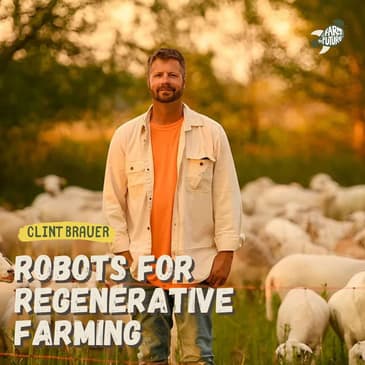
Join us for a deep dive into the world of chemical-free farming with Clint Brauer, CEO and Founder of Greenfield Robotics. From autonomous weeding robots to regenerative agriculture practices, Clint shares how technology can help scale sustainable farming while keeping farmers' needs at the forefront. We explore the challenges of agricultural chemicals, the importance of soil health, and a vision for localized, nutrient-dense food systems.
About Clint:
Clint Brauer is a third-generation farmer from Kansas who is on a mission to eliminate harmful chemicals through food production by leveraging robotics. His journey began in 2020 when he abandoned his role as an LA-based tech executive to help his family and its farm after his father was diagnosed with Parkinson’s, a disease linked to a 200–600% increased risk when exposed to herbicides. With numerous farmers using his Robots-as-a-Service and two consumer packaged goods deals under his belt, it’s safe to say he’s on track.
Links:
Discounts
- Get 10% off delicious local farm-fresh food delivered to your door with my link for FarmMatch: https://farmmatch.com/jane
- Get 15% off high-quality Italian olive oil with code FARMTOFUTURE: https://shop.vignolifood.com/FARMTOFUTURE
- Get 40% the CircleDNA’s Premium DNA test with code JANEZHANG: https://circledna.com/premium
Connect with Jane Z.
- Instagram: @farm.to.future
- Email: jane@farmtofuture.co
- Website: farmtofuture.co
[00:00:00] The reason Silicon Valley tech keeps failing in this environment is because they're used to just preaching some crazy thing and people get excited. They adopt it. They don't think about it. Farmers, they don't care. You show up with a hype cycle of farm, they'll be like, really nice. And then it's over. I'm Jane Z. And this is Farm to Future, the podcast all about eating better for the planet.
[00:00:25] We talk a lot about regenerative agriculture on this podcast, which can sometimes feel like turning back the clock 100 years to this image of this idyllic, chemical-free farming. And that's probably what a lot of Amish farms look like still today. But realistically, if we're going to feed 9 billion people on this planet, we're going to need some help from modern tools and technology. That's where Greenfield Robotics comes in.
[00:00:50] Founded by Clint Brauer, a Kansas farmer who spent over a decade working in tech, Greenfield is building autonomous robots that help farmers weed their fields without chemicals. And these bots are starting to do a lot more, like spray fertilizer on crops. But this all started from a deeply personal place. When Clint's father developed Parkinson's, he suspected that that came from farm chemicals. Clint knew there had to be a better way. Today, we're going to explore how these robots work,
[00:01:19] the reality of chemical spraying on farms, and Clint's vision for localizing and democratizing our food system. If you're new here, welcome, welcome. Be sure to subscribe on Spotify, Apple Podcasts, or wherever you're listening. And you can find me, Jane Z, on Instagram at farm.to.future. All right, on to the show. Welcome to the podcast, Clint. Hey, thanks for having me. So I found out about Greenfield through Jared Brown.
[00:01:49] We were both at the Thrive Agriculture Summit in California. And there was actually a startup presenting a similar technology, but they were precision fertilizer spraying. And then I turned to my right and started talking with Jared. And he was like, oh, we do something similar, but we actually don't even use chemicals. And I was like, oh, well, we got to get you on the podcast. And so here we are. Yeah, well, thanks. I'm glad that happened.
[00:02:16] So I want to start out with your backstory and how you got into the space to begin with. Because you've worked also in the media and TV and film world. I don't know if I'd say in the TV and film world, but we have folks on our team who have. But yeah. Okay. Yeah. Listen, I got on the internet early. I grew up here in Kansas where we're headquartered. Graduated and moved out to L.A. and got the internet.
[00:02:43] In 1997 business development firm, which became U.S. Web Los Angeles at the time. So for old school people, that means something. And so Joe Firmage and aliens and the whole thing. And so I had 13 years in tech in L.A. Also, you know, had a base at times in New York and San Francisco travel quite a bit like anybody who does that. So the reason I came back here was what prompted was divorce. I didn't want to live in L.A. anymore.
[00:03:11] But the reason I came back to Kansas instead of moving somewhere else is my dad came down to Parkinson's. And he had a bunch of siblings. None of them had it. And that seemed odd to me. But either way, great parents, always there for everything and worked really hard to be able to do that. And so I thought, I'll move back. My sisters weren't a place to move completely back. And so I thought, well, it's my turn. So that's what brought me back.
[00:03:38] And then the longer I was at it, you know, I had always been interested in organic food and eating healthy. The more I researched, I thought it was pretty likely you got Parkinson's from farm chemicals. And so that's kind of how this whole thing started, you know, 15 years ago. Wow. Now, Greenfield's not 15 years old, but that was how we got here. Can you say more about the chemicals? Do you mean glyphosate specifically or? There's a bunch.
[00:04:06] Glyphosate is the one that everyone talks about, right, the most. Because it's, I don't know if it's the number one in sales or not. It probably is real close. But, you know, it's up there and it's the one that everyone talks about. It's also becoming one of the least effective. There's resistance. On my farm, we actually have three grasses that are resistant to it now. I was told a few years ago, walk in some fields with a co-op agronomist. But, yeah, things that you're spraying to control wheat, right? So the class of this is herbicides, right?
[00:04:35] I can't stand that people call it pesticides. Pesticides are insecticides, fungicides, herbicides. We're talking about herbicides when we talk about glyphosate, right? That has very little impact. Well, it's not designed to impact insects and create fungus, but we could talk about that as well. Right, right. Some of the consequences have been on human health and frogs and, you know, other animals that have come up in headlines. Yeah.
[00:05:05] What are some of the other chemicals that are on your radar or that you've come across in your research? Yeah, I mean, 2,4-D, paraquat, these are commonly used. Paraquat, gramoxin is banned in a lot of countries and we still use it here. And it's very popular. And the reason it's popular is it's, you know, when you spray it on a field before going to plant the field, it's pretty, it is very thorough. You know, it basically turns the field orange and then you can plant into the field and it's pretty effective.
[00:05:35] There is actually some resistance starting to occur to it, which is mind-blowing. But 2,4-D, paraquat, and there's just, there's a list. I mean, when you go to spray, just to give you an idea, you're spraying up to seven or eight chemicals normally now. One or two might be a surfactant, you know, to make it penetrate the leaf better. But it's, no one sprays one chemical anymore, almost ever. And the reason being because of the resistance, right? Yeah.
[00:06:04] Can you paint a picture for me as a city gal? Like where does those like exposure points come into play? Like are you, as a farmer, I'm assuming it's all mechanized through machines now where you're spraying, you're mass spraying. So are you kind of protected by being in a vehicle? Are you like wearing protective gear while you're spraying? Like how, how does that exposure happen? Well, let's talk about just here in the U.S.
[00:06:30] Cause I, you know, I see things, videos online in India, people spraying and I'm like, oh my God, hopefully they're wearing more protective stuff than that. But look, if you're, if you're a farmer in the United States and you're, you know, a pretty good sized farmer, you probably have a spray rig or someone spraying it for you. And the way this works is you have chemicals on your farm, right? And somehow you're taking chemicals from your farm and you're putting them into the bin or the tank on this large sprayer, which is a massive machine.
[00:06:58] You can stand right under it, fully grown, right? Huge machine. You could drive a car under most of them. And so you're putting, you know, 400 gallons plus a thousand gallons in there at a time. You're adding water, you're stirring it. It agitates itself when you get in that thing and you drive down the highway to your, your fields. And you go from field to field and you can move 15, 20 miles an hour through a field while you're spraying.
[00:07:23] And in that vehicle, you know, of course they have all sorts of things to protect you, your breathing and all that while you're in that, that sprayer. But if you happen to be driving by at the wrong time, you know, you might say get a whiff or two of that. Now there are laws. There are laws. It's here in Kansas, over 15 mile an hour wind, you can't spray. There are certain chemicals now they figured out like dicamba does some inversion at night, meaning it wants to actually float away from the ground enough because of the difference going on with the heat cycles.
[00:07:52] So they don't allow it to really spray. Well, actually I think they may allow it now again, but you have to put other chemicals in there to make it work. And so then you do this and you spray and you run all over the place. So you might spray in a given day, a large sprayer can spray thousands of anchors, right? You're refilling and refilling an edge field. You know, hopefully you're wearing all the things you should be wearing. You probably are not if you're a farmer because no one's going to suit up to look like they're at a nuclear, you know, contamination site.
[00:08:22] And that's reality. And then at the end of this, and then this is something nobody really talks about, but how do you clean out that sprayer? Right? And so, and I think this one right here is probably, when I talk to farmers about this, look, nobody wants to be doing this, right? Why do they do it? It's hyper efficient. You know, even with the weed resistance in that, it is hyper efficient. Right. But if you're a farmer and you have kids and grandkids, where are you cleaning out that sprayer?
[00:08:52] On your farm. Right. It's every farm. I say this, every farm is a, you know, has some potential issues in the making. Yeah. And where they clean them out. And so, you know, there's a lot of good regulation. If you're a licensed chemical applicator, you have to take classes on it. I think I let mine expire, but I was at one point, you know, and you're taught, you know, safety and all that. But, you know, the issue is this. It's very simple.
[00:09:18] The sheer magnitude, the sheer numbers has just become too much. Right? I mean, when this started out, it wasn't like you would go just spray every field before you planted. Right? You would use to till the fields, which is also, as it turns out, not always great. But the sheer magnitude is just insane. And now we've done, and everyone recognizes that, you know, in the right amount of zero, right? Because there's nothing natural. Yeah.
[00:09:46] Their chemicals naturally occur in nature. They occur in nature. Glyphosate does not occur in nature. Big difference. So, yeah, nature can kill you. Okay. That's fine. But why would we make things and voluntarily overuse them? That can kill us. You know, it's dangerous enough. There's nothing enough out there. So, these are the arguments, the big, you know, ones put out, right? It's just nonsensical journal. So, that's it. It took a while to figure that out, right?
[00:10:15] In the beginning, it was like, oh, whoa, like, you get so much more productivity when you apply these chemicals. But now we're seeing all the negative externalities, but also productivity is not there. At the end of the day, well, correct me if I'm wrong, but at the end of the day, I feel like the number one thing farmers care about is yields. Right? Historically. And that's still true today. Yep. Okay. Hopefully that changes. But yeah. Say more about that.
[00:10:41] Well, if we're raising food, shouldn't the nutrient density actually have the highest value possible? So, it should be nutrient density over yield, right? Because if I grow 60 bushels of nutrient crap wheat versus 40 bushels of nutrient dense wheat, the end impact and the goal might turn out the 40 bushels is actually a better product and more useful. But right now, the government subsidies are based on yield. Right. Right. How would we shift that?
[00:11:12] Consumers. And I think that shift is underway. So, at the end of the day, the world you really want to live in is this. As much food as possible is raised as local as possible in the most nutrient dense way possible. That impacts the environment the least or improves the environment. And that really is where the end game needs to be. It's going to take us a long time. Yeah. But, you know. I agree with you.
[00:11:41] I'm curious your thought on the economics of it all. Like, if farmers are being paid per bushel or per, you know, unit weight or volume, how would we incentivize nutrient density? Like, how would you measure that? And how would you charge for that? Yeah, there is. There's actually projects out there have been doing that. My friend Jill Clapperton has been a scientist on nutrient density for 20 years. You can absolutely measure it. You can measure it in meat. You can measure it in grains. You can measure it in vegetables. And it's absolutely measurable.
[00:12:10] And the only reason it's not being measured is we started putting stupid things on a cereal box. And we're not getting, you know, and we're not even measuring all the right things, right? When I used to grow a lot of herbs and stuff, I dove into this world of like polyphenols and all these things that we don't even put anywhere. But those are the things that prevent cancer. And so I think the first thing is, like anything, it's education, people understanding. I think the second is the more local you go, the more the margin shifts to the producer.
[00:12:37] And when the producer has higher margin, the producer can tell their stories and grow for the attributes that are desirable. The example I always use is we could grow a lot higher potassium wheat if there was a local market for it. And so a guy like my dad, when he had Parkinson's and he wanted as much potassium, but he really didn't like eating bananas. And he sure as hell got sick of my romaine lettuce. But he could have eaten bread all day loaded with potassium. I think that's the type of seed changes we'd like to see to do stuff like that.
[00:13:06] And so I think on a local basis, you can support that. You can't do that on a dumb supply chain, right? Where it's a dumb thing going in a dumb box sitting in a dumb channel in a dumb store. The more local, the more accountability, the more the farmer margin. Those are hard and fast rules. How do you grow wheat with more potassium? It's seed selection and it's soil. And so different seeds express in different ways, right? And that's anything ever.
[00:13:35] That could be tomatoes, spinach. It doesn't really matter. And then the second thing is your soil. And that's where we kind of get back to the chemical thing is the health of the soil. The less you till the soil on average, meaning don't turn it over, the more healthy it is. Because it's got infrastructure built in. It's got things clinging to the roots that need to talk to each other and work together to feed the plant. And so you don't want to till at that point. Those are your number one and number two ways to impact your nutrient density. And then freshness.
[00:14:05] We did something here in a hydroponic operation I helped and had K-State just do a real brief test. And I'm not going to tell you it was like crazy scientific. But, and we tested the nutrient density to decline in our hydroponic lettuce over days, charted it. And it was substantial. And so now it's lettuce, you know, it's mostly water, but the fresher, the better, right? I thought you were going to say fertilizer and compost, but I'm sure that's part of it.
[00:14:34] Well, if you, that's part of building the soil can be, you know, there's actually a path to no fertilizer, by the way. Okay. I want to hear about that. Yeah. So, I mean, plants convert energy, you know, sunlight and CO2 into, you know, oxygen for us, right? And the byproduct is carbon in the soil. And then that sets off a chain reaction. And scientists can describe this from here much more detailed than me.
[00:15:00] But, you know, where the soil fungus, fungi and bacteria are working together and they feed the plant, right? Right. The better the soil condition is to make that happen, the more you have something there for them to feed, the better off you are. And so one of the core concepts in regenerative agriculture is try to have a growing root at all times or as often as possible so that those colonies continue to survive and thrive and grow.
[00:15:31] And when you do that, that's when you start seeing things like earthworms show up and you'll see worm castings on the surface of your land. If you, I went out my 40 acres here in the winter and looked and I have worm castings on the land. So that's good. And that's a sign of life. And so when you see that type of stuff, you want something growing all the time. Now, the challenge is we've depleted a lot of the soil. A lot of the soil biology has been severely damaged or gone.
[00:15:59] And so there's a time that you have to rebuild it. But when you rebuild it, you have to be very careful because the way we got into this jam was the green revolution. And I'm not saying that was a bad thing at the time. But what we have done with the green revolution is we said synthetic chemicals are going to replace that entire cycle I just described. And instead, we're going to feed the plants directly with our own chemical fertilizer, which also contributes to nutrient density loss.
[00:16:26] Right. And you're killing the soil biology because you just basically substituted. And so that's the challenge when we're regenerative farmers. They're spending a lot of time monitoring their soil biology. They're monitoring if they use a biological, the impact. They're watching their carbon to nitrogen ratios. And there's just and we know like nothing. But it's a fascinating topic.
[00:16:47] And I highly encourage if you ever go to a green cover seed conference and you listen to these farmers present, you will be confused whether they're a PhD in biology or they're a farmer. And they're a farmer. It's pretty amazing what you're seeing here. And because they've stepped into the gap where the universities are lagging. And all they're doing, a great regenerative farmer is focused on building that soil health. Right. That's it.
[00:17:15] Not yield, building soil health because the yields come after that. Right. They're in the lab, so to speak, every day on their farm. They're in the lab every day. Yeah. And I do a terrible job on my farm since I started the robotics company. Yeah, you've been kind of busy. Yeah, yeah. But I understand enough to design these things to help with this, right? Are you using your farm as a lab too? Yeah, always have. Have you been transitioning over the last 15 years?
[00:17:45] Oh my gosh, yeah. I've killed so many things. And it's just, yeah, I have two greenhouses we built. And, you know, I'm growing the winter and the summer have. You know, this is the first winter. I'm not growing anything right now. I just never got to it. But, yeah, I've always been testing things. And, you know, at times on farm, it looks like a train wreck. But I think in the next year or two, people are going to be sitting up. So I think I'm about to become the best. Oh, okay. Yeah. It's going to take time, but the machines are going to let me get there finally.
[00:18:12] The machines have caused my demise, but the comeback is coming now. What was the first machine like? It was a joke. It was a joke. I mean, everything we made the first two years was a joke. But we had no money, and we still don't have a lot of money. But we didn't know what we were doing. I mean, we're pretty smart technology guys. And as far, we brought in hardware experts. But we learned a ton.
[00:18:37] The first machine was actually 12 inches wide because we wanted to see if it could fit in 15-inch. And then I saw, like, oh, my God, there's no way, like, we want to start with this. And so we went to the wider, bigger, you know, machines for 30-inch rows. So, yeah, they were, you know, terrible. We didn't even make them. Yeah, the first few. Yeah. Did they do anything? Yeah. I mean, yeah.
[00:19:04] No, I think we got to buy, I think it would be 5, 6, 7, and 8, literally numbered machines, which I had great names for them, but the engineering team won't let me do that anymore. But we... Did you have, like, a theme for the names? I just, no. I just picked random things. It made the investor updates a lot more fun. But, no, 5, 6, 7, and 8 actually would go down some rows and do some weeding, you know? They were a little orange. How did they, like, pick up the wheat and, like, deroot it? Like, how did that work?
[00:19:33] Well, we're doing a lot of things now with these robots more and more. But the first thing, the thing we do the most of stills, we simply cut them at the ground. Okay. And they do come back. But sometimes, 80% of the time, they don't come back enough to care too much before the crop can a piece. And so, a 20% of the time will run a second time, at least in this region. And we saw that in Nebraska last year, too. Central Nebraska. So, they just cut the weeds.
[00:20:00] And I thought of that idea and thought, surely not. And as it turns out, it works. Tested it for a couple years before we even started this. Does that work? On every single weed. Canopy covers, blocks the sunlight so the weeds can't come back. Mm-hmm. And so, a lot of crops that do that, then you're in good shape. You know, not always every time. Sometimes, they have to run that second time. And I think, in a certain situation, I could see us having to run a third time. But, and look, we get weeds.
[00:20:28] We dive a weed called crabgrass, right? And it shows up and it sucks the soul out of plants late in the year. And we have found when it's real hot and dry, if we cut that crabgrass real low, it does stun it. But if it's wet and it's nice out and everything's green, you know, it's kind of like mowing your lawn. Like, it might slow it down a bit, but it's coming back. Right. And so, but we have something else that already fixes that. Come on, we've been testing for four years. Oh, okay. Okay. Are you ready to talk about that or is that still under wraps?
[00:20:58] No, the only thing I'll say is we'll be testing it this summer. Stay tuned. You'll be able to see it in action. Yeah. But we do have a herbicide-free solution. I'm not saying it'll work in every single farm in their current situation. It'll work in a lot. Okay. What kind of farms are you guys best fit for? Well, I designed it because the biggest chemical problem is, you know, the most amount of acres want to impact and we're in South Central Kansas where, you know, we're not growing a lot of watermelon.
[00:21:26] And so it's, it's the big acres you see in the movies, right? The corn, the cotton, the soybeans, you know, there's 90 million acres of soybeans alone in the United States, right? Wow. Almost all have chemicals put on. Like there's most of those millions. And so we designed initially, that's, you know, what we designed, which is actually harder to do than a lot of the crops we could have run in in California because the precision requirements are off the charts for what we do.
[00:21:55] So that's what we started. But this year, if things go according to plan and they never go perfectly, but we'll be on about 11 crops this year. And so that will include some specialties. Okay, cool. Specialties meaning not corn, soy, cotton, stuff like that. Okay. What are they? We're going to run on some squash. We'll run on some white corn. Hopefully it's going into whole foods. We're going to hopefully run in some lemon trees. Already did actually a couple months ago. So hopefully we'll be back out there. Hopefully some vineyards. There's probably some other.
[00:22:25] That feels very, like an orchard or vineyard environment feels very different from row crops. Am I mistaken? It's a lot easier. Yeah. Yeah. What kind of weeds do lemon trees get? Actually on that one, you're just kind of maintaining it. And that particular one is a regenerative farmer. One of the first. And so we're just sort of maintaining the height for everything around there. And then eventually might help him plant cover crops and stuff like that as well, you know, with the bots. And eventually might help foliar feed as well. Right?
[00:22:54] So, yeah. The bots, the one thing I will say today is the bots this year will be in fields. You, the farmer will plant the crop. And the bots that you can see behind me here, we will weed during the day. And in some cases with some smaller number of bots, we will foliar feed at night. And then later in the season with some small number of the bots, we will plant cover crop between the rows. And then with some small number of the bots, we will actually touch the plant leaves hopefully and understand what they need to be fed. Wow.
[00:23:23] So, your whole kind of regenerative farm AI assistant package. change. There's something there. There is. We actually have drones flying, doing stuff. And I think that there's a lot to be said there. But I think big tech likes to throw a lot of crazy words out there and talk a lot of gibberish. And look, I lived in that space and I had success because I learned to just keep my head down and actually deliver things. I did pretty heavy
[00:23:52] data science stuff well beyond everyone else that was just talk back then. And same thing here. You know, we could talk about 3D mapping fields and digital twins and doing all the things and all that. But listen, everything needs to be actionable. There is not a lot of margin for error on a farm. You don't get to go out there and pursue fantasies. Everything you do has to have a number attached and accountable from day one. And the reason Silicon Valley tech keeps failing in this environment
[00:24:19] is because they're used to just preaching some crazy thing and people get excited. They adopt it. They don't think about it. Farmers, they don't care. You show up with a hype cycle of farm, they'll be like, really nice. And then it's over. Yeah. Well, I was going to ask, like, what has been your conversations like with farmers over the years? Like, who's the most receptive? What kinds of questions do they ask? Who actually wants to
[00:24:47] implement these bots? You know, everyone on our team, even without the ag background, when they actually start meeting farmers, when they do it, because I always tell them these are the best people left on the planet. They just aren't. And, and they always say that after they do it, they're like, my God, I see what you mean. These are just great people to talk to, you know, and they truly are. There's, I'm sure there's a few rascals, but it's, you know, it's like any other
[00:25:16] industry. There's an adoption curve and there are some people that will never adopt. You know, my mom is never going to use an iPhone, right? She's never going to use that level of sophistication of phone. That's okay. No one's trying to sell her an iPhone, right? Even though it's been out forever. Same thing in farming. If you're a 55 or 65, and I'm generalizing, some of the more inventive farmers are well past that age, but you're tilling and you own all your tillage equipment,
[00:25:41] which we don't really work with tillage because we just don't think it has a future, except in, you know, some extreme cases. I just don't, we don't talk, we don't, we're not rude, you know, but I understand where they're at. So we don't sell to them. So, you know, we've never, I've never lost a sale to a farmer, but I understand right away who I'm selling and who I'm not. And that's no different than any industry. So I will say the Midwestern broadacre farmers have been more receptive because I understand it really well. In Salinas, we haven't had a problem, but they're getting
[00:26:09] bombarded by guys who appear out of Silicon Valley, pump them for information, waste their time, and then go back home and go broke or exit. And they never see him again. And I think people understand I'm not that guy. So yeah. Yeah. I mean, you're, you're, you're a local camp. I am a farmer. Yeah. And you're a farmer. Are those Silicon Valley folks, are they, do you have competitors who are building similar bots? No, no, they think they are.
[00:26:39] Fair. There are, there are actually a company or two that I think is doing good work in specialty, but in broadacre, it's mostly us. I do have our friends at AI gen, uh, Kenny and they, those guys are doing, I think some pretty cool stuff in sugar beets today. And I talked to them from time to time, support what they're doing. They, they, they got the same reason as me, you know, get, they want to reduce chemicals, you know, so they're a little more specialized in their, their system, but it's pretty cool what they came up with. I really admire what they did.
[00:27:07] So they're out there doing stuff in broadacre, which is, which is great. So those guys, and they're in Malaysia, but our friends at earth sense, I think are doing pretty cool stuff out in Malaysia and palm trees and stuff. Great guys. So they're doing, they're doing cool stuff. And there's, you know, you got some other interesting ones, carbon robotics doing laser weeding. I think that that is in a tilled, highly tilled environments makes sense in specialty for where it is today. Our opinion is that tillage is going away in all environments. And in fact,
[00:27:34] we will show it this year, but in the interim, that's a 20 year adoption curve. And so I think they have a legitimate thing going and going well. So there's, there's a few out there. Who are some of your longest running customers and what are some of the results that you've seen? Yeah. I mean, the results are, it works. It's, it's not perfect, right? And herbicides aren't either. So when you go look at a field that's got a bunch of weeds and we run on, you know, Tori balls and with us for four years. And I'm of course the oldest customer of all,
[00:28:01] what you're going to see is there's a bunch of weeds. Then we go through and there's a few, there's a few, you know, we don't get every single one, but we get a lot. And so herbicides are not perfect either. And herbicides to have yielding and a million other problems we could spend this whole day talking about. But the results are good. And so, yeah, we have a lot of customers every year we're growing with. Right. And they put up with this, right? I'm starting to get to point with farmers. I'm not apologizing the first five minutes before we do anything. But the first two or three
[00:28:31] years, I was like, here's all the bad things that might happen and probably will. And here's how I'm going to react to that for you. And you're not going to lose money on this. So don't worry. Right. We're kind of past that now. Spinning blades moving at a high speed. I was going to say, like gate off the farm, make sure the kids are not running through the field. That doesn't, yeah, that, that really is not in this setting a big deal. Yeah. But spinning blades hitting your crop. Yeah. That's a real big deal.
[00:29:01] So big spray rigs, like I described earlier, they'll take out two plus two to 4% of the crop, two to three, if you're a decent driver and just by smashing it, running over it. But we're at 1% now. Last year, hoping to go even less this year. So that, that was a big deal. But we had fields where things got a little out of control in the past, a few years ago, you know? And so we wrote checks, you know? That's what you got to do.
[00:29:26] Yeah. And they're good with us. You know, I always overpaid because I know actually it doesn't just impact them that year. It impacts their overall yield and their averages yield subsidies from the government. So you want to overpay and make sure. Yeah. Yeah. Whereas my own farm, we've never written me a check. And so, you know, it's my yield averages was going off a cliff for years. You got bigger. Yeah.
[00:29:52] Yeah. How does the software work? Are you using AI for the recognition or do you like load in information about here are the specific weeds? Here's what they look like. Is it kind of like a plant ID? No. So my co-founder, Stephen Gantner has been doing vision for 30 years. And we, he was the one of the first people in the world. You can look it up. It's called the telegarden. He was on that team. I'm sure he kind of helped lead it knowing Stephen's capabilities.
[00:30:19] It was the first way to manipulate a robotic arm over the internet basically. And they grew plants and it's famous and it's in some museum. And so he's been doing robotic stuff since that time, 1991, 1992. He was on there. I don't, I think I met Ken eons ago, Ken Goldberg and him worked together on it at Berkeley. And so Stephen, we understand this stuff really well and trying to
[00:30:44] recognize images as you're flying over them and to cut them is a very hard problem. And it's a high energy problem as well. And so we are a more, let's develop ways, simply cut everything between the rows and get as close as you can to the rows. And so that's where we have started. And like I said, post plant weed control, that's pretty good. The next one deals with the pre-plant
[00:31:14] and in-rob, right? But it's a mechanical means and it's way superior to anything else we've seen. And so you're using biology to your advantage is all I'll say. You have to be smarter. I think a lot of robotics companies start because if an engineer comes up with an idea or a university and they try to figure out applications, we try to figure out the lowest energy, most effective way to solve the
[00:31:41] problem and then put the technology on top of it. And that is what sets us apart. So what powers the robots? Do you have battery packs in there? Batteries, yeah. There's, you know, it would take a lot of solar panels to do these things. So yeah, we could ask that. How long do they run for? Preempting your ask on that. When they're cutting weeds, they're going to have about five hours, we swap them. Now we could in theory take that to 10 hours, put more batteries in it, we might. But it's only, they come to the edge of the field, you literally pick them up,
[00:32:10] they're like car battery. And we hot swap them. 40 pounds each. Okay. Yeah. Last year I had to carry a couple because our algorithm trying to figure out the battery juice levels wasn't accurate early in the season. I had to carry them clear across like a half mile there and back. I was super pissed. That algorithm got a lot better after that. But yeah, I was like, I'm getting a little old for this, but my shoulders hurt. Oh my.
[00:32:38] But yeah, they come to edge field, you hot swap. The farmers are going to do it themselves this summer. They hot swap them and then they say, okay. And then they take off again. They come out the same place. So it's a really easy process from that perspective. I want to touch on your business model. Cause you have sort of a, it's like a rental service slash like robots as a service. Can you talk about how that works? Yeah. There's, there's two current models actually now. The one is robotics as a service
[00:33:04] and you just pay a per acre fee and it gets done. That's all you need to know. I mean, it's not that simple historically, but that's about where we're at now. And in that case this year, actually the main folks doing that is our co-op partner MKC. So they're, I think the largest grain co-op in the state of Kansas invested a few years ago and started working with us. And they've been patient through all the craziness. And I think this year would be the first year that they're running it end to end. And we're really not very involved aside from early
[00:33:31] in the season to train some of their folks. And so they'll do that on a per acre basis. They'll just show up, weed the field, go home, right? Go to the next field. The other model this year, we're letting farms in all these disparate regions actually lease the robots and they're going to maintain them. They're going to fix them. They're going to deploy them. They're going to swap the batteries. They're going to charge the batteries, but it's a lease. We're not selling the robots. If you sell a machine, most state laws say they have to be able to maintain that machine for 10 years.
[00:34:01] And I also think there's a lot of Silicon Valley funded startups that maybe haven't realized that, that are selling machines, that they'll be maintaining those machines for 10 years. Right. Does that vary by state? It can't, it does, but it's pretty common. I see. And so, yeah. So these machines, they were so much better than what they were five years ago. It's a joke, but every year they leapfrog, but I don't really want to be maintaining these 10 years from now.
[00:34:29] So the leapfrogs are still coming, you know? Right. Okay. That's because you're still iterating on the machines. Yeah. Yeah. I don't want a farmer to ever feel like they're stuck with something. Yeah. Technology gets better, but yeah. Do you think you'll ever be at a place where the hardware stays stable and you just make updates to the software where you could sell them? I think it'll go beyond that. And that's all I'll say about it. I think it's going to go very open source down the road. Very, very.
[00:34:59] Yeah. In terms of the software, the hardware, both? All of it. I'm a big believer in decentralization. Yeah. And I really think capabilities are eventually being pushed to the edges. Hell, it just was announced with DeepSeek, right? Yeah. I mean, we've got a model in Silicon Valley that wants to pump a lot of money into something and go win or take all based on the amount of capital. But that doesn't work when they're competing with something that's decentralized. And that's absolutely where we're going. Mm-hmm.
[00:35:27] And do you mean decentralized in terms of the farmers themselves would be tinkering on the machines? I think so, given time. You know, I don't think we're ready for that. I don't think anybody would be ready for that yet. But I think that, you know, and decentralized economies also. I mean, again, if we get back to that long term, let's say 20 years from now, a lot of farming's localized markets. What they want to do in that localized market will be quite a bit different than what is 600 miles away or in China or India.
[00:35:54] And they're going to want different end effectors and different implements or end effectors, whatever you want to call it, depending on your context. That will behave differently based on the thing they're doing. And so I think it's pretty easy to predict it'll go that way eventually. Can you give me an example of what they might want to tweak? Yeah, absolutely. For example, if a different plant, you might want to hit it with a much higher concentration of a particular foliar feed, right?
[00:36:20] You know, and so you might need to design a different nozzle or have it apply in a different way or have it adjust based on the humidity outside dynamically. Right. And so that's just, you know, one idea. You might have it tend to if you have a seeder, right, a planter or drill. Right. You might want to the way that that seed presents itself into the soil might change completely based on the soil's type.
[00:36:46] As you're moving through the field, the way you cover it could be dynamically adjusted, you know, all these types of things. So there's just an endless number of things. And farmers were the original hackers, just so you know. And so they kind of got away from that now with kind of John Deere and everyone just sort of this huge thing. But I think we're going to go back to that, you know. So, I mean, we're not even close to this here at Greenfield yet, right? I mean, we're right now just getting, hey, let's get these things down to a cost where it just makes no sense not to use them.
[00:37:14] But I think that that day is coming, you know, and that excites me, certainly, to see what farmers can come up with down the road here. Yeah. Where are the machines getting built? Is that at your farm? Here, right on the other room. Wow. Yeah. Rewild. Yeah. No, I mean, we source parts and some subassembly might get done somewhere else. But no, I mean, they're made here. Oh, wow. I mean, end to end. Yeah. Yeah. How involved are you still in that process?
[00:37:43] I don't pick up wrenches much anymore. And so, no, I mean, no, I'm still, I mean, we're small. So, I'm heavily involved. 10. Probably should be 15, but we're a little underfunded. And so, we're 10 full time. And we have contractors been working with us for three to five years that are, you know, beyond that. We're pretty set. This is a very mature team. And, you know, the youngest guy on the team acts like he's mature. So, this is a very, it's become very stable.
[00:38:13] Very stable place. Yeah. Yeah. That's a good spot to be for a startup. Yeah. As far as the team goes. Our funding's always crap. Right. That'll change. Yeah. You're working on that. Oh, yeah. What's this partnership with Chipotle? Is it a partnership? Well, they invest. They invest. Okay. Okay. Yeah. So, that was their venture arm, number one. But we are working towards getting some bots in some of their fields. And hopefully that happens this year. Oh, cool. Yeah. If not, the next year. But I'm pushing very hard for this year.
[00:38:43] That's exciting. Yeah. I heard on a podcast you mentioned something about a B2C, a consumer direction for Greenfield. Is that still on the table? Yeah, it is. Okay. Look, if we talk about, okay, when you grow food, ingredients, and you think about where all the money goes, right? Why does a farmer raise a bushel of wheat, which is 60 pounds, and get paid about today what's called $5, right? So, 60 divided by five. I can't do the math. Can you do it quick?
[00:39:13] You know. 12. There you go. Thank you. 12 cents. And then you take that pound, let's just say it takes a pound of wheat to make a loaf of bread. Probably doesn't. But if it did, that loaf of bread's $5. But 99% of the ingredients are wheat. Where is all that margin going, right? And I know the answer, right? Because I've built two supply chains now. And you go to a grocery store. Where is all the margin going?
[00:39:42] Well, I think we all know food waste now, right? And so you look at this and you say, how do you solve this? And I see all these half solutions out there. But the way you solve this is you produce food in a local basis. And you give the farmer more margin. And you take the speculators out of it. Which is what we did with the Canada pet food supply chain that, you know, I've helped build lead. And it's far from done.
[00:40:08] But farmers on that, on average, are getting paid 40% higher cash for their crop than local wholesaler that was buying it, right? Well, how do we find that cash? We cut all the financial middlemen out. And so when we talk about brands and CPGs, how does a CPG work? Well, a ton of their money is spent on marketing. And the marketing, historically, is puffery. The marketing is, what can we make up, right? It's kind of like Taco Bell.
[00:40:37] And no offense to Taco Bell, but they're like, how do we remarket the same ingredients 65,000 different ways, right? Like, they got to have a chart, right? You know, and it's like, oh my God, you know, it's been going on since I was in college. And that's CPG, right? But what do we want as consumers? We want what's real. And we want to know this is real. Stop selling me hype, right? Sell me the real thing. Well, that starts at how has it grown? And how do you have confidence in how it was grown?
[00:41:06] It starts on the farm. And so when I say direct to consumer, what we're talking about is building a brand, a green field that's recognized so that we can help farmers become transparent and we can help them move on shelf because then you know it's chemical free. You could literally pull up and watch how the robots ran the fields, right? I mean, that's possible today. We don't do it, but it's possible. Very possible. I mean, we have a replay function every field we run. So how do you explain it? There should be no mystery meat.
[00:41:37] The consumer should understand everything that happens on their food. It's okay to have mystery on how your rubber tires were made or your car was manufactured that you should have a pretty good understanding of what you're putting in your mouth. I would agree with that. And so that's our drive is to drive that transparency and to be that leading, you know, apple of food that basically says, I know what this stands for, right?
[00:42:02] And help farmers achieve that without being there to create some massive financial arbitrage opportunity for ourselves, right? It's good enough for us to get the robots adopted and to help them access markets and win. So that's where we want to go. That's why we're doing a crowd fund. It's one of the reasons is we want to build a consumer following and we want farmers and consumers to own this company long-term period. I think it's food. It makes sense. You know, farmers, you know, consumers don't own a tire company, but food. Yeah.
[00:42:33] Yeah. We all eat. There's nothing arguably more important, you know? Yeah. Although funny enough, Michelin stars was a great campaign by a tire company. Was it? I didn't even know they did it. Yeah. I was randomly making that up. Really? Started by Michelin and they, I guess they wanted to find a way. The connection maybe is like travel. So getting people to drive around to different cities and how do we do that? Let's like make up this star system for restaurants.
[00:43:02] Wow. I had no concept. That's how that started. Yeah. Yeah. It's pretty wild. Very creative. I really had no idea that Michelin, the tires had anything to do with the restaurant. I just assumed it was some French person named Michelin. You know, like I never even looked that up. I know. It's crazy. I didn't pronounce the way it would have been in France, but yeah. Right, right. I'm not going to even try. Yeah. Embarrass everyone. That's pretty cool. Mm-hmm.
[00:43:32] Yeah. So what's the vision here? I'm envisioning like I go to Whole Foods, pick up bread. Is there like a logo? Yeah, probably. A Greenfield logo on it? Mm-hmm. Well, the vision is you go to some local purveyor that's not Whole Foods long-term, right? And the bread has been custom-made for you. And the bread has been custom-made for you the day before that you select it, and it gets dropped off by a drone. And it's absolutely fresh with no preservatives. Zero chemicals. When I say zero chemicals, I mean zero chemicals. And I have thought this through.
[00:44:02] Mm-hmm. And so, listen, I was growing a lot of tomatoes and stuff by hand so that I don't arrive at this lightly. I have thought through how bread gets to your doorstep fresh with zero preservatives. I have thought through how meat gets to your doorstep at a much lower cost than you're paying in a grocery store. Huh. And so, all those things have been thought through. And I have done that, by the way. At one point, I was delivering my farm's produce to people's doorsteps and to coolers just to see how it went. I did that for two years. Wow. How'd that go for you? It sucked.
[00:44:31] But I learned a lot. Yeah. That's so funny you mentioned drones. So, a while ago, during my master's, I wrote a children's book about acorns and foraging in the future. And as part of my kind of world building, I had these butterfly drones and owl drones That's cool. that would deliver your acorns and like food to you. That's pretty cool. Owl drones. That's Harry Potter-ish right there. That part. Yeah, exactly.
[00:45:01] I mean, if we're going to have drones, why not make them look good? Well, I mean, for that matter, why do we need robotic weeders, right? Just if we can train the goats or sheep. I mean... That's true. And I've actually thought about that quite a bit. People bring it up to me and joke and I'm like, unfortunately, I've actually spent some brain cycles thinking through that. Yeah. I mean, that's a good point. That's a big part of regenerative too, is like letting the ruminants actually fertilize the soil. That's a huge part of it. I run sheep. Yeah. Oh, you have sheep on the farm? Oh, yeah.
[00:45:30] We have 16 baby lambs. Yeah. Oh. Right now. Yeah. Wow. They're super great. They're a hoot. Do you let them go in the field? Oh, yeah. Oh, yeah. We graze farmland pretty much primarily. Okay. Cropland, you know. And I think that's the big shift coming to on meat is 250 million acres of cropland that mostly are not grazed. And when you start doing cover crops and things like that, then you start grazing.
[00:45:56] On that note, I mean, you kind of painted a picture earlier of your kind of theory of change of how we get to no chemicals. And you mentioned kind of local, regional food systems. What's your vision for how we all, you know, eat nutrient dense, good local food? And where do the robots fit into that picture? No, that's great. Here's the way I see this happening is right now we're eliminating chemicals in corn, soybeans,
[00:46:25] that kind of stuff, or reduce chemicals in specialty, meaning herbicides and those types of things. We'll help them reduce, you know, fertilizer applications that become up with more natural applications. And that's big scale farming. That's not going to change overnight. We're not going to stop having 90 million acres of soybeans anytime soon. And so as we do that, we're actually, you know, running in more and more specialty, like I mentioned, and we're driving down the cost of these machines and adding to their attachments and capabilities and standardizing.
[00:46:55] As we do that, we're driving down the cost of these machines. It won't be too long. They'll pay for themselves in a year. Yeah. There's no tractor pays for itself in a year. There never will be. So once you start doing that kind of stuff, now you have the flexibility that people truly, even in a small setting, can afford these. And instead of needing a community robot, they can have their own, which in farming, it's kind of hard to do community things because you have to react sometimes really quickly. And so they can have their own.
[00:47:22] And so now it becomes more and more realistic for, you know, someone who used to do what I do, seven acres of vegetables and herbs to have something like this, to maintain that and to wake up every morning and know it's already was foliar fed the right nutrients overnight. And I already checked this and you have a problem over here with insects and what do you want to do about it? And so as you drive down those costs of production, both on large scale and small scale, that enables the local small scale producer now to become cost effective on a local basis versus the gigantic
[00:47:51] stores and all that. Yeah. And it also, more importantly, provides continuity of supply. I think the issue when you're a small scale farmer is the continuity of supply because you don't have enough labor. There's no one wants to do that. Right. I mean, I had so many people quit on me out here. It was crazy. They couldn't hang with me. Like I'm an old man, but they couldn't hang. And because there's just not very many people can do that physical exertion anymore. You know, I just, I'm that way. I used to box and do all the stupid things.
[00:48:18] So, so you've got to make it to where that person like farmer Shelby here locally who worked with me and now has gone up. I think she's better than me doing local produce, but it would sure help her at some point to have a robot assistant that's doing all these things. And as you do that, and as the methods become more proactive and healthier plants, let me just give you another example. Insects, right? One of the big issues with growing inside in a greenhouse that no one understands and no
[00:48:45] venture capital firm in Silicon Valley listened to me until they had a, you know, an investment go from a billion dollars to 30 million. In valuation is insects, right? You can't plant the same thing in the same place all the time and think insects aren't going to find you. I don't care if you're in a building, you know, maybe on the moon, but it's, and it's like, they don't even understand gravity when it comes to agriculture. Right. And so, well, when you're indoor, the same rules apply.
[00:49:14] Bugs will find you, right? So what's your best defense against bugs? Crop rotation. I'm a bug. I like strawberries. Oh, I got here a little late. This is something I don't like. Well, I die. It's over. Right. And so crop rotation, just like we do outside and regenerative indoor, you got to do the same thing. No one's really figured that out how to do that yet at any scale in an indoor ag.
[00:49:39] Your second line of fence is a healthy, well, healthy soil, which leads to healthy plants. But let's just say your soil is not perfect because it would never will be. And your plants aren't perfect because this is in the garden of Eden. And so then we go in and you could foliar spray. So this year we're foliar spraying crops. And one of the things that has molasses. Do you know why we're putting molasses in it? You want to guess? No, I don't know.
[00:50:08] We're putting molasses because it raises the bricks level, the sugar level of the plant. And when you raise it above a certain amount, insects can no longer eat the plant. It will kill them. Huh. So no insecticide. Give them like insect diabetes or something. It disrupts their ability to eat. Yeah. And so this has been now guys have been doing this. And so if you think, go back to the local farmer, Farmer Shelby or back me in the day is insects are a big deal when you're raising vegetables.
[00:50:38] And so if, but if you could foliar feed things that make it super healthy and your soil is getting better, and then you could on top of that, raise the sugar level of the plant where you have no insects. Now we're talking about, you can harvest things with fewer blemishes. Now you're in better shape for robotic harvesting and all that. So that's kind of the vision. You said, what is it? It's like, well, drive down the cost, drive down the cost of the vehicles and the end effectors and all the things.
[00:51:02] And then eventually really a lot of people can farm and you've democratized and decentralized supply chains because it no longer takes scale to win. And what wins at that point is you've got something unique that someone needs. Going back to my dad's story, high potassium bread. Right. Right. Right. How far out do you think we are from that? Well, the more money Greenfield raises, the faster it accelerates because I will see it through. But left to itself, it could be quite a long time. Yeah.
[00:51:31] Well, that's a good segue to call to action. Do you want to tell everybody about the campaign y'all are running? Gosh, legally, I don't know if I can say much. But running a crowdfund, just Google Greenfield Robotics and it'll come up or, I don't know, chat GPT will probably say something about us. And I haven't even looked. And you can check it out. It's a chance for you to invest and you don't have to be a billionaire or VC or high net worth. And you can just take a look at it.
[00:51:59] It's a chance to maybe do something fun. The only thing I say to any person I ever talk to about investing in Greenfield is be prepared to lose it all. So we're doing our best. We're not living some exotic life here in Kansas. There are no Ferraris here at the farm. But, you know, it still is an early business and it still could fail. Yeah, right. And but I mean, it's a it's a future worth betting on.
[00:52:24] And I mean, I don't say that as like a financial advice way, but I think what you guys are doing is really interesting. You've clearly found a niche where robotics actually applies to a real problem and is getting us towards this regenerative, this future. But I sort of see it as like tech enabled regenerative. Right. So, yeah, we're fixing gaps, you know, things that make it easier to scale regenerative without chemicals is the way we put it. Right. Love it.
[00:52:54] So, yeah. And then eventually, like I said, long term, I've never really talked about that much publicly, but longer term, you know, democratizing the markets and allowing people to raise highly specialized crops for human health purposes. You know, it's where we want to go with this. And I would say the other thing, forget about the crowdfund is invest in your local farmer and take the time because what you really invest in is your own health. Yeah. Clear as day. Take that time. Watch one less Netflix movie.
[00:53:19] Just go take the time, spend the extra money because it will cost you extra now on a local basis most of the time. That's not true in meat, by the way, anymore. But it used to be. Yeah. I just bought 625 a pound grass fed beef and entire cow. You just got to own a freezer, but the freezer is 500 bucks. So it pays for itself. From a farm. So you get a Whole Foods, it's going to cost you 15 bucks a pound. Yeah. Grocery store prices are getting pretty wild. Goes back to what I was saying. Who's making all the money? Yeah.
[00:53:47] I order from a, it's not super local, but an Amish farm in Pennsylvania. Oh, yeah. It's still in the Northeast, but their workshops are amazing. I bet they are. Yeah. Do you know what kind of pigs they are? Oof. I don't know. I'm maybe able to open it up real quick. I'm just curious. It's something I don't have. My wife has stopped me. Oh, really? Yeah. She's like, let's stop with the sheep. My enough friends raise cattle and I don't have to worry about that. It doesn't say what kind. It doesn't say?
[00:54:17] No. I'm surprised. A lot of times the purveyors, like they'll, you know, get really excited to tell you about the breed of pig, you know? It's funny. I mean, they're just getting their tech together. They actually used to send photos of handwritten letters from the farmers because they're not on the internet. And so it would be like, the cows are very happy this season and it's getting cold.
[00:54:43] So we're moving all the chickens indoors and, you know, the kids are doing great. Farmer Dan. Are you sure this is real? No, this is real. Are you sure? Have you been there? Are you sure? I haven't been. I should go visit. It's starting to sound a little suspect. I'll send you one of these. It's super cute. That's cool. Yeah. The food's great. The pork chop. By the way. Oh, I bet they are amazing.
[00:55:12] They're probably raising a pen in Canada, but no, I'll tell you that the smartest agronomic mind in all of agriculture, regenerative focus, but in all of ag, and I can say this easily is John Kemp, who's actually Amish. If you have never had a chance to listen to John Kemp's podcast, it will just blow your mind. And it's just really enjoyable. And he brings in the other smartest people and, you know, which is why I'm never on there. But, but these are agronomic experts, right?
[00:55:41] I'm not that. It's pretty amazing. But John's an Amish guy and he's just brilliant. And it's just so dedicated to his craft. It's, it's amazing to listen to. You know? I think I have seen, I think I saw him on RFK did a round table. Yeah. On farmers. There's no doubt about that. Probably. Yeah. Yeah. Yeah. I'm sure that's right. Yeah. Sounded really smart. He very much is. Well, this was really fun. I know we're over time. Was there anything else you wanted to cover?
[00:56:12] No. Oh yeah. I guess the one thing I would add is just would love for folks to, we're not sure how we're going to do it yet this summer, but if they can kind of send us their email or something via the website or just keep an eye, you know, we'll probably have events at all these different fields. One of the reasons we're going in all these different places is so farmers can see them and consumers can see them. We don't have a demand problem with farmers, by the way, at all. Well, sales are not an issue here, but we'd like to have consumers there and people see it. And we just want people to understand what's possible, right?
[00:56:42] And what's happening, what's real, what's possible, what we're working on. And the best way of seeing is believing. And there's something very interesting that happens. And it actually still hits me too. You walk into a field and these little yellow things are just running around and they're picking their own rows and they're going over here and they're going over there and they're doing all this and there's no one there. And it's kind of crazy.
[00:57:08] And it still hits me when I go out there, but people love it, you know? And I think the fact that they're kind of small and just zipping around, it makes it even more fun. And I like that they're yellow. It makes them look friendlier. Yeah. We had a couple of investors came up with yellow and I was like, you know, I'm not, these things are not what I'm good at. So we'll go with it. And then they wanted to put bumblebee things on them. I said, that's where I draw one. But you pushed it too far. But yeah. Oh, so fun. Yeah.
[00:57:36] I'm happy to share and post on social once you guys are ready. Where are the events going to be? Are they all in Kansas? They'll be on actual fields. Yeah. I mean, the event will just be, we're running this field. Okay. And so come see them, you know, Nebraska, Kansas, Oklahoma, Illinois, possibly California and yeah, possibly Michigan, Indiana. Okay. Most likely. Cool. All right. We'll get the word out. Yep. It's our whistle stop version of the whistle stop, I guess. Yeah.
[00:58:05] A little robotic farm tour this summer. Thanks for having me. Appreciate it. Thanks, Clint. I'm glad we made this happen. And that's a wrap. Thank you so much for tuning in. Remember to nourish your body and I'll talk to you next time. Bye. Love to movies. Bye. Bye. Bye.