
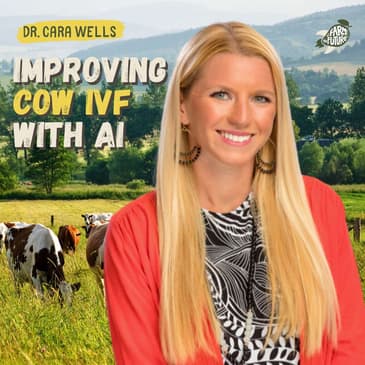
Ever wondered how modern breeding techniques are making cattle farming more sustainable? This week, we dive deep into the world of cattle IVF with Dr. Cara Wells, a reproductive physiologist and founder of EmGenisys. She explains how advanced reproductive technologies are helping create more efficient, climate-friendly cattle while improving animal welfare and food production.
About Dr. Cara Wells
Dr. Cara Wells is an entrepreneur, inventor, and animal scientist who has revolutionized the field of embryo evaluation technology. After earning her B.S. and PhD in Animal Science from Texas Tech University, she gained valuable experience working in both animal and human clinical IVF laboratories. This unique perspective helped her identify key industry challenges and opportunities.
As the founder of EmGenisys, she holds 8 issued US patents, 8 US patents pending, and 54 international patents. Under her leadership, EmGenisys has gained national and international recognition, secured seed funding, and expanded into new markets including human health and space agriculture.
Beyond her work at EmGenisys, Cara is passionate about mentoring the next generation of entrepreneurs and serves in advisory roles for multiple companies, including ventures in pollinator conservation, epigenetics, and biometric sensors. She lives in Dripping Springs, TX with her husband, 2 horses, boxer dog, and cat.
Dr. Cara Wells on LinkedIn: https://www.linkedin.com/in/cara-wells-phd/
Website: https://www.emgenisys.co/
Discounts
- Get 10% off delicious local farm-fresh food delivered to your door with my link for FarmMatch: https://farmmatch.com/jane
- Get 15% off high-quality Italian olive oil with code FARMTOFUTURE: https://shop.vignolifood.com/FARMTOFUTURE
- Get 40% the CircleDNA’s Premium DNA test with code JANEZHANG: https://circledna.com/premium
Connect with Jane Z.
- Instagram: @farm.to.future
- Email: jane@farmtofuture.co
- Website: farmtofuture.co
[00:00:01] I'm Jane Z, and this is Farm to Future, the podcast all about eating better for the planet.
[00:00:07] It's 2024, and cow IVF is a thing.
[00:00:12] And Dr. Cara Wells is on a mission to help us breed cows more sustainably.
[00:00:17] Cara is a reproductive physiologist who founded EmGenisys.
[00:00:21] They developed this technology that uses AI to watch videos of embryos and predict which ones will lead to successful pregnancies.
[00:00:29] I know, this sounds kind of sci-fi, and to be honest, I did get a little queasy talking about some of this stuff.
[00:00:35] But we also had a really honest conversation about the realities of modern cattle farming, from birth to pasture to feedlot to the slaughterhouse.
[00:00:44] And when this really clicked for me was learning how IVF could actually help us transition to more sustainable and regenerative farming.
[00:00:51] We now have the technology to breed cows that need less feed, produce less methane, and potentially thrive on grass alone,
[00:00:59] which gets us to a future where cows can live their whole lives on pasture,
[00:01:03] and we can get fully grass-fed and grass-finished beef at scale.
[00:01:08] If you're new here, welcome, welcome.
[00:01:10] Be sure to subscribe on Spotify, Apple Podcasts, or wherever you're listening.
[00:01:14] And you can find me, Jane Z, on Instagram at farm.to.future.
[00:01:19] Welcome to the show, Cara.
[00:01:22] Everyone I've talked to about the Thrive Summit, I'll mention cow IVF, and that is the most, like, head-turning thing,
[00:01:29] because, I don't know, I guess it sounds the most controversial when you first think about it.
[00:01:33] And I think for folks that are not familiar with the animal industry and with the cattle industry,
[00:01:38] it can be like, oh, whoa, cows have IVF, too?
[00:01:41] Like, that's kind of wild.
[00:01:42] So I'm so glad we're getting the chance to, like, sit down, deep dive into what you work on.
[00:01:47] But I want to start out with your background and how you sort of got into this space to begin with.
[00:01:52] Well, thanks, Jane, and thank you for having me on your podcast.
[00:01:55] And thank you for helping inform people about cattle IVF.
[00:01:59] It's a subject that I'm really passionate about, but yes, most people are very unfamiliar with it.
[00:02:03] My background specifically, I am a reproductive physiologist.
[00:02:07] And in my career, I've had the opportunity to work with both human and animal IVF systems.
[00:02:13] And I got familiar with these processes when I was a student at Texas Tech University.
[00:02:19] Initially, I had aspirations to become a large animal veterinarian.
[00:02:22] I've grown up absolutely loving horses, loving everything about them.
[00:02:27] And so horses really inspired my journey to learn more about large animals and animal health.
[00:02:33] While a student at Texas Tech, I was doing all the things that I could to get into vet school,
[00:02:38] which included undergraduate research.
[00:02:40] And through that research path, I really found a love and appreciation for reproductive sciences,
[00:02:45] which includes assisted reproductive techniques like embryo transfer, IVF, cloning,
[00:02:51] and other way to perpetuate genetics from animals, and obviously the study of human embryos.
[00:02:58] So in this process, I became really familiar with these IVF techniques.
[00:03:03] And I stumbled on a problem that it doesn't matter what species the embryo is,
[00:03:09] whether it's human, horse, cows, pigs,
[00:03:12] the way that we evaluate embryos to select them for transfer has not changed in about 50 years now,
[00:03:19] since we first started doing IVF back in the 70s.
[00:03:22] And I became really fixated on that problem and created a startup company called EmGenesis to create non-invasive solutions to evaluate embryos
[00:03:32] with the intent to improve pregnancy outcomes of IVF and embryo transfer in both people and animals.
[00:03:38] This is kind of off topic, but I remember last time we chatted, you mentioned you live outside of Austin.
[00:03:42] And in Texas, there's sort of this big exotic animal.
[00:03:46] I don't want to call it like obsession, but like a lot of people have exotic animals, right?
[00:03:50] Yeah, so this is one of my favorite topics.
[00:03:53] I find it fascinating.
[00:03:54] I really have a passion for conservation and endangered species.
[00:03:58] And in Texas, and I think some other states too,
[00:04:02] exotic wildlife species have really found a refuge on Texas ranches on private land.
[00:04:08] Interestingly, our climate in Texas is very similar to some of the regions in the world where these animals are most at risk.
[00:04:16] And that's Africa and that's India.
[00:04:17] These animals are very accustomed to a warm, dry climate.
[00:04:20] And guess what?
[00:04:22] We have that here in Texas.
[00:04:23] So in Texas, it is completely legal and actually incentivized by our agricultural exemptions to have species like giraffes, bongo, kudu,
[00:04:34] Texas deer, and even rhinoceros.
[00:04:37] And animals from these regions on Texas private ranches are privately owned.
[00:04:42] And these ranches are doing great things for conservation to help protect these endangered species,
[00:04:47] even outside of the government-funded zoos and other associations.
[00:04:51] Driving around the neighborhood, does it feel like a safari?
[00:04:53] Like, are you seeing these animals off the road?
[00:04:55] I wish.
[00:04:56] But yes, actually, sometimes, especially in the Texas hill country west of Austin, San Antonio,
[00:05:02] you'll be driving down the highway, see a high-fence ranch,
[00:05:04] and it's not completely out of the ordinary to see kudu, oryx, even zebra I saw one day standing by the fence.
[00:05:13] And yeah, they're safe, happy, and healthy on these ranches.
[00:05:16] And there's even some groups that have made like conservation meets capitalism models
[00:05:20] to breed and incentivize the reproduction and protection of these animals.
[00:05:25] When you say conservation meets capitalism, you mean like they'll breed for other folks to raise?
[00:05:30] Yes. So these animals, because they are rare and exotic, they have a very high inherent value.
[00:05:37] When people typically think about owning exotics, their mind goes towards game hunting,
[00:05:42] which is legal and it is a thing in Texas.
[00:05:45] But a lot of the people in this market that want these animals really do want to do good things for conservation.
[00:05:51] And they like the ability to have really pretty pasture ornaments, as I call them.
[00:05:55] So there's a market where you can buy these animals, which are typically valued at upwards of $10,000,
[00:06:02] sometimes upwards of $100,000.
[00:06:04] And when they breed and make live offspring,
[00:06:07] that offspring can be sold live to other people who want to invest in these exotic animals.
[00:06:12] And they can go start their own nucleot herds and such,
[00:06:16] and really create value from these live animals.
[00:06:19] Do you think you would ever work on IVF for these animals?
[00:06:23] Like, would you ever do like giraffe IVF or zebra IVF?
[00:06:26] Actually, yes.
[00:06:27] So the product that I'm working with is software to evaluate embryo health.
[00:06:32] And we do this through very non-invasive measures.
[00:06:34] We take 30-second videos of embryos just under a microscope.
[00:06:38] Commercially, our big opportunities are in domestic species,
[00:06:42] where a lot of reproduction takes place, like cattle or horses.
[00:06:45] And on the flip side of that coin, even human IVF,
[00:06:48] our technology is the first of its class to see embryo health in real time,
[00:06:54] which means we can see if that embryo is stressed.
[00:06:57] We can see if that embryo is developing normally.
[00:06:59] We can see if that embryo is starting to struggle,
[00:07:02] if their metabolism is slowing down.
[00:07:04] And with these capabilities,
[00:07:05] we can really get a pulse on that embryo's health
[00:07:08] with less trial and error than traditional measures.
[00:07:11] So MGenesis has actually done a couple of special contract projects
[00:07:16] working with some exotic species.
[00:07:18] One of my favorites was with the San Diego Zoo,
[00:07:21] where we looked at southern white rhino
[00:07:24] and northern white rhino videos of embryos.
[00:07:27] That was a favorite.
[00:07:28] And then we're also working with some breeders
[00:07:30] to do a Grevy zebra, kudu, and bongo project here in the future,
[00:07:34] which is really exciting.
[00:07:36] So I've not had the opportunity to see a giraffe embryo yet,
[00:07:39] but that's definitely on the list.
[00:07:40] You're like living a dream job.
[00:07:42] Do you feel like that?
[00:07:44] Sometimes, you know, ever a dull moment,
[00:07:46] I really feel privileged and fortunate to get to work
[00:07:49] with such cool animals,
[00:07:51] get invited to go out to some of these properties
[00:07:53] and, you know, play a small role
[00:07:56] in keeping these animals on this planet
[00:07:58] for future generations to enjoy and protect as well.
[00:08:02] Talk about how you developed this technology
[00:08:04] because it's super fascinating.
[00:08:05] And it started out with a really manual process, right?
[00:08:08] So yeah, going back to what I said earlier
[00:08:11] is the way that people select which embryos to transfer,
[00:08:15] whether it's animal or human,
[00:08:17] has not changed in about 50 years.
[00:08:19] That is human embryologists looking at these embryos
[00:08:22] under a microscope
[00:08:23] and grading the embryos based off visibly apparent characteristics
[00:08:27] like cell shape, color, size, symmetry, fragmentation.
[00:08:31] And that's really subjective.
[00:08:33] Jane, if you and I were both embryologists,
[00:08:35] we might see the same embryo and you might love it
[00:08:38] and I might think that it was already dying.
[00:08:40] There are studies out there that shows that
[00:08:42] one in three embryologists do not agree
[00:08:44] on the quality grade of embryos.
[00:08:46] And that's a problem,
[00:08:47] especially since in every mammalian IVF system,
[00:08:51] a lot of money is invested into these processes
[00:08:53] and to produce the embryos
[00:08:55] and two, to care for those animals
[00:08:57] after the embryo is transferred.
[00:08:58] So I really thought that in this day and age of technology,
[00:09:03] where cameras are really good,
[00:09:04] where machine learning is really good,
[00:09:06] there should be more objective ways
[00:09:08] to evaluate this embryo's health.
[00:09:11] So literally in April 2020,
[00:09:13] at the start of the pandemic,
[00:09:16] I came across a TED Talk
[00:09:17] from an interesting technology
[00:09:18] that had nothing to do with reproduction,
[00:09:20] animals, or even embryos for that matter.
[00:09:23] It was a filter
[00:09:24] called video motion magnification
[00:09:26] developed at MIT,
[00:09:28] which amplified micromotions
[00:09:29] embedded in video data.
[00:09:30] So the example that really resonated with me
[00:09:33] was they took a video
[00:09:34] of just a man sitting in front of the camera,
[00:09:37] nothing special, right?
[00:09:37] But then when they use this video filter,
[00:09:39] you could see his skin turn red and blue
[00:09:41] as his blood became oxygenated and deoxygenated.
[00:09:44] I'm like, well, that's super cool.
[00:09:46] That's not something that I can see
[00:09:48] in your face looking at you right now,
[00:09:50] but it's something that was very apparent
[00:09:52] and clear with this filter.
[00:09:54] So I was like, well, that's super cool.
[00:09:56] I wonder what would happen
[00:09:57] if we put this filter on videos of embryos.
[00:10:00] Embryos are living, growing organisms.
[00:10:03] They're going from, you know,
[00:10:05] in a cattle example,
[00:10:06] one cell to live calf
[00:10:09] that can nurse, walk, run
[00:10:11] in a span of about nine and a half months.
[00:10:13] So we know that these cells should be dividing.
[00:10:15] They need to be differentiating
[00:10:16] into different cell types.
[00:10:18] And as an embryologist,
[00:10:19] that's not something that I can see
[00:10:20] looking at these embryos under a microscope,
[00:10:21] but we know that it's happening
[00:10:23] and it's happening at a rather quick pace.
[00:10:25] So I shared this TED talk
[00:10:28] with a veterinarian
[00:10:29] that I was friends with,
[00:10:30] Dr. Russell Killingsworth,
[00:10:31] who's actually one of my co-founders of MGenesis.
[00:10:33] And I was like, check this out.
[00:10:35] Let me know what you think.
[00:10:36] And immediately his brain
[00:10:38] went to the same place that I did.
[00:10:40] And what would happen
[00:10:42] if we use this video filter
[00:10:43] on videos of embryos?
[00:10:45] So Dr. Killingsworth
[00:10:46] is a cattle veterinarian
[00:10:47] out of Shamrock, Texas,
[00:10:48] and he exclusively practices
[00:10:50] embryo transfer in cattle.
[00:10:52] So he comes across
[00:10:53] a lot of embryos every week.
[00:10:55] So within a week of watching the video,
[00:10:58] he was taking videos
[00:10:59] with just an old camera
[00:11:00] that he had mounted to his stereoscope,
[00:11:03] recording them
[00:11:03] and emailing me those videos.
[00:11:05] I purchased the filter from MIT.
[00:11:07] I applied it to these videos of embryos
[00:11:09] and we saw that some of them moved
[00:11:10] and some of them didn't,
[00:11:11] which was super cool,
[00:11:12] but we weren't sure what that meant.
[00:11:14] Is movement good?
[00:11:15] Is it bad?
[00:11:16] We needed to study this.
[00:11:17] So about 30 days later,
[00:11:19] the animals that these embryos
[00:11:21] were transferred in
[00:11:22] were pregnancy tested.
[00:11:23] So we had initial pregnancy outcomes
[00:11:25] on these transferred embryos.
[00:11:27] So we know which embryos
[00:11:28] made pregnancies,
[00:11:28] which ones did not.
[00:11:29] So I had something to compare it to.
[00:11:32] Like I said,
[00:11:32] April 2020 wasn't really supposed
[00:11:34] to leave the house.
[00:11:35] So I was sitting at home
[00:11:37] trying to mine objective data
[00:11:39] from these videos of embryos.
[00:11:41] So the way that I did that
[00:11:43] is I took this 30 second video
[00:11:44] and I paused it
[00:11:46] at five second intervals.
[00:11:47] And every five seconds,
[00:11:48] I measured the X and the Y diameter
[00:11:50] of those cells.
[00:11:52] And I measured how
[00:11:53] the inside of the embryo,
[00:11:55] which we call the inner cell mass,
[00:11:56] moved within the outside membrane,
[00:11:58] which is called the zona pellucida.
[00:12:00] And what we ended up finding
[00:12:01] in that study
[00:12:02] is that fast and slow embryos
[00:12:04] did not make pregnancies.
[00:12:05] Average activity embryos
[00:12:07] did make pregnancies.
[00:12:08] It was a rather perfect
[00:12:10] bell-shaped curve
[00:12:11] where the extremes
[00:12:13] didn't make pregnancies
[00:12:14] and the ones
[00:12:15] in the bulk of the population did.
[00:12:16] So we knew we were
[00:12:18] onto something
[00:12:18] we thought
[00:12:19] this was really fascinating.
[00:12:21] No one had done studies
[00:12:22] looking at real-time activity
[00:12:23] in embryos before.
[00:12:25] And so that was
[00:12:25] the origin story
[00:12:26] of MGenesis
[00:12:27] and that what led us
[00:12:29] to win our first
[00:12:30] grant and prize funding
[00:12:32] to automate this
[00:12:33] and go on
[00:12:34] and build a commercial product
[00:12:35] and a company from it.
[00:12:37] And I love that,
[00:12:38] you know,
[00:12:38] this was like
[00:12:38] a little silver lining
[00:12:39] that came out of the pandemic.
[00:12:41] You know,
[00:12:41] you actually had the time
[00:12:42] and space to go
[00:12:43] and like review
[00:12:44] these videos manually,
[00:12:46] pause them every five seconds
[00:12:47] and figure that out.
[00:12:48] That's super cool.
[00:12:49] And so what does
[00:12:50] the technology look like today?
[00:12:52] I'm assuming you've applied
[00:12:53] some kind of machine learning
[00:12:54] to it.
[00:12:55] Sure.
[00:12:55] So our technology
[00:12:57] today
[00:12:57] is completely software
[00:12:59] and videos
[00:13:00] can be collected
[00:13:01] off of hardware.
[00:13:02] So phones and microscopes
[00:13:05] that people who work
[00:13:06] with embryos
[00:13:07] already own.
[00:13:08] So what we ask people
[00:13:09] to do is just take
[00:13:10] a 30 second video
[00:13:11] of those embryos
[00:13:12] and we built
[00:13:13] a web-based platform.
[00:13:14] So a website
[00:13:15] where you can upload
[00:13:16] those videos.
[00:13:17] Behind the scenes
[00:13:18] in those videos,
[00:13:19] we do two things
[00:13:20] which is a very quick
[00:13:21] instant process.
[00:13:22] But the first thing
[00:13:23] that we do
[00:13:24] is we quantify
[00:13:24] the activity present
[00:13:26] in the embryo region
[00:13:27] of those videos.
[00:13:28] So basically
[00:13:29] what we do
[00:13:30] is we go frame by frame
[00:13:31] through those videos
[00:13:33] and we calculate
[00:13:33] how much the embryo changes.
[00:13:35] That activity
[00:13:36] is directly correlated
[00:13:37] to the embryo's health,
[00:13:39] viability,
[00:13:39] stress,
[00:13:40] and metabolic function
[00:13:41] and even sex.
[00:13:42] Fun fact,
[00:13:43] male embryos
[00:13:44] grow faster
[00:13:44] than female embryos
[00:13:45] and we can see that
[00:13:46] with this technology.
[00:13:47] The second thing
[00:13:48] that we do
[00:13:49] is we've trained
[00:13:49] machine learning models
[00:13:51] based on
[00:13:52] pregnancy outcomes
[00:13:53] of these embryos
[00:13:54] to predict
[00:13:55] if the embryo
[00:13:56] has activity patterns
[00:13:57] of those associated
[00:13:58] with full-term pregnancies
[00:13:59] or activity patterns
[00:14:00] of embryos
[00:14:01] that never make
[00:14:02] pregnancies at all.
[00:14:03] And using the machine
[00:14:04] learning allows us
[00:14:05] to be highly specific
[00:14:06] and highly targeted
[00:14:07] to create
[00:14:08] highly predictive
[00:14:09] and accurate likelihoods
[00:14:11] of that embryo's chance
[00:14:12] in making a pregnancy.
[00:14:13] So what the user sees
[00:14:15] in our web-based platform
[00:14:16] is just a viability score
[00:14:18] which is a probability
[00:14:19] which they can use
[00:14:20] to help manage
[00:14:21] their embryo transfer
[00:14:22] and selection decisions.
[00:14:23] I'm picturing
[00:14:24] red, yellow, green.
[00:14:25] Yeah, exactly.
[00:14:25] Exactly.
[00:14:26] So I'm curious,
[00:14:27] I'd love to dive
[00:14:28] into the cattle industry
[00:14:29] and what it looks like
[00:14:31] working with them.
[00:14:32] How common is IVF
[00:14:33] in cattle breeding?
[00:14:35] It's a great question.
[00:14:36] So IVF
[00:14:37] is definitely
[00:14:38] still a high-end
[00:14:39] niche market
[00:14:39] in the cattle breeding
[00:14:41] industry right now
[00:14:42] but it's gaining traction.
[00:14:43] We're seeing
[00:14:44] about 15%
[00:14:45] increase
[00:14:46] of volume
[00:14:47] of embryos
[00:14:47] made in cattle
[00:14:48] year over year
[00:14:49] and this is a trend
[00:14:50] that's been going on
[00:14:51] for about 10 years now.
[00:14:53] And you might wonder
[00:14:54] why do IVF
[00:14:55] and the purpose
[00:14:56] in cattle
[00:14:57] what's the benefit?
[00:14:58] And I like to remind people
[00:15:00] that the process
[00:15:01] for IVF in cows
[00:15:02] is very similar
[00:15:03] to the process
[00:15:04] of IVF in people
[00:15:05] but the intended use
[00:15:06] is very different.
[00:15:07] In humans,
[00:15:08] IVF is used
[00:15:09] to treat infertility.
[00:15:10] So these are
[00:15:11] patients,
[00:15:12] couples,
[00:15:13] typically that try
[00:15:14] to get pregnant
[00:15:14] on their own
[00:15:15] the natural way
[00:15:16] and they experienced
[00:15:18] a year of trying
[00:15:19] to not get pregnant
[00:15:20] and so then
[00:15:21] they need more
[00:15:22] intervening measures
[00:15:23] like IVF
[00:15:24] to help them
[00:15:25] treat that infertility.
[00:15:26] In cattle,
[00:15:27] we're not trying
[00:15:28] to treat infertility
[00:15:30] as much as we're
[00:15:31] trying to perpetuate
[00:15:32] superior genetics.
[00:15:33] So a male,
[00:15:35] a bull,
[00:15:36] he can impregnate
[00:15:36] as many females
[00:15:37] a year
[00:15:38] as we want
[00:15:39] to breed him,
[00:15:40] right?
[00:15:40] You know,
[00:15:41] he's not carrying
[00:15:41] that baby
[00:15:42] so he's not limited
[00:15:43] by nature
[00:15:43] to how many females
[00:15:45] can be inseminated
[00:15:46] with his genetics
[00:15:47] each year.
[00:15:47] But the female,
[00:15:49] she can only have
[00:15:49] one calf per year
[00:15:50] naturally
[00:15:51] so if we have
[00:15:52] a female that
[00:15:53] doesn't require
[00:15:54] a lot of feed,
[00:15:55] that has
[00:15:55] excellent confirmation
[00:15:56] that makes more
[00:15:57] milk than the
[00:15:58] average cow,
[00:15:59] hence can feed
[00:16:00] more people
[00:16:00] per animal
[00:16:01] than lower
[00:16:02] performing cows,
[00:16:03] she's bottlenecked
[00:16:04] by her own
[00:16:05] reproductive system
[00:16:06] because she can
[00:16:07] only have
[00:16:07] one calf
[00:16:08] per year.
[00:16:09] But IVF
[00:16:10] allows us
[00:16:10] to release
[00:16:11] those floodgates.
[00:16:12] We can take
[00:16:13] that female's
[00:16:14] eggs,
[00:16:15] her oocytes,
[00:16:15] and we can get
[00:16:16] 5, 10,
[00:16:17] 15, 20
[00:16:18] oocytes
[00:16:19] per collection,
[00:16:20] fertilize them
[00:16:21] with bulls
[00:16:22] from good genetics,
[00:16:23] make multiple
[00:16:24] embryos,
[00:16:25] and put those
[00:16:25] embryos into
[00:16:26] lower quality
[00:16:27] surrogates
[00:16:28] who can have
[00:16:29] that female's
[00:16:30] genetic calf
[00:16:31] with those
[00:16:31] excellent
[00:16:32] sustainability
[00:16:33] genetics that
[00:16:33] we all want
[00:16:34] and she can
[00:16:35] have more
[00:16:35] babies than
[00:16:36] one per year
[00:16:37] that nature
[00:16:38] would restrict
[00:16:38] her to.
[00:16:39] So we really
[00:16:40] use IVF as a
[00:16:41] tool to create
[00:16:42] genetic progress
[00:16:43] and help reach
[00:16:44] some of these
[00:16:44] animal welfare,
[00:16:45] health,
[00:16:46] and sustainability
[00:16:46] goals through
[00:16:47] amplifying genetics
[00:16:48] at a faster rate
[00:16:49] than can be
[00:16:50] achieved by nature.
[00:16:50] I have so many
[00:16:51] questions.
[00:16:52] I want to learn
[00:16:53] about the
[00:16:53] connection to
[00:16:54] sustainability,
[00:16:54] but I was
[00:16:56] reading this
[00:16:56] novel called
[00:16:57] The Farm.
[00:16:58] Have you
[00:16:58] heard of that?
[00:16:59] I've heard of it,
[00:17:00] but I've not read it.
[00:17:01] I'm sorry.
[00:17:01] Yeah, no, it's okay.
[00:17:02] So the premise is
[00:17:03] it's basically about
[00:17:04] surrogacy,
[00:17:05] but it's this
[00:17:06] sort of dystopian,
[00:17:08] but not even
[00:17:08] that far off
[00:17:09] story.
[00:17:10] So there's this
[00:17:10] retreat that
[00:17:11] women go to
[00:17:12] in upstate New York
[00:17:13] and it's very
[00:17:14] wellness focused.
[00:17:15] You can have
[00:17:15] unlimited,
[00:17:16] super healthy
[00:17:17] food and yoga
[00:17:18] classes and you
[00:17:20] spend time in
[00:17:20] nature and you
[00:17:21] get paid a lot
[00:17:22] of money to be
[00:17:23] there and all
[00:17:23] you have to do
[00:17:24] is produce a
[00:17:25] baby.
[00:17:26] And that's sort
[00:17:26] of the premise
[00:17:27] is that it's
[00:17:28] this like ultra
[00:17:29] elite surrogacy
[00:17:31] targeting very
[00:17:32] wealthy women
[00:17:33] and couples who
[00:17:34] either can't have
[00:17:35] children on their
[00:17:36] own, they're older
[00:17:37] or they just
[00:17:38] prefer to have
[00:17:39] someone else carry
[00:17:40] it.
[00:17:40] And so the
[00:17:41] product is these
[00:17:42] surrogates, but
[00:17:43] they're all like
[00:17:43] very young, very
[00:17:44] healthy individuals.
[00:17:46] And as you were
[00:17:47] talking, I was
[00:17:47] thinking like,
[00:17:48] oh, that's kind
[00:17:49] of another
[00:17:49] difference in
[00:17:50] like how you
[00:17:51] would approach
[00:17:52] this process.
[00:17:52] It feels weird
[00:17:53] talking about
[00:17:53] breeding humans,
[00:17:54] but like the
[00:17:55] difference in
[00:17:55] surrogates too
[00:17:56] is like you
[00:17:56] mentioned with
[00:17:57] the cow surrogates,
[00:17:58] you could go
[00:17:59] with, I think
[00:17:59] you use the
[00:18:00] word like inferior
[00:18:01] surrogates, but
[00:18:02] like inject these
[00:18:04] embryos that have
[00:18:04] superior genetics
[00:18:05] in them.
[00:18:06] Exactly.
[00:18:07] So we're not
[00:18:08] completely off base
[00:18:09] with this book.
[00:18:10] So these inferior
[00:18:12] animals, typically
[00:18:13] they're heifers and
[00:18:15] they've been
[00:18:15] genetically tested
[00:18:16] and they're
[00:18:17] healthy, but
[00:18:18] they don't
[00:18:18] possess the
[00:18:19] genetics to
[00:18:20] make more
[00:18:21] milk than the
[00:18:22] average cow does
[00:18:23] or feed efficiency
[00:18:24] genetics.
[00:18:24] So they're just
[00:18:25] kind of average
[00:18:26] baseline cow.
[00:18:27] Now I will
[00:18:28] throw the caveat
[00:18:29] in there that
[00:18:30] the recipients,
[00:18:31] the surrogates
[00:18:32] that we use,
[00:18:33] they're still
[00:18:33] really high
[00:18:34] quality premium
[00:18:35] animals and
[00:18:36] they're actually
[00:18:36] probably better
[00:18:37] genetics than
[00:18:38] what you see
[00:18:38] in other
[00:18:39] countries.
[00:18:40] But for here,
[00:18:41] they're not the
[00:18:41] really high end
[00:18:42] elite breeding
[00:18:43] donors that we
[00:18:44] really want to
[00:18:45] perpetuate the
[00:18:45] genetics from.
[00:18:46] So we have
[00:18:47] farms where
[00:18:49] these heifers
[00:18:50] go to live
[00:18:51] and they will
[00:18:51] be our surrogates
[00:18:52] and these heifers
[00:18:53] are fed some
[00:18:54] of the best
[00:18:54] diets in animal
[00:18:56] agriculture in
[00:18:57] this country.
[00:18:57] A lot of them
[00:18:58] have activity
[00:18:59] trackers so we
[00:19:00] can see when
[00:19:01] they're in heat,
[00:19:02] we can see if
[00:19:03] they're not
[00:19:03] coming up for
[00:19:04] water as much,
[00:19:05] we can see if
[00:19:05] they're laying
[00:19:06] down too much,
[00:19:07] which can be a
[00:19:07] sign that they're
[00:19:08] sick and so
[00:19:09] they're monitored
[00:19:10] constantly so we
[00:19:11] can give them
[00:19:11] the best health
[00:19:12] and that's
[00:19:13] because they're
[00:19:13] going to be
[00:19:14] the surrogates
[00:19:15] for some of the
[00:19:15] best genetics
[00:19:16] in the country.
[00:19:17] On the donor
[00:19:18] side, which these
[00:19:19] are the superior
[00:19:19] genetic animals,
[00:19:20] these females
[00:19:21] were typically
[00:19:22] genetically tested
[00:19:23] as young animals
[00:19:24] just an ear sample
[00:19:26] and their DNA
[00:19:27] was tested.
[00:19:28] And with that,
[00:19:28] we can see
[00:19:29] their propensity
[00:19:30] for milk production,
[00:19:32] confirmation,
[00:19:33] fertility,
[00:19:34] feed efficiency,
[00:19:35] which is how fast
[00:19:36] you grow off
[00:19:37] of how much feed.
[00:19:38] It's better if you
[00:19:39] grow a lot,
[00:19:39] consuming less feed,
[00:19:41] that's less inputs
[00:19:42] that we have to put
[00:19:42] into that other.
[00:19:43] Methane is actually
[00:19:44] a genetic trait
[00:19:45] and so we can
[00:19:46] take all these
[00:19:47] factors and pick
[00:19:48] which ones will be
[00:19:49] a good candidate
[00:19:51] to breed.
[00:19:51] Other factors we can
[00:19:52] look at is heat
[00:19:53] tolerance.
[00:19:53] So some places
[00:19:55] in the world
[00:19:55] are very warm,
[00:19:56] we want these
[00:19:56] heat tolerant
[00:19:57] animals,
[00:19:58] insect tolerance
[00:19:59] or insect
[00:20:00] resistance if,
[00:20:01] you know,
[00:20:01] this animal is
[00:20:01] going to live
[00:20:02] in like a hot
[00:20:02] humid area of the
[00:20:03] world.
[00:20:04] So we can look
[00:20:04] at all these
[00:20:05] factors that really
[00:20:06] play into that
[00:20:07] animal's health
[00:20:07] and performance
[00:20:08] and select which
[00:20:09] donors we want.
[00:20:10] Once they're selected
[00:20:11] as a donor,
[00:20:12] they just go through
[00:20:13] a very minimally
[00:20:14] invasive egg
[00:20:15] retrieval process.
[00:20:16] We call this
[00:20:16] an ovum pickup
[00:20:17] in cattle or OPU
[00:20:18] where their oocytes
[00:20:20] or their eggs
[00:20:21] are aspirated
[00:20:21] from their ovaries.
[00:20:22] It's a standing
[00:20:23] procedure,
[00:20:24] takes a few minutes,
[00:20:25] then that animal
[00:20:25] is free to go.
[00:20:26] She doesn't really
[00:20:27] know anything
[00:20:27] ever happened to her.
[00:20:29] Those eggs
[00:20:29] are taken to an
[00:20:30] IVF lab,
[00:20:31] they're fertilized
[00:20:32] with sperm,
[00:20:33] they're grown for
[00:20:33] seven days and at
[00:20:34] seven days they can
[00:20:35] either be frozen
[00:20:36] or shipped fresh
[00:20:37] to that surrogate
[00:20:38] facility that I
[00:20:39] told you about
[00:20:40] where those
[00:20:41] embryos are
[00:20:41] transferred into
[00:20:42] the surrogates
[00:20:43] and then that
[00:20:44] pregnant animal
[00:20:44] is taken care of
[00:20:45] until she gives
[00:20:47] birth and weans
[00:20:47] that calf.
[00:20:48] When you say
[00:20:48] aspirated,
[00:20:49] is that like a
[00:20:50] vacuum device?
[00:20:51] Correct, yeah.
[00:20:52] Okay, okay.
[00:20:52] And conformation,
[00:20:53] you mentioned that's
[00:20:54] one of the traits,
[00:20:54] what does that mean?
[00:20:55] So conformation
[00:20:56] is the animal's
[00:20:58] anatomy and their
[00:20:59] structure.
[00:20:59] So when we look
[00:21:01] at conformation,
[00:21:01] we want good
[00:21:03] hooves,
[00:21:04] we want good
[00:21:05] bones,
[00:21:05] we want good
[00:21:06] udder
[00:21:07] conformation.
[00:21:08] conformation,
[00:21:08] we typically
[00:21:09] want them to be
[00:21:10] lean and energy
[00:21:11] efficient,
[00:21:11] but if they were
[00:21:12] a beef animal,
[00:21:13] we would want
[00:21:14] them to be a
[00:21:15] very muscular
[00:21:15] animal because
[00:21:16] they're creating
[00:21:16] more protein
[00:21:17] on their structure.
[00:21:18] So when we say
[00:21:19] conformation,
[00:21:20] we're really looking
[00:21:20] at that animal's
[00:21:21] build and how
[00:21:22] that can apply
[00:21:23] to their performance
[00:21:23] or their longevity
[00:21:25] and their health.
[00:21:26] This may be a
[00:21:26] silly question,
[00:21:27] but are all
[00:21:28] female cows bred
[00:21:29] for milk and
[00:21:32] all male cows
[00:21:32] bred for beef?
[00:21:33] No, so typically
[00:21:34] we look at the
[00:21:35] animal's breed for
[00:21:36] that some breeds
[00:21:38] are more inclined
[00:21:39] to make more
[00:21:40] gallons or higher
[00:21:41] quality milk and
[00:21:42] some breeds are
[00:21:43] more inclined to
[00:21:44] grow fast,
[00:21:45] be highly muscular
[00:21:46] and make good
[00:21:47] beef.
[00:21:48] So when we look
[00:21:49] at breeds on
[00:21:49] the dairy side,
[00:21:51] you're probably
[00:21:51] familiar with those
[00:21:52] black and white
[00:21:52] cows.
[00:21:53] Those are called
[00:21:53] Holsteins.
[00:21:54] That's your
[00:21:54] stereotypical dairy
[00:21:56] cow.
[00:21:56] There's also a
[00:21:57] smaller breed called
[00:21:59] Jersey's that are
[00:22:00] really popular in
[00:22:01] this country.
[00:22:01] Those are those
[00:22:02] brown ones and
[00:22:03] they have really
[00:22:04] high lipid
[00:22:04] content in their
[00:22:05] milk, so high
[00:22:06] butterfat content.
[00:22:07] So their milk is
[00:22:08] actually more used
[00:22:09] towards ice cream,
[00:22:10] butter, and
[00:22:12] creamier products than
[00:22:14] what the Holsteins
[00:22:15] milk would be used
[00:22:16] for.
[00:22:16] On the beef side,
[00:22:17] you're probably
[00:22:18] familiar with
[00:22:18] certified Angus
[00:22:19] beef and just
[00:22:20] that black beef
[00:22:21] cow.
[00:22:21] That's an Angus,
[00:22:22] that's a very
[00:22:23] popular beef cow in
[00:22:24] this country that
[00:22:25] is famous for
[00:22:25] that, but there's
[00:22:27] tons of different
[00:22:27] beef and dairy
[00:22:28] breeds, but
[00:22:29] they're selected
[00:22:30] for their ability
[00:22:31] to make either
[00:22:32] good meat or
[00:22:32] good milk.
[00:22:33] Gotcha.
[00:22:33] How does natural
[00:22:36] breeding work in
[00:22:37] the cattle industry?
[00:22:38] Do they just
[00:22:38] put a male and
[00:22:39] female cow together
[00:22:40] in a barn?
[00:22:41] What does that
[00:22:41] look like?
[00:22:42] Sure.
[00:22:43] So the dairy
[00:22:44] industry really
[00:22:44] doesn't use natural
[00:22:46] live cover breeding
[00:22:47] anymore.
[00:22:48] If they're not doing
[00:22:49] embryo transfer,
[00:22:50] they're probably
[00:22:51] doing artificial
[00:22:51] insemination.
[00:22:53] So that's where
[00:22:54] the semen is
[00:22:55] collected from the
[00:22:55] bulls.
[00:22:56] It's either frozen
[00:22:57] and put into
[00:22:58] straws, and when
[00:22:59] the females are in
[00:23:00] heat, you can just
[00:23:01] go and inject that
[00:23:02] semen into their
[00:23:03] uterus to breed
[00:23:04] them.
[00:23:04] And artificial
[00:23:05] insemination is
[00:23:06] really great because
[00:23:07] it's cleaner and
[00:23:08] safer for the
[00:23:09] bulls than
[00:23:10] actually natural
[00:23:11] reproduction.
[00:23:12] In nature, that
[00:23:13] bull is very likely
[00:23:14] to get kicked, which
[00:23:15] can hurt him or
[00:23:16] render him infertile.
[00:23:17] With artificial
[00:23:18] insemination, only
[00:23:19] the people doing it
[00:23:20] get kicked.
[00:23:21] So it's actually
[00:23:21] safer for the
[00:23:22] animals.
[00:23:23] But natural
[00:23:24] reproduction is more
[00:23:25] common on the
[00:23:26] beef side where
[00:23:27] these animals are
[00:23:28] typically raised on
[00:23:29] several hundred
[00:23:29] acres or even
[00:23:30] sometimes several
[00:23:31] thousand acre
[00:23:32] pastures.
[00:23:33] In the sense, we
[00:23:34] turn out a bull
[00:23:35] with females.
[00:23:36] He is allowed to
[00:23:37] hang out with
[00:23:38] them, eat with
[00:23:39] them when they
[00:23:39] come in heat, and
[00:23:40] then nine and a
[00:23:41] half months later,
[00:23:42] those calves will
[00:23:42] be born.
[00:23:43] Nine and a half
[00:23:44] months, that's
[00:23:44] really similar to a
[00:23:45] human gestation
[00:23:46] period.
[00:23:46] It is, yes.
[00:23:47] But their babies
[00:23:48] are a lot bigger
[00:23:49] than ours.
[00:23:49] Yeah, I would
[00:23:50] imagine.
[00:23:51] I want to go back
[00:23:51] to the sustainability
[00:23:52] piece.
[00:23:53] So you had
[00:23:54] mentioned certain
[00:23:55] traits that we
[00:23:56] would look for
[00:23:57] including lower
[00:23:58] methane gas and
[00:23:59] then also being
[00:24:01] able to grow
[00:24:01] faster on less
[00:24:03] feed.
[00:24:03] Are those like
[00:24:04] some of the
[00:24:04] characteristics that
[00:24:05] you would point
[00:24:06] to when we look
[00:24:07] at how this
[00:24:08] process helps
[00:24:09] with sustainability?
[00:24:10] Definitely.
[00:24:10] And it also
[00:24:11] highly ties into
[00:24:13] the economics of
[00:24:14] producing animals
[00:24:15] in these products.
[00:24:16] So it's actually
[00:24:17] a really favorable
[00:24:18] ecosystem when you
[00:24:19] are selecting for
[00:24:20] sustainability.
[00:24:21] We have to
[00:24:22] remember that the
[00:24:24] owner of these
[00:24:24] animals, which
[00:24:25] we're going to
[00:24:25] call the B for
[00:24:26] dairy producer, they
[00:24:27] have to pay for
[00:24:28] everything that their
[00:24:29] animal eats and
[00:24:30] they get paid for
[00:24:32] the products that
[00:24:33] their animals make.
[00:24:34] So they get paid
[00:24:35] for milk if you're
[00:24:36] a dairy or beef or
[00:24:38] per pounds of
[00:24:38] carcass if you're a
[00:24:40] beef producer.
[00:24:40] So we're
[00:24:41] incentivized to want
[00:24:42] these animals to
[00:24:42] make as much as
[00:24:43] possible.
[00:24:43] But if we're
[00:24:44] paying for their
[00:24:45] feed and if it
[00:24:46] takes a lot of
[00:24:47] pounds of feed to
[00:24:48] get a gallon of
[00:24:49] milk or pound of
[00:24:50] muscle, these
[00:24:51] inputs can be very
[00:24:52] very costly for
[00:24:53] those producers.
[00:24:54] But genetically,
[00:24:56] some animals grow
[00:24:56] faster off less
[00:24:58] feed, that's
[00:24:58] called being
[00:24:59] feed efficient,
[00:24:59] or make more
[00:25:00] milk off of less
[00:25:01] feed.
[00:25:02] And so it's
[00:25:03] really desirable
[00:25:03] for that producer
[00:25:04] to select for
[00:25:05] those things because
[00:25:06] then he can feed
[00:25:07] the animals less,
[00:25:08] but they still
[00:25:09] grow and they're
[00:25:10] highly efficient.
[00:25:11] Selecting against
[00:25:12] methane also plays
[00:25:14] into this equation,
[00:25:16] if you will,
[00:25:16] because methane is
[00:25:18] really nothing but
[00:25:19] wasted energy, right?
[00:25:20] It's energy out.
[00:25:22] Well, feed is
[00:25:22] energy in.
[00:25:23] So when you have
[00:25:24] high methane out,
[00:25:25] you're wasting the
[00:25:26] energy from the
[00:25:27] feed that you just
[00:25:28] purchased and gave
[00:25:29] to that animal.
[00:25:29] So when we select
[00:25:31] for less methane
[00:25:32] and high feed
[00:25:33] efficiency, they're
[00:25:34] not wasting that
[00:25:35] energy as methane,
[00:25:36] but they're putting
[00:25:37] that energy towards
[00:25:37] growth.
[00:25:38] So they're putting
[00:25:38] it into muscle mass
[00:25:40] or into milk
[00:25:41] production, less
[00:25:42] methane, more
[00:25:43] product.
[00:25:43] It's a win-win for
[00:25:44] people consuming
[00:25:45] them, the producer
[00:25:46] paying for them,
[00:25:47] and the environment
[00:25:48] because we don't
[00:25:49] have to put as
[00:25:50] many inputs to get
[00:25:51] pounds of protein
[00:25:52] out of these animals.
[00:25:53] Can you say more
[00:25:54] about the economic
[00:25:54] impact?
[00:25:55] Like how much a
[00:25:56] farmer puts in
[00:25:58] versus like how
[00:25:58] much they make
[00:25:59] per cow?
[00:26:00] Sure.
[00:26:01] Off the top of my
[00:26:01] head, most farms
[00:26:03] are probably looking
[00:26:04] at about $8 to $10
[00:26:05] per head per day
[00:26:07] and feed cost alone.
[00:26:09] I'm not actually sure
[00:26:10] beet prices and milk
[00:26:12] prices at the moment,
[00:26:13] but obviously those
[00:26:14] prices need to be
[00:26:15] high enough to justify
[00:26:17] the $8 to $10
[00:26:17] per head per day
[00:26:19] of feed inputs.
[00:26:20] So for a dairy cow,
[00:26:21] they would need to
[00:26:22] at least be producing
[00:26:24] $8 worth of milk
[00:26:25] per day to break
[00:26:26] even.
[00:26:26] Okay, gotcha.
[00:26:28] Do you have any
[00:26:29] info on the economic
[00:26:30] impact of failed
[00:26:31] embryo transfers?
[00:26:32] That I can speak
[00:26:33] a lot more to.
[00:26:34] So yes, IVF is an
[00:26:36] expensive process.
[00:26:36] It's a high risk,
[00:26:38] high reward game.
[00:26:39] If you will,
[00:26:39] a lot of times
[00:26:40] these embryos that
[00:26:42] possess the genetics
[00:26:43] of these genetic
[00:26:44] traits that we just
[00:26:44] talked about,
[00:26:45] feed efficiency,
[00:26:46] methane reduction,
[00:26:47] fertility,
[00:26:47] confirmation,
[00:26:48] that's going to be
[00:26:49] a premium animal.
[00:26:50] You know,
[00:26:51] if you look at
[00:26:52] your show dogs
[00:26:53] or your show horses
[00:26:54] or your show cattle,
[00:26:55] those are going to
[00:26:56] run a higher premium
[00:26:57] than a more average
[00:26:59] animal,
[00:27:00] if you will.
[00:27:00] So being successful
[00:27:02] with IVF can really
[00:27:03] create a high value
[00:27:05] offspring at the
[00:27:06] end of the day,
[00:27:06] but it's not a process
[00:27:08] that's without cost.
[00:27:09] So the producer
[00:27:10] needs to pay
[00:27:12] to make the embryos
[00:27:13] and then once the
[00:27:14] embryos are made,
[00:27:15] they need to pay
[00:27:16] to have those
[00:27:17] embryos transferred,
[00:27:18] which is usually
[00:27:19] looking at about
[00:27:20] $75 per embryo.
[00:27:22] To transfer an embryo,
[00:27:23] you have to have
[00:27:24] a female to put
[00:27:25] those embryos into,
[00:27:26] so you have to have
[00:27:27] a herd of surrogates
[00:27:28] that you've already
[00:27:29] purchased that are
[00:27:30] healthy and that are
[00:27:31] good contenders to be
[00:27:32] the surrogates of
[00:27:33] these really high value
[00:27:34] embryos.
[00:27:34] We're probably looking
[00:27:35] at about $2,300
[00:27:39] per surrogate animal
[00:27:40] and feed comes into
[00:27:41] us.
[00:27:42] Whether you're a donor
[00:27:42] or you're a surrogate,
[00:27:43] you have to eat,
[00:27:44] so we're looking at
[00:27:44] $8 to $10 per day.
[00:27:46] So in our calculations,
[00:27:48] using a very generous
[00:27:49] 50% pregnancy rate
[00:27:51] of IVF,
[00:27:52] which typically
[00:27:53] it's much less than
[00:27:53] that, but we'll be
[00:27:54] generous here,
[00:27:55] we're looking at
[00:27:56] about $5,500
[00:27:57] per pregnancy
[00:27:59] of every embryo
[00:28:00] that goes into
[00:28:00] the system.
[00:28:01] So it is a
[00:28:02] significant financial
[00:28:03] investment to do IVF.
[00:28:04] On the flip side,
[00:28:05] you're going to have
[00:28:06] an animal that grows
[00:28:07] faster, that requires
[00:28:09] less input, and could
[00:28:10] also be sold at a
[00:28:11] premium, so that's
[00:28:12] the benefit.
[00:28:12] By our technology
[00:28:13] at MGenesis,
[00:28:14] we're trying to push
[00:28:15] the boundaries of
[00:28:16] that 50% pregnancy
[00:28:17] rate.
[00:28:17] By selecting the
[00:28:18] healthiest embryos
[00:28:19] that are going to
[00:28:20] make viable pregnancies
[00:28:21] rather than not
[00:28:22] make pregnancies at
[00:28:23] all, we can improve
[00:28:24] pregnancy outcomes by
[00:28:25] about 20%, which
[00:28:27] really decreases
[00:28:28] producers' cost per
[00:28:29] pregnancy at the
[00:28:30] end of the day.
[00:28:31] Yeah, that's a lot.
[00:28:32] I mean, if you add
[00:28:32] it up 5,500 times,
[00:28:34] if you're putting
[00:28:34] embryos in like 10,
[00:28:35] 20 cows, that adds
[00:28:36] up pretty quickly to
[00:28:38] like tens of
[00:28:38] thousands of
[00:28:39] dollars.
[00:28:39] It is.
[00:28:40] In fact, I'll raise
[00:28:42] you in here.
[00:28:43] A lot of the groups
[00:28:43] that we work with are
[00:28:44] doing about 100
[00:28:45] embryos per day.
[00:28:46] I even know of a
[00:28:48] farm that's doing
[00:28:49] about 1,000 embryos
[00:28:50] a day, seven days a
[00:28:51] week.
[00:28:52] So these really
[00:28:53] progressive groups
[00:28:54] that have really
[00:28:54] invested in genetics
[00:28:55] and IVF as a method
[00:28:57] to breathe their
[00:28:57] animals, they're
[00:28:58] putting tens of
[00:28:59] millions of dollars
[00:28:59] into these systems
[00:29:00] each year because
[00:29:02] they've seen the
[00:29:02] results of genetic
[00:29:03] progress really be
[00:29:04] advantageous to their
[00:29:05] herds.
[00:29:06] How big are these
[00:29:07] operations?
[00:29:07] Are we talking about
[00:29:08] the Cargills of
[00:29:09] the world?
[00:29:10] What sort of scale
[00:29:11] of operations are
[00:29:12] you working with?
[00:29:12] It completely
[00:29:13] ranges.
[00:29:14] No one out of
[00:29:14] Cargill of the
[00:29:15] world, if you will,
[00:29:17] but like I said,
[00:29:17] there's some very
[00:29:19] large dairies that
[00:29:20] are really invested
[00:29:21] in this that do up
[00:29:23] to 1,000 embryos a
[00:29:24] day.
[00:29:24] A lot of these
[00:29:25] dairies are not
[00:29:25] doing near that
[00:29:26] many.
[00:29:27] That's a very
[00:29:27] large scale.
[00:29:28] But some of these
[00:29:28] other groups, they
[00:29:29] might just do a
[00:29:30] handful of transfers
[00:29:31] a year.
[00:29:32] They might pick two
[00:29:33] or three of their
[00:29:34] favorite females that
[00:29:35] they're going to
[00:29:36] select as donors.
[00:29:37] They'll invest in
[00:29:38] that and they might
[00:29:38] have 15 embryo
[00:29:39] calves a year and
[00:29:41] that's still
[00:29:41] advantageous to their
[00:29:42] systems.
[00:29:42] So we work with
[00:29:44] farms of all
[00:29:45] sizes, some very
[00:29:47] mom and pop, some
[00:29:48] that are trying to
[00:29:49] have high quality
[00:29:50] genetics just to
[00:29:51] feed their family
[00:29:52] on their farm,
[00:29:53] their own beef,
[00:29:54] raise the way that
[00:29:55] they want to.
[00:29:56] Some of them are
[00:29:56] trying to produce
[00:29:57] animals for their
[00:29:58] children to show and
[00:30:00] then others are
[00:30:00] trying to do this
[00:30:01] more at scale and
[00:30:02] more commercially.
[00:30:03] Did you say that
[00:30:04] developing the
[00:30:04] actual embryo, that
[00:30:05] cost $75?
[00:30:06] It costs a little bit
[00:30:07] more than that.
[00:30:07] The $75 is what
[00:30:09] you pay the
[00:30:10] veterinarian to put
[00:30:12] that embryo into
[00:30:14] the recipient animal.
[00:30:15] Embryo production
[00:30:16] costs are really
[00:30:17] variable and the
[00:30:18] different IVF labs
[00:30:19] have different ways
[00:30:20] that they charge.
[00:30:21] Some of them they
[00:30:21] charge per procedure
[00:30:23] a flat rate.
[00:30:24] Some of them they
[00:30:24] charge per embryo
[00:30:26] produced.
[00:30:27] I think I've seen
[00:30:28] costs about $85 per
[00:30:29] embryo produced
[00:30:30] marketed from some
[00:30:31] of these IVF labs.
[00:30:32] And if I really
[00:30:34] want to throw a
[00:30:35] wrench into the
[00:30:36] system, there is a
[00:30:37] method to produce
[00:30:38] embryos that don't
[00:30:40] actually involve the
[00:30:41] live animals at all.
[00:30:43] And this is the
[00:30:43] cheapest way to make
[00:30:45] embryos.
[00:30:45] In the slaughterhouse,
[00:30:47] the ovaries really
[00:30:48] don't have a lot of
[00:30:49] value.
[00:30:50] I mean, you don't
[00:30:51] eat ovaries, but
[00:30:52] the ovaries are where
[00:30:53] all the eggs live.
[00:30:54] So there are some
[00:30:56] groups that have
[00:30:56] popped up in recent
[00:30:57] years where they
[00:30:58] take the ovaries
[00:30:59] of these slaughtered
[00:31:01] animals, they collect
[00:31:02] the eggs out of
[00:31:03] those ovaries, and
[00:31:05] then they fertilize
[00:31:05] them with good
[00:31:06] semen and make
[00:31:07] embryos out of
[00:31:08] them.
[00:31:08] This is a much
[00:31:09] cheaper process
[00:31:10] because it doesn't
[00:31:11] actually involve the
[00:31:12] live animals.
[00:31:13] And the market for
[00:31:14] this is mostly two
[00:31:16] things.
[00:31:16] One is an
[00:31:16] international market.
[00:31:17] We can sell U.S.
[00:31:19] genetics in the
[00:31:20] form of an embryo
[00:31:21] and ship it across
[00:31:22] the ocean much
[00:31:23] cheaper than we can
[00:31:24] ship a live animal
[00:31:25] across the ocean.
[00:31:27] An embryo is the
[00:31:27] size of a grain of
[00:31:28] sand.
[00:31:29] So selling these
[00:31:30] cheaper embryos to
[00:31:31] countries like India
[00:31:33] or Africa really
[00:31:34] allows them to have
[00:31:35] highly productive
[00:31:36] western genetics at a
[00:31:38] fraction of the cost
[00:31:38] that it would be to
[00:31:39] make those live
[00:31:40] animals.
[00:31:40] The other market
[00:31:41] demand for this
[00:31:43] slaughterhouse oocyte
[00:31:44] model, if you will,
[00:31:45] is for a system
[00:31:46] called beef and
[00:31:47] dairy.
[00:31:47] Dairies takes a
[00:31:49] female getting
[00:31:50] pregnant and giving
[00:31:51] birth to start
[00:31:52] lactation.
[00:31:52] So she has to have
[00:31:54] a calf and give
[00:31:55] birth to make milk.
[00:31:56] The dairies want
[00:31:57] milk.
[00:31:57] Well, sometimes we
[00:31:58] don't need a one-to-one
[00:31:59] ratio of dairy
[00:32:00] calves to these
[00:32:02] lactating calves.
[00:32:03] So instead of
[00:32:04] making dairy calves
[00:32:05] that we don't want,
[00:32:06] there's a model
[00:32:07] where we can make
[00:32:09] purebred beef
[00:32:09] embryos for the
[00:32:11] beef embryo
[00:32:11] into the dairy
[00:32:13] cow.
[00:32:13] That embryo does
[00:32:14] the job of getting
[00:32:15] that dairy cow
[00:32:16] pregnant and
[00:32:16] lactating and
[00:32:17] making milk,
[00:32:18] but then they have
[00:32:19] a calf that can
[00:32:20] be higher value,
[00:32:21] go into the beef
[00:32:22] system versus a
[00:32:24] dairy cow that they
[00:32:25] don't need or want
[00:32:25] at that time.
[00:32:26] So it really helps
[00:32:27] us maximize the
[00:32:28] best of both the
[00:32:29] genetics in the beef
[00:32:30] world and the dairy
[00:32:31] world under the
[00:32:32] same roof.
[00:32:32] That all sounds
[00:32:33] like, it makes
[00:32:34] total economic
[00:32:35] sense.
[00:32:36] Do you ever just
[00:32:37] get the heebie-jeebies
[00:32:38] talking about this
[00:32:39] stuff?
[00:32:40] And maybe it's
[00:32:40] because I don't
[00:32:41] interact that much
[00:32:42] with cows, but I'm
[00:32:43] just, I don't know,
[00:32:44] the slaughterhouse
[00:32:44] piece, I don't know,
[00:32:45] I just felt a type
[00:32:46] of way about it
[00:32:47] because I was
[00:32:48] thinking about with
[00:32:48] humans, there's
[00:32:49] the organ donation
[00:32:51] process where you can
[00:32:52] sign off on that or
[00:32:53] donate your body to
[00:32:55] research after you
[00:32:56] die.
[00:32:56] There's no kind
[00:32:57] of like consent
[00:32:57] process for these
[00:32:58] cows, obviously, but
[00:33:00] I don't know, do
[00:33:00] you ever feel
[00:33:01] ethically or like
[00:33:02] morally weird about
[00:33:03] this stuff?
[00:33:04] It's a great
[00:33:04] question.
[00:33:05] Science is
[00:33:05] incredibly advanced.
[00:33:06] It's amazing that we
[00:33:08] can do any of this
[00:33:09] stuff and that it
[00:33:10] actually works, but
[00:33:11] ethically and morally,
[00:33:13] I find comfort in
[00:33:15] knowing that we're
[00:33:16] breeding animals that
[00:33:17] are highly productive,
[00:33:18] they're good for the
[00:33:19] planet, they're healthy
[00:33:20] for people to eat.
[00:33:21] Most importantly,
[00:33:22] we breed animals for
[00:33:23] health.
[00:33:23] An efficient animal
[00:33:24] is a healthy animal.
[00:33:25] You're not making a
[00:33:26] lot of milk or a
[00:33:27] lot of meat if
[00:33:27] you're sick and
[00:33:28] can't walk.
[00:33:29] So we're really
[00:33:29] selecting genetics that
[00:33:31] make healthy,
[00:33:32] disease-resistant,
[00:33:33] strong animals.
[00:33:34] So I personally
[00:33:36] believe that the
[00:33:36] work that we do in
[00:33:37] perpetuating these
[00:33:38] genetics, even if the
[00:33:39] origin source is kind
[00:33:40] of funky, that we're
[00:33:42] making healthier
[00:33:43] animals overall and
[00:33:44] that really goes into
[00:33:45] animal welfare.
[00:33:46] I have a dog and a
[00:33:47] cat that sleep with
[00:33:48] me every night.
[00:33:48] I have two horses in
[00:33:50] my backyard that my world
[00:33:51] completely revolves
[00:33:52] around.
[00:33:52] So animal welfare,
[00:33:54] animal well-being is
[00:33:55] definitely front and
[00:33:56] center of something that
[00:33:57] I strive to do as an
[00:33:58] animal scientist every
[00:33:59] day.
[00:34:00] And what I've seen in
[00:34:01] these breeding systems is
[00:34:02] they have a lot of
[00:34:03] experts, a lot of
[00:34:04] veterinarians, and a
[00:34:05] lot of professionals to
[00:34:06] make this work.
[00:34:07] These animals get
[00:34:08] treated incredibly well.
[00:34:09] There's a lot of money
[00:34:10] being spent on them.
[00:34:12] They're up to date on all
[00:34:13] their health records,
[00:34:14] vaccines.
[00:34:14] They have nutritionists
[00:34:15] working for them.
[00:34:16] So I've really seen it
[00:34:18] as a very happy,
[00:34:19] positive side of the
[00:34:20] industry, and I am happy
[00:34:22] to play a role in it.
[00:34:23] So I 100% understand the
[00:34:26] heebie-jeebies that it's
[00:34:27] a little weird, brave new
[00:34:28] world that we're talking
[00:34:29] about.
[00:34:29] But when the end result is
[00:34:31] just a healthy live calf,
[00:34:33] it's kind of rewarding
[00:34:33] and actually kind of
[00:34:34] amazing that we can see
[00:34:35] those animals as a ball
[00:34:36] of cells and then see
[00:34:38] them again nursing and
[00:34:39] walking around in a pen.
[00:34:41] It's pretty fulfilling
[00:34:42] actually.
[00:34:43] How often do you get to
[00:34:44] visit the cows?
[00:34:45] Not as often as I like.
[00:34:46] Being a startup founder,
[00:34:48] I usually joke that I'm
[00:34:49] an expert in PowerPoint
[00:34:50] and pitching by this
[00:34:51] point, and I don't get
[00:34:52] actually the hands-on
[00:34:53] experience with the
[00:34:54] animals that I like.
[00:34:55] But, you know, I do work
[00:34:56] really closely with the
[00:34:58] groups that we collect
[00:34:59] data with, our customers,
[00:35:00] go to different events
[00:35:02] and shows and stuff.
[00:35:02] So I do get to see them
[00:35:03] every once in a while,
[00:35:04] and I do have a lot of
[00:35:05] people that send me
[00:35:06] photos and videos of the
[00:35:07] babies that we make.
[00:35:08] So that's really
[00:35:09] rewarding.
[00:35:10] That's super sweet.
[00:35:11] Just on a personal note,
[00:35:12] so I have a dog too,
[00:35:13] and I love him to death,
[00:35:15] but every time we travel,
[00:35:16] it's always like a,
[00:35:17] you know, you gotta
[00:35:18] plan around for it.
[00:35:19] How do you plan for
[00:35:20] travel?
[00:35:20] Because we just met up
[00:35:21] in California with your
[00:35:22] horses.
[00:35:23] So I'm married.
[00:35:24] My husband is a great
[00:35:26] stay-at-home horse,
[00:35:27] dog, and cat dad.
[00:35:28] So we joke that we
[00:35:30] can't go on trips with
[00:35:30] each other because
[00:35:31] typically one of us
[00:35:32] needs to be at home
[00:35:33] taking care of animals.
[00:35:34] But my parents are
[00:35:36] actually an amazing
[00:35:37] support system.
[00:35:38] I think my dog likes
[00:35:39] my mom more than
[00:35:40] anyone in this world.
[00:35:41] She brings some treats
[00:35:42] and toys every time she
[00:35:43] comes to visit.
[00:35:44] So my parents definitely
[00:35:46] help pick up the slack
[00:35:47] for travel,
[00:35:48] and we'll come stay
[00:35:48] at our house and take
[00:35:49] care of the horses,
[00:35:50] dog, and cat if we
[00:35:51] have to leave.
[00:35:52] But yeah, yeah,
[00:35:52] it takes a village
[00:35:53] sometimes.
[00:35:54] Yeah, that's so nice
[00:35:55] that your parents are
[00:35:55] nearby.
[00:35:56] Very nice.
[00:35:57] Yeah, no, I really
[00:35:58] appreciate the work
[00:35:59] that they do,
[00:35:59] and I know that
[00:36:01] they're probably even
[00:36:01] better taken care of
[00:36:02] with grandma and
[00:36:03] grandpa than with
[00:36:04] us, so totally
[00:36:05] spoiled.
[00:36:05] I don't have to worry
[00:36:06] at all, but I do
[00:36:08] have cameras on my
[00:36:09] horses, so we can
[00:36:10] peek at them if
[00:36:11] necessary.
[00:36:11] After entering this
[00:36:13] space and being in
[00:36:14] the cattle industry,
[00:36:15] has it changed the
[00:36:16] way you think about
[00:36:16] food at all or
[00:36:17] changed the way you
[00:36:18] eat?
[00:36:19] Yeah, you know, I
[00:36:20] think overall, if I
[00:36:21] were to say how I
[00:36:22] think about it, I
[00:36:22] think I appreciate it
[00:36:23] a lot more.
[00:36:24] I mean, food doesn't
[00:36:25] just magically get on
[00:36:27] anybody's plate.
[00:36:28] It takes a lot of
[00:36:29] science, a lot of
[00:36:30] research, and a lot
[00:36:31] of people managing
[00:36:32] really complex systems
[00:36:33] like live organisms,
[00:36:35] like the weather,
[00:36:37] like droughts, and
[00:36:38] you know, different
[00:36:39] climate crisis, and
[00:36:40] that to create food,
[00:36:42] whether it be plants
[00:36:42] or animal protein, for
[00:36:45] us to consume.
[00:36:46] I feel really safe and
[00:36:48] comforted in the
[00:36:48] quality of food that
[00:36:50] we produce in this
[00:36:51] country, just getting
[00:36:52] to go out to these
[00:36:53] farms, seeing the
[00:36:54] animals' lives, seeing
[00:36:55] where they live, and
[00:36:56] seeing that a lot of
[00:36:57] these animals get
[00:36:58] taken care of like
[00:36:59] pampered pets just
[00:37:00] because they have so
[00:37:01] many scientists
[00:37:03] working on them every
[00:37:04] single day.
[00:37:04] So I have definitely
[00:37:05] come to appreciate
[00:37:06] it.
[00:37:07] I think we call it
[00:37:08] advocating sometimes
[00:37:09] in this industry,
[00:37:10] where it's just fun to
[00:37:11] share stories about
[00:37:12] agriculture that most
[00:37:14] people don't necessarily
[00:37:15] get to see.
[00:37:16] And I think I'm a good
[00:37:17] example of this because
[00:37:18] I grew up southwest
[00:37:19] Houston in the
[00:37:20] suburbs, and I was not
[00:37:22] born on a ranch.
[00:37:23] I did not necessarily
[00:37:24] know how cattle were
[00:37:26] produced or, you know,
[00:37:27] where food came from,
[00:37:29] but studying the stuff,
[00:37:30] working with the people,
[00:37:31] it just really gives you
[00:37:32] a good sense of
[00:37:33] wholesomeness that a lot
[00:37:34] of care and inspection
[00:37:35] and animal health
[00:37:36] monitoring goes into
[00:37:37] everything that we eat.
[00:37:39] And like I said earlier,
[00:37:40] we're economically
[00:37:41] incentivized to do so.
[00:37:42] These animals aren't
[00:37:43] healthy, people don't
[00:37:44] get paid.
[00:37:45] So that's a lose-lose.
[00:37:46] So we're really
[00:37:47] incentivized as an
[00:37:48] industry to make as
[00:37:48] healthy of animals as
[00:37:49] possible.
[00:37:50] And that makes me feel
[00:37:51] good about the food that
[00:37:52] I consume.
[00:37:53] So not to play devil's
[00:37:54] advocate, I'm just like
[00:37:55] coming from a curious
[00:37:56] place, but I think on the
[00:37:57] media we see a lot of
[00:37:58] coverage of these
[00:37:59] CAFOs, the
[00:38:00] concentrated animal
[00:38:01] feeding operations.
[00:38:02] And my understanding is
[00:38:04] with animals that are in
[00:38:05] those places, they'll
[00:38:07] spend most of their
[00:38:08] life in kind of like a
[00:38:09] small, tight space.
[00:38:11] Whereas maybe the
[00:38:12] beginning of life,
[00:38:12] they'll have more room
[00:38:14] and be better taken
[00:38:15] care of, and then end
[00:38:16] of life, they're taken
[00:38:17] to a slaughterhouse.
[00:38:17] Is that kind of your
[00:38:19] understanding of the
[00:38:20] industry?
[00:38:20] So yeah, I mean,
[00:38:21] most beef animals live
[00:38:22] the majority of their
[00:38:23] life on pasture, and
[00:38:25] they're only taken to
[00:38:26] the feedlot in their
[00:38:27] last final months to
[00:38:28] really put on weight
[00:38:29] before they're
[00:38:30] slaughtered.
[00:38:31] And yeah, that is a
[00:38:32] harsh reality of trying
[00:38:34] to feed a world with
[00:38:36] over 8 billion people
[00:38:37] on this planet.
[00:38:38] But even in the
[00:38:39] feedlot, I've seen good
[00:38:41] measures trying to
[00:38:42] protect these animals
[00:38:43] and keep them
[00:38:43] comfortable as much as
[00:38:44] possible.
[00:38:45] It's definitely not the
[00:38:46] nice pasture that we
[00:38:47] see them on, but they
[00:38:48] love the feed.
[00:38:49] They think it tastes
[00:38:50] great, so they're
[00:38:51] pretty happy about
[00:38:51] that.
[00:38:52] They always will have
[00:38:53] clean water, they'll
[00:38:54] have shade, but I've
[00:38:55] even seen some cool
[00:38:56] stuff that people are
[00:38:57] doing to reduce stress
[00:38:58] in animals.
[00:38:59] For example, someone on
[00:39:01] my board, Dr. Tom
[00:39:02] Smith, he's actually
[00:39:04] co-founder of a really
[00:39:05] cool product called
[00:39:06] Therapies.
[00:39:07] And what Therapies is,
[00:39:08] it's a pheromone product
[00:39:10] that is topical.
[00:39:12] You could put it on
[00:39:13] these animals on their
[00:39:14] forehead or on their
[00:39:15] neck, and when they
[00:39:16] inhale it, it releases
[00:39:17] stress and it calms
[00:39:19] them down and it
[00:39:20] reduces cortisol
[00:39:21] ultimately at the end
[00:39:22] of the day.
[00:39:22] So it makes them more
[00:39:23] comfortably.
[00:39:24] I have been to some
[00:39:25] slaughterhouses.
[00:39:26] The first time I went,
[00:39:27] I wasn't really sure
[00:39:28] what to expect, and it
[00:39:30] wasn't as bad as I
[00:39:31] thought.
[00:39:31] I mean, sure, not
[00:39:33] great.
[00:39:34] I'll consent to that
[00:39:34] all day, every day.
[00:39:35] But at the slaughterhouse,
[00:39:37] the animals have to be
[00:39:38] inspected live by a
[00:39:39] veterinarian once they
[00:39:40] get there.
[00:39:40] So if that animal's sick
[00:39:42] coming off the truck or
[00:39:43] can't walk, they're not
[00:39:44] allowed to go into that
[00:39:45] system.
[00:39:46] The slaughter process is
[00:39:47] very quick, as painless as
[00:39:49] possible.
[00:39:49] I hate that part, but I'll
[00:39:51] say that it's quick.
[00:39:52] And then everything after
[00:39:53] that point is going to
[00:39:54] protect the meat and keep
[00:39:56] it safe for human
[00:39:57] consumption.
[00:39:58] I know that they have
[00:39:59] USDA inspectors that
[00:40:01] they'll look at the
[00:40:01] lymph nodes and check
[00:40:02] other things to make
[00:40:03] sure that animal wasn't
[00:40:04] sick at time of
[00:40:05] slaughter.
[00:40:06] And then they really
[00:40:07] just go trying to keep
[00:40:08] the temperature right,
[00:40:09] prevent contamination.
[00:40:11] And I think they even
[00:40:12] x-ray the animals to
[00:40:13] make sure no chips or
[00:40:14] needles or anything are
[00:40:16] in their meat.
[00:40:17] So it's a necessary evil,
[00:40:19] I think, in my opinion.
[00:40:20] I don't love it, but we
[00:40:21] have to have high, dense
[00:40:23] nutrition for the people
[00:40:24] on this planet and for
[00:40:26] our pets and the other
[00:40:27] animals on this planet.
[00:40:28] And I just, I don't know
[00:40:30] at this day and age how we
[00:40:32] could feed our population
[00:40:33] without these systems.
[00:40:34] So, you know, it's one of
[00:40:36] those things that we have
[00:40:37] to accept.
[00:40:37] But I do know with the
[00:40:39] people that I work with,
[00:40:41] we try to make every day
[00:40:42] of that animal's life as
[00:40:43] comfortable as possible.
[00:40:44] And fortunately, most of
[00:40:46] their life is spent grazing
[00:40:47] in a nice, beautiful
[00:40:49] pasture somewhere.
[00:40:50] They put a lot of money
[00:40:51] in science into their soil
[00:40:52] to make, you know, good
[00:40:53] diversity of grasses and
[00:40:55] such, which, you know, go
[00:40:56] into turn, make healthy
[00:40:58] meat and milk.
[00:40:58] So it's tough.
[00:40:59] I hate that process, which
[00:41:00] is why I focus on the
[00:41:01] making babies end of the
[00:41:03] spectrum rather than the
[00:41:04] end of life end of that
[00:41:05] spectrum.
[00:41:06] But yeah, that's what
[00:41:07] I've seen.
[00:41:08] And like I said, I'm kind
[00:41:09] of the city girl from
[00:41:10] Houston that got immersed
[00:41:12] into the system.
[00:41:13] And it's been a lot of
[00:41:14] learning, but I do
[00:41:15] appreciate it.
[00:41:16] And I am very proud of
[00:41:18] the food that we make
[00:41:18] in this country.
[00:41:19] Just to confirm, like,
[00:41:20] how long are the cows
[00:41:21] spending on pasture versus
[00:41:23] in the feedlot?
[00:41:23] So they're typically
[00:41:25] slaughtered by the time
[00:41:26] they're two years old.
[00:41:27] And we do that because we
[00:41:29] want to hit peak growth.
[00:41:30] Because, you know, if you
[00:41:31] slaughter them as calves,
[00:41:32] what, you're going to get
[00:41:32] a couple hundred pounds of
[00:41:34] meat off of them?
[00:41:35] We want, you know, to make
[00:41:37] as much meat per animal as
[00:41:38] possible.
[00:41:38] But once they're done
[00:41:39] growing, there's really no
[00:41:40] point in keeping them
[00:41:42] alive, if you will, because
[00:41:43] then you're just going to
[00:41:44] feed an animal that's not
[00:41:46] going to get any bigger.
[00:41:47] And also, the meat gets
[00:41:48] less tender as the animals
[00:41:50] get older.
[00:41:51] So it's a higher quality
[00:41:52] eating experience if these
[00:41:54] animals are slaughtered
[00:41:55] younger.
[00:41:55] Like I said, we usually aim
[00:41:56] to slaughter them by the
[00:41:58] time they're two years
[00:41:59] old.
[00:41:59] And they probably won't end
[00:42:01] up in a feedlot, but for
[00:42:02] the last, like, three or
[00:42:04] four months of their life,
[00:42:05] I believe.
[00:42:06] So up until then, they're
[00:42:07] born on grass and pasture.
[00:42:09] And those are the cows that
[00:42:10] you see driving along
[00:42:11] highways in rural America.
[00:42:13] That makes me feel a bit
[00:42:14] better.
[00:42:15] I wasn't sure, like, how
[00:42:16] much time they actually
[00:42:17] spend, you know, on
[00:42:18] pasture versus feedlot.
[00:42:19] Feedlot, I mean, that's
[00:42:20] an expensive diet to give
[00:42:21] them.
[00:42:22] So pasture is much
[00:42:23] cheaper.
[00:42:24] It's less labor
[00:42:25] intensive.
[00:42:25] You put the animals out
[00:42:27] there and you check on
[00:42:28] them every few days.
[00:42:29] Now, with cool technology
[00:42:31] like ear sensors and
[00:42:32] stuff, we can get alerts,
[00:42:33] you know, where those
[00:42:34] animals are, GPS alerts
[00:42:35] and stuff like that.
[00:42:36] But it really is cheaper
[00:42:38] to keep these animals on
[00:42:40] grass.
[00:42:40] So we try to do that as
[00:42:41] long as possible and
[00:42:42] then finish them in the
[00:42:44] feedlot so they can pack
[00:42:45] on the pounds to make as
[00:42:47] much protein per animal.
[00:42:48] And then once they hit
[00:42:49] that plateau is when
[00:42:51] they're slaughtered.
[00:42:52] What are your thoughts on
[00:42:53] grass finished beef?
[00:42:54] I think it's great.
[00:42:55] I think that there's a lot
[00:42:56] of data that says that the
[00:42:57] beef is a more nutritious
[00:42:59] product depending on the
[00:43:01] kind of grasses that
[00:43:01] they're eating.
[00:43:02] But the harsh reality is
[00:43:04] grass finish is a really
[00:43:05] inefficient system.
[00:43:07] We can't grow the animals
[00:43:08] at the same size, grass
[00:43:09] finishing them as we can
[00:43:11] in a feedlot.
[00:43:12] So if we're going to feed
[00:43:13] all the people in cities,
[00:43:15] we don't have enough
[00:43:16] pastures to do that.
[00:43:18] Like we have to do that
[00:43:19] with the feedlot where
[00:43:20] they're fed the more
[00:43:21] concentrated diet.
[00:43:22] So I mean it would be
[00:43:23] great if we can get to a
[00:43:25] point in society where
[00:43:27] animals can be grass
[00:43:29] finished and still have
[00:43:30] the efficiency to feed
[00:43:31] our population.
[00:43:32] But we're just not there
[00:43:33] yet.
[00:43:34] But as a shameless plug to
[00:43:36] the IVF industry,
[00:43:37] everything that we do
[00:43:38] with genetics is
[00:43:38] permanent and it's
[00:43:39] cumulative.
[00:43:40] So the more we shift
[00:43:41] these animals genetically
[00:43:42] to grow fast, be feed
[00:43:44] efficient, we're one step
[00:43:46] closer to getting to a
[00:43:47] point where we can really
[00:43:48] grow these animals in
[00:43:49] regenerative agricultural
[00:43:50] systems, grass fed, where
[00:43:52] potentially they can be
[00:43:54] productive enough to feed
[00:43:55] Earth's population.
[00:43:56] Okay, I love that.
[00:43:57] There we go.
[00:43:58] IVF and regenerative.
[00:44:00] Okay, yes, I'm on board.
[00:44:02] Can I ask like when you
[00:44:03] shop personally for beef
[00:44:05] or milk, do you now look
[00:44:06] for certain labels or
[00:44:07] certain things?
[00:44:08] Well, I am a startup
[00:44:09] founder who doesn't pay
[00:44:11] myself very well.
[00:44:12] So we typically buy the
[00:44:13] lower price products.
[00:44:14] Just because, you know,
[00:44:15] that's what I can afford.
[00:44:17] But like I said, you
[00:44:18] know, I know that all
[00:44:19] that product has been
[00:44:20] inspected.
[00:44:21] I've been to the farms
[00:44:22] where it comes from.
[00:44:23] I've been impressed with
[00:44:24] every farm that I've
[00:44:25] gotten to go to to date.
[00:44:26] So even those lower
[00:44:28] value products, the
[00:44:30] cheap non-organic milk
[00:44:31] or whatever, it's still a
[00:44:32] high quality product in
[00:44:33] my mind.
[00:44:33] So yeah, maybe one day
[00:44:35] we'll, you know, sell
[00:44:36] them Genesis and I can
[00:44:37] buy whatever I want.
[00:44:38] But right now we
[00:44:39] grocery shop on a
[00:44:40] budget.
[00:44:40] You get all the Angus
[00:44:41] beef you want.
[00:44:42] Yeah.
[00:44:43] I love it.
[00:44:44] Okay.
[00:44:44] Any scientists or
[00:44:45] entrepreneurs listening to
[00:44:46] this podcast, you know,
[00:44:47] you've obviously made a lot
[00:44:49] of inroads with
[00:44:49] MGenesis.
[00:44:50] If you were to give any
[00:44:51] advice to scientists
[00:44:53] looking to bring a
[00:44:54] technology to market,
[00:44:55] what advice would you
[00:44:56] share?
[00:44:57] Well, I am a scientist.
[00:44:58] I came out of academics
[00:44:59] and basically did this.
[00:45:01] And I think the biggest
[00:45:02] strength that I had was I
[00:45:04] had really good mentors
[00:45:05] from the start and I was
[00:45:06] open-minded and coachable.
[00:45:08] And I think that those two
[00:45:09] things are really the
[00:45:11] pillars of what make a
[00:45:12] good entrepreneur.
[00:45:13] As a scientist, I've
[00:45:14] definitely had to swallow
[00:45:16] my pride several times.
[00:45:18] I came out of academics
[00:45:19] and I thought I knew
[00:45:20] everything.
[00:45:21] I'd published papers.
[00:45:22] I'd done peer-reviewed
[00:45:23] presentations.
[00:45:24] But sometimes applying
[00:45:25] scientific innovation to
[00:45:27] industries at scale are
[00:45:28] two totally different
[00:45:29] ballgames.
[00:45:30] I've really had to pivot
[00:45:31] some of my scientific
[00:45:33] ideas and really immerse
[00:45:35] myself into the
[00:45:36] commercial IVF sector and
[00:45:38] see what can these labs do?
[00:45:39] What can they do with
[00:45:40] time constraints?
[00:45:41] What can they do with
[00:45:42] labor constraints?
[00:45:43] What can they afford and
[00:45:44] what can they do at scale?
[00:45:46] And then we have to take
[00:45:47] that scientific innovation
[00:45:48] and apply those demands
[00:45:51] from the market to them.
[00:45:52] And sometimes just because
[00:45:53] something works doesn't
[00:45:54] mean we'll use it.
[00:45:55] But if you're open-minded,
[00:45:56] you can see these things
[00:45:57] and do different iterations
[00:45:58] of your technology to get
[00:45:59] there.
[00:46:00] It would not be here today
[00:46:01] if I didn't have good
[00:46:02] mentors and people that
[00:46:03] were willing to take a
[00:46:05] chance on me, let me come
[00:46:06] to their farm, let me come
[00:46:07] to their lab, let me see
[00:46:08] what the real world does.
[00:46:10] And with that, we've been
[00:46:10] able to take a lot of
[00:46:11] insights and do that.
[00:46:12] I would also tell
[00:46:13] entrepreneurs that
[00:46:15] entrepreneurship is not a
[00:46:16] get-rich-quick plan.
[00:46:17] It can be a get-rich plan,
[00:46:18] but it's definitely not a
[00:46:19] get-rich-quick plan.
[00:46:20] I've been with Imgenesis
[00:46:21] for five years.
[00:46:22] We started as an idea.
[00:46:24] Now we have a product.
[00:46:25] We're just now raised our
[00:46:26] first seed fund and are
[00:46:28] getting our first revenue
[00:46:29] in.
[00:46:30] So it's taken five years
[00:46:31] of really hustling and
[00:46:32] grinding to get to this
[00:46:33] point.
[00:46:34] And there's been a million
[00:46:35] reasons financially or
[00:46:37] motivationally why we
[00:46:38] should give up.
[00:46:39] But I mean, I think when
[00:46:40] you're trying to quite
[00:46:41] literally change the world,
[00:46:43] whether that's the food
[00:46:43] that people eat or keeping
[00:46:45] rhinos on this planet
[00:46:46] longer, it's going to be
[00:46:47] a long road and there's
[00:46:48] going to be challenges.
[00:46:49] I would just say buckle
[00:46:50] up, prepare to have to be
[00:46:52] resilient, but it really
[00:46:53] is a rewarding career
[00:46:55] path I've found.
[00:46:56] I've gotten to meet some
[00:46:57] of the coolest people in
[00:46:58] the world.
[00:46:58] I get to learn about new
[00:46:59] stuff every day.
[00:47:00] I like being introduced to
[00:47:02] stuff on your podcast,
[00:47:03] Jane.
[00:47:03] So it's very rewarding,
[00:47:05] but it's definitely
[00:47:05] challenging and not without
[00:47:07] its obstacles.
[00:47:08] I'm so glad you mentioned
[00:47:09] the open mindedness.
[00:47:11] And I think it's so true
[00:47:12] coming from academia and
[00:47:14] trying to bring your
[00:47:15] innovation to market.
[00:47:16] There's just so much stuff
[00:47:17] that like when it hits the
[00:47:18] oxygen of real people
[00:47:20] wanting to pay you stuff,
[00:47:21] like you do have to pivot
[00:47:23] and iterate sometimes.
[00:47:24] People think with their
[00:47:25] wallets, I mean, it could be
[00:47:27] the best science in the
[00:47:27] world, but if economically it
[00:47:29] doesn't make sense, then
[00:47:30] people won't use it.
[00:47:31] So we have to take all of
[00:47:32] these things, economics,
[00:47:34] our personal mission,
[00:47:36] sustainability goals,
[00:47:37] altruistic goals, and wrap
[00:47:39] it up in a process that it
[00:47:41] makes sense economically for
[00:47:42] the people buying it or else
[00:47:44] we'll never get a single
[00:47:45] sale.
[00:47:45] It takes a lot of humility
[00:47:46] and patience.
[00:47:47] It does.
[00:47:48] Well, I'm a big fan of your
[00:47:49] work, Cara, and it sounds
[00:47:51] like y'all are doing some
[00:47:52] really important work for
[00:47:53] the industry and climate
[00:47:54] change and animal welfare,
[00:47:56] and I'm a fan.
[00:47:57] And I appreciate you coming
[00:47:58] on the pod and also holding
[00:47:59] a safe space for me to ask
[00:48:01] some really basic questions
[00:48:02] about the industry.
[00:48:03] I learned a lot this hour,
[00:48:04] and I really appreciate you
[00:48:05] being on.
[00:48:06] Oh, thank you so much, Jane,
[00:48:08] for the opportunity to be
[00:48:09] here, and please fire away
[00:48:10] with the questions.
[00:48:11] This is, it's a crazy
[00:48:13] science.
[00:48:13] We don't mind being
[00:48:14] challenged, and you know,
[00:48:16] consumers have to buy our
[00:48:17] products, so if there's
[00:48:17] concerns, then IVF doesn't
[00:48:19] have a place in
[00:48:20] agriculture.
[00:48:20] So yeah, please keep
[00:48:22] challenging us.
[00:48:22] Your listeners are more
[00:48:23] than welcome to reach out
[00:48:24] to me, and yeah, happy to
[00:48:26] keep the conversation going.
[00:48:27] Thank you.
[00:48:28] And that's a wrap.
[00:48:29] Thank you so much for
[00:48:30] tuning in.
[00:48:31] Remember to nourish your
[00:48:32] body, and I'll talk to you
[00:48:33] next time.