Episode Highlights:
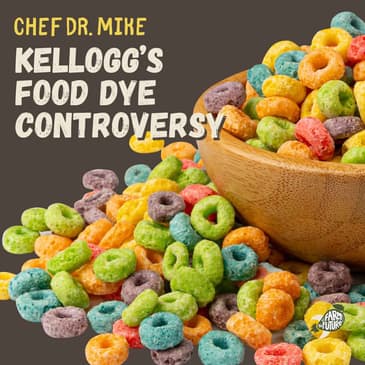
- Making sense of the recent Kellogg's food dye petition and what it means for ultra-processed foods
- Research showing how ultra-processed foods affect weight gain regardless of macronutrients
- How chewing food impacts GLP-1 production
- Why replacing artificial ingredients with natural ones may not solve core issues
- The complex relationship between food manufacturers, pharmaceutical companies, and healthcare systems
- The importance of the "food matrix" and processing methods beyond ingredients
About Chef Dr. Mike:
Chef Dr. Mike is a cardiologist turned culinary medicine expert who combines his medical expertise with a deep understanding of food science and cooking. He teaches healthcare providers and the public about the connections between food, health, and medicine through his work with culinary medicine programs and his weekly column at the Center for Food is Medicine.
Links & Resources:
- Gluten-free artisan bread recipe 😋
- Kevin Hall's NIH research on ultra-processed foods and weight gain
- Japanese study on chewing and GLP-1 production
- Recent article on why nutrients don't tell the full story
Join me at the THRIVE Global Impact Summit on November 7 in Santa Clara: https://bit.ly/GlobalImpactSummit24
Connect with Chef Dr. Mike:
Discounts
- Get 10% off delicious local farm-fresh food delivered to your door with my link for FarmMatch: https://farmmatch.com/jane
- Get 15% off high-quality Italian olive oil with code FARMTOFUTURE: https://shop.vignolifood.com/FARMTOFUTURE
- Get 40% the CircleDNA’s Premium DNA test with code JANEZHANG: https://circledna.com/premium
Connect with Jane Z.
- Instagram: @farm.to.future
- Email: jane@farmtofuture.co
- Website: farmtofuture.co
[00:00:00] Are we even doing the right thing by focusing on Froot Loops? I don't think that's the food that we want to promote here, right?
[00:00:06] Yeah, I agree with you 100%. People want to pick this one ingredient. It makes it black and white when we have a bad guy.
[00:00:13] And you think about it, that's what we've done. It's saturated fat. It's cholesterol.
[00:00:17] Oh, if we get rid of this one bad guy, unicorns will arrive and there will be world peace and so on and so forth.
[00:00:25] And it's just not that simple.
[00:00:28] I'm Jane Z and this is Farm to Future, the podcast all about eating better for the planet.
[00:00:35] This past week, you might have seen the viral news about food influencers like Food Babe and Dr. Will Cole delivering a petition with over 400,000 signatures to Kellogg's headquarters.
[00:00:48] And this petition was about replacing the artificial food dyes in Froot Loops cereal.
[00:00:53] The story has sparked heated debates about food additives and comparing ingredients between the U.S. and countries like Canada and Australia.
[00:01:02] But like with most viral headlines, there is more to the story.
[00:01:05] Chef Dr. Mike is back on the show to help us understand the deeper science behind ultra-processed foods,
[00:01:11] going beyond just ingredients to look at how food processing itself affects our health.
[00:01:16] He explains how everything from the way we chew our food to the physical structure of the ingredients impacts our body's response.
[00:01:24] We talk about why focusing on single ingredients actually makes us miss the bigger picture and what the latest studies tell us about ultra-processed foods.
[00:01:33] Before we dive in, some exciting news.
[00:01:36] I'm going to be attending the Thrive Global Impact Summit in Santa Clara on November 7th.
[00:01:42] It's a gathering of leaders in the ag tech space.
[00:01:45] There's going to be some heavy hitters there, including Bayer, the parent company of Monsanto, Driscoll's Berries, and Microsoft.
[00:01:53] And I'm very curious how these big companies are thinking about regenerative agriculture.
[00:01:58] Now, I will be there.
[00:01:59] I would love to see some of you there.
[00:02:01] And this is a great opportunity to use up any conference or learning budget you have left for the year.
[00:02:06] Check out the registration link in the show notes.
[00:02:09] If you are new here, welcome, welcome.
[00:02:11] Be sure to subscribe on Spotify or Apple Podcasts or wherever you're listening.
[00:02:16] You can find me, Jane Z, on Instagram at farm.to.future.
[00:02:21] All right, let's dive in.
[00:02:24] Chef Dr. Mike, welcome back.
[00:02:26] Thank you, Jane.
[00:02:27] Great to be back with you.
[00:02:28] I think this is our first fall episode.
[00:02:30] And we were just chatting about how you guys in Montana are just getting air now after the wildfires,
[00:02:37] which I'm sure you're very glad about.
[00:02:39] Breathing is nice.
[00:02:41] Breathing is nice.
[00:02:44] Yeah, here in Boston, things are just starting to cool down and we're starting to see the leaves change.
[00:02:50] It is a bit of a later fall this year.
[00:02:53] But, you know, with every year and climate change, things are getting wonky.
[00:02:57] So you never know what to expect.
[00:02:58] That's true.
[00:02:59] You know, nature keeps us guessing.
[00:03:01] And I kind of love the variability of the seasons.
[00:03:04] You know, all of us coming from a tribe somewhere, all of us had some degrees of seasonality.
[00:03:10] I mean, often we think, well, down at the equator, the tropics.
[00:03:13] And I lived in Florida for a while.
[00:03:15] It doesn't really change.
[00:03:16] But it actually does.
[00:03:17] I mean, it may be more like a rainy or wetter season and then a little bit drier, etc.
[00:03:23] I've been fortunate enough to go to the Caribbean a bit.
[00:03:27] And I can tell you, going there in the summer, even though the temperatures are roughly the same, it's very different because the winds shift.
[00:03:35] And, you know, that would really affect the weather.
[00:03:38] And sort of whether it was very cool and pleasant and you were enjoying it or whether, you know, it was very still.
[00:03:43] And you were kind of sweating in the doldrums waiting for any miniature lick, as it were.
[00:03:48] So I think if we work, we can always find some aspect of seasonality to embrace.
[00:03:54] And for me, that can be reflected at the kitchen table.
[00:03:58] Oh, absolutely.
[00:03:59] I've been leaning heavily into soups and teas and warm liquids lately.
[00:04:04] And this is not seasonal, but I think you'll be proud.
[00:04:07] I started making my own bread a few months ago.
[00:04:09] I found this gluten-free artisan bread recipe online.
[00:04:14] And it uses this flour blend that's from Italy.
[00:04:17] It's great.
[00:04:19] It's not officially sourdough, although I am thinking about maybe making my own sourdough starter.
[00:04:25] But it just makes this like wonderful loaf of bread that tastes like real glutenous bread.
[00:04:30] So I was very happy about that one to share.
[00:04:33] I definitely recommend sourdough.
[00:04:35] A lot of sourdough actually is, by the government labeling standards, gluten-free.
[00:04:40] Because what happens is as that bread ferments, the bacteria break down the gluten.
[00:04:47] And historically, if you go back again sort of to ancient Greece talking about these fermented bread, sourdoughs, etc.,
[00:04:53] they were often recommended for the elderly, the infirm or ill, and very young children.
[00:05:00] Gluten-free by government standards is not actually 100% gluten-free, as you would think.
[00:05:06] It's only so many parts per million or billion.
[00:05:09] But as you let a sourdough ferment, the longer it ferments, the more it breaks down the gluten.
[00:05:15] So I always do a sourdough pizza.
[00:05:18] But if you were to let it go more than about 72 hours of fermentation using my sourdough mother,
[00:05:25] it gets to where you can't even make pizza out of it because it doesn't have any structure.
[00:05:29] Because so much of the gluten has broken down.
[00:05:31] What kind of texture does that turn into?
[00:05:33] It just kind of rips very easily. It's very soft.
[00:05:37] I can use it for some other things.
[00:05:39] But to stretch a pizza dough, you need a little bit of that elasticity,
[00:05:43] be able to put some tension on the dough without it just shredding apart.
[00:05:47] And that's sort of what happens if the sourdough is let to ferment too long.
[00:05:52] You can see that because when I feed the sourdough, you put this fresh blob of dough in.
[00:05:57] You come back in a week and it's completely broken down into this sourdough mother that's just this sort of gooey, gelatinous mess.
[00:06:04] So there's always a little bit of balancing between the early sourdough that doesn't have a whole lot of sourdough character.
[00:06:11] And you want to get that sourdough flavor.
[00:06:14] And again, you know, break down some of that gluten so it's more digestible.
[00:06:18] I'd say almost all the breads and things that I make are sourdough.
[00:06:23] And I don't think it's the gluten.
[00:06:25] We've talked about this before, but I really think it's all the other additives.
[00:06:29] But I just generally stay away from all that commercial because I don't like get sick and have to go to the hospital or anything.
[00:06:34] But I don't feel good after I eat it.
[00:06:36] Yeah.
[00:06:37] The commercial stuff.
[00:06:38] Yeah.
[00:06:39] No, same here.
[00:06:40] And I know we've talked about European bread versus American bread.
[00:06:44] I'm able to eat like most things in Italy and France and feel just fine and come back here and it's a disaster.
[00:06:53] You know, we just talk about taking two days or so to ferment, even when I'm just making a sourdough boulet.
[00:06:59] It's sort of a three-day process.
[00:07:00] I do a pre-ferment with my sourdough the night before, kind of get that activated.
[00:07:05] And then it ferments for a good 36 hours before it goes in the oven, sometimes 48 hours.
[00:07:11] And if you look at a commercial loaf, I was talking one time to, we were talking about pizza and he ran one of the franchises for a chain.
[00:07:20] I won't name which one so we don't get in trouble.
[00:07:22] But he said it's two hours from when he starts to make a dough to a finished pizza.
[00:07:27] And they achieve that by loading the dough with sugar, which yeast break down, and then pumping it full of a lot of yeast.
[00:07:36] And it, you know, just goes through.
[00:07:37] And so it's just sort of this explosion of yeast to proof the dough in a very rapid time.
[00:07:43] I mean, that's just two hours from start to finish.
[00:07:46] And so you get an idea that that's, you know, definitely not the bread that we're talking about.
[00:07:51] You know, we knead it or we put it in our stand mixers and knead it.
[00:07:56] But a lot of the artisanal bread, if you really go back to how they made it, particularly before sort of these big commercial bakeries and industry, people didn't knead, you know, 100 loaves a day.
[00:08:07] I mean, you just as a baker, you physically couldn't do that.
[00:08:10] You know, it was a lot of sort of what people do with these no-kneed breads where you let the bread in.
[00:08:16] And it's just smart, right?
[00:08:17] If you're a baker, let the bread do the work.
[00:08:19] Let the yeast do the work.
[00:08:21] So you turn it a couple of times within an hour or two, then just let it ferment and then, you know, bake it up.
[00:08:27] And you let the sourdough, the yeast, the bacteria do all the work.
[00:08:30] And it turns out you get, in my opinion, something that's much more healthful for us in terms of digestion and the kind of products that are in that bread.
[00:08:40] I think you point out a really key difference between the two processes, which is time and like how much time you let it ferment.
[00:08:48] But also it's a bit like having a pet, right?
[00:08:51] I've heard you kind of have to feed the mother.
[00:08:54] Is it every day that you feed it?
[00:08:56] No.
[00:08:57] Well, mine's over a decade old.
[00:08:59] My mother.
[00:08:59] So I've had it for quite a while.
[00:09:02] So what I do is I have two jars.
[00:09:04] So I have a backup.
[00:09:05] The original mother's over a decade old.
[00:09:07] The other one's probably about six years.
[00:09:08] I was like, well, you know, if anything goes wrong, I don't want to lose it.
[00:09:11] So I have two jars in the back and I just put them in the back of the fridge and then feed them about once a week because it stays so cool back there.
[00:09:20] When I'm going to use it and I need to rev it up to make a pizza dough or something or bread dough, I'll take that out.
[00:09:28] And then I'll let it pre-ferment the night before.
[00:09:31] So I'll take out, say, 100 grams of mother, mix that with 50 grams of water, 50 grams of flour, depending on what I'm making.
[00:09:39] And then I let that come up to room temperature overnight.
[00:09:43] And then the next day I have a really ready, active pre-ferment that will start working on the dough right away.
[00:09:51] One of my latest obsessions is watching YouTube videos of people bake at bakeries.
[00:09:57] And I found this woman who runs a micro bakery out of her home where she bakes sourdough loaves for people in her neighborhood.
[00:10:04] But, you know, she runs a little business and she's got the set weekly schedule where I think it's Wednesday is our dough day where she makes all the dough.
[00:10:14] And then Thursday is bake day and Friday is delivery day.
[00:10:17] And it's really satisfying to watch this whole process.
[00:10:20] But it really is quite the timing is like so, so particular.
[00:10:25] She's up at like 3 or 4 a.m. getting these into the oven to make sure they're fresh and ready for customers.
[00:10:31] Yeah.
[00:10:31] As we were saying, I want to have the pizza dough on Friday.
[00:10:35] I need to start on a Wednesday.
[00:10:37] And if I'm baking boulet for Sunday, then I need to start so many days ahead.
[00:10:43] We plan a lot of other things in our lives, but when it comes to our food, so often we're dependent on the convenience factors.
[00:10:51] If you take a little time to plan, it can make a huge difference.
[00:10:54] And it's also really great because it's a stress reliever, right?
[00:10:58] You're not like, oh, what am I going to do tonight for dinner?
[00:11:00] Oh, God, I hate this.
[00:11:02] We've got so much stress in our lives.
[00:11:03] If you just sit down and think about what I'm going to do on the weekend, sometimes you can make some food on a Saturday and Sunday, make a little extra this, a little extra that.
[00:11:12] And then you've got meals for the rest of the week.
[00:11:15] You and I were talking about some of the articles to look at.
[00:11:18] For the viewers out there, I do a weekly column called Study Spotlight on the Center for Food as Medicine dot org.
[00:11:24] And this week's article kind of gets into that.
[00:11:27] It really looked at this very interesting study.
[00:11:30] So the background is, I believe it was 2019, published in 2020.
[00:11:35] Kevin Hall, Professor Dr. Kevin Hall from the NIH, did a really groundbreaking study.
[00:11:40] And he took about 20 people and he put them on a diet that was all ultra processed food.
[00:11:47] So it was 100 percent, you know, like Cheerios and Chef Boyardee, ravioli in a can, all that stuff.
[00:11:53] And they ate that for a week and they did a bunch of measurements, including weight, etc.
[00:11:57] And then they had a washout period.
[00:11:59] And then they went back and they ate a diet that was essentially matched for calories, but not just calories, but for macronutrients.
[00:12:06] So the amount of protein that was being offered in each meal was the same.
[00:12:10] The only difference really was the level of processing in the food.
[00:12:14] And one of the things they found was that when people ate ultra processed food for a week, they gained a kilo, which is about 2.2 pounds.
[00:12:22] And then when they got away from the ultra processed food and went on the non ultra processed food, they lost weight.
[00:12:28] They lost about a kilo, which was very interesting.
[00:12:31] And right now he's doing a huge study with hundreds of people based on that pilot study they did.
[00:12:38] This study that I looked at this week came out of Japan.
[00:12:42] And the first caveat is it was only nine people.
[00:12:45] So it's a small study and it was all Japanese men.
[00:12:49] So, again, the applicability would know.
[00:12:51] But what I found fascinating was that they did the same thing.
[00:12:54] They put them on a week of ultra processed food, two week washout, then a week of a diet with non ultra processed food.
[00:13:01] But everything was matched.
[00:13:02] So it was like, you know, I think 20, maybe 15 percent protein, 20 something percent carbs, so much fat.
[00:13:09] And those were matched.
[00:13:11] And they got exactly the same result.
[00:13:13] When they ate ultra processed food, they gained about a kilo.
[00:13:16] When they didn't, they lost about a kilo.
[00:13:18] One of the interesting things was they also looked at how much you chew your food.
[00:13:23] Now, when we look at how much we eat, chewing and particularly, believe it or not, the sound of us eating, the auditory feedback of us chewing, as well as the sensation of chewing, impacts our satiety centers in our brain and starts telling us, oh, OK, we're eating.
[00:13:42] Let's now start to not be so hungry.
[00:13:45] And that's immediate feedback.
[00:13:47] And so the more you chew, the less you eat.
[00:13:51] In this study, there were some additional references that I looked up.
[00:13:54] And I was unaware that they had done a number of studies.
[00:13:59] And these were, again, done in, I think, Japan and Asia, where they looked at chewing your food 15 times versus chewing your food 40 times or more.
[00:14:09] 40 times.
[00:14:10] What was fascinating is there was a statistically significant difference in your body secretion of GLP-1.
[00:14:19] Now, for those of people who don't know, you've heard of GLP-1.
[00:14:23] If you turn on your TV at all and see the incessant commercials for Ozempic and Wagovi and all those kind of medications, what they do is they mimic the effects of GLP-1.
[00:14:35] So what's really fascinating, there's a way to increase your body's own secretion instead of relying on a pill with all the side effects.
[00:14:46] And there are significant side effects that we're seeing with these medications simply by chewing your food more.
[00:14:54] In essence, eating more slowly, being more mindful of your food.
[00:14:57] And I thought that was kind of a fascinating real-world application, given how often we just kind of eat really fast and we don't chew our food.
[00:15:08] And ultra-processed food is specifically manufactured to make you chew less.
[00:15:13] So the bread is much softer.
[00:15:15] Yeah.
[00:15:16] And sorry, GLP-1, can you just walk us through a quick explanation?
[00:15:20] Sure. So it's basically an insulin kind of related peptide hormone that our body secretes when we eat to help us digest and maintain our blood sugar, etc.
[00:15:32] And so the medications, Wagovi and Ozempic, mimic the effects of that hormone.
[00:15:40] Because when people get type 2 diabetes, their body doesn't respond to insulin and those types of hormones in the right way.
[00:15:48] It becomes kind of immune to the effects.
[00:15:52] You can think of it sort of like, you know, if you get like 100 tweets or 100 emails, you just sort of start to ignore them.
[00:15:59] And that's what happens is because your body's secreting all this insulin and things all the time.
[00:16:05] There becomes a downregulation.
[00:16:07] Your body's sort of like, yeah, not insulin again.
[00:16:09] I'm busy right now.
[00:16:10] And so you become what we call insulin resistance.
[00:16:13] And those effects are what we see when people have type 2 diabetes, which is over 90% of all the cases of diabetes that we have in the country.
[00:16:22] It's exactly the opposite of type 1 diabetes.
[00:16:25] And that's usually juvenile onset, young adult onset, where somebody's pancreas actually doesn't make enough insulin.
[00:16:33] So one form of diabetes is a deficit.
[00:16:35] So your body's saying, hey, where's that insulin?
[00:16:37] We need some insulin.
[00:16:39] The other is where your body makes so much insulin all the time because of all these different effects that the receptors are like, yeah, insulin, whatever.
[00:16:48] I'll get back to you.
[00:16:49] And so you sort of start ignoring it.
[00:16:52] And so what happens is to overcome that effect, that downregulation of receptors, et cetera, you need to sort of even amp it up even more to be heard.
[00:17:04] So that's kind of the difference there.
[00:17:07] One of the insights for me in the study is that how we eat really impacts.
[00:17:13] And this was a measure.
[00:17:14] You know, this was a very important measure showing how we eat affects how our body responds and how our hormone responds.
[00:17:21] So, for example, doing those what we call MB Eats or mindfulness-based eating awareness techniques, doing those gratitude exercises where you're chewing very slowly and trying to appreciate.
[00:17:33] You know, people say, well, you know, is that just hooey?
[00:17:35] Is it just in your head?
[00:17:36] Is there anything?
[00:17:37] You know, some people are very adamant about, you know, I've got to see something, the hard science.
[00:17:43] And so here's a piece of hard science for you.
[00:17:45] And I think I listed that in the references on that article where measurable levels of very important hormones that are the difference between not having diabetes and having diabetes can be measured and affected by how we eat.
[00:18:01] And so, you know, I thought that was a very important, if subtle, takeaway.
[00:18:06] Yeah.
[00:18:07] If you chew 40 times, you can avoid taking Ozempic.
[00:18:11] Exactly.
[00:18:12] And whether 30 times works or 25 times, you know, how many times it is, I don't know.
[00:18:17] But so often in my world, talking with healthcare providers, all they care about is what's the percent fat, how much protein, how much level of this nutrient, and ignore everything else.
[00:18:30] Which, again, sort of misses what I think are the important points.
[00:18:34] When we focus on nutrients, we sort of think that's the end all because that's what we know.
[00:18:40] But we don't know what we don't know.
[00:18:42] And that's a big problem because if you look at a clove of garlic, you know, there's a handful of nutrients in there.
[00:18:50] But there's about 5,000 compounds.
[00:18:51] So one of our points that we emphasize in our culinary medicine approach to food and health is that we have to understand that these nutrients work in combination.
[00:19:02] You know, some things may inhibit the absorption of other things.
[00:19:06] Some things work synergistically together for completely different effects.
[00:19:10] My favorite example is if I were to say to you, no more wine.
[00:19:16] And you would say, oh, Mike doesn't want any more wine.
[00:19:19] Don't pour him another glass.
[00:19:20] But if I were to add a piece of punctuation and put a comment there and I said, no, more wine.
[00:19:27] It's exactly the opposite.
[00:19:29] Right.
[00:19:29] So that punctuation changes the information and how we receive that information and decode it and then subsequent actions.
[00:19:39] What we're finding is, you know, food does that, too, because every piece of food has lots of different combinations that don't work in isolation.
[00:19:49] One of the problems with our current method of analysis is we look at a nutrient and we try to look at a singular effect.
[00:19:56] That's looking like looking at the word no and more.
[00:20:00] They're two different things.
[00:20:02] But when we put them together and then even if it can mean something different, we add a piece of punctuation to it.
[00:20:08] And so that's information, you know, and that's what our body is receiving to give you an idea of how vast those combinations are in the foods we eat.
[00:20:19] I'll give you my chess analogy.
[00:20:22] So chess has 32 pieces.
[00:20:24] So you can imagine a food or meal with 32 different nutrients.
[00:20:30] It's not that hard, right?
[00:20:31] There's vitamin A in a carrot and then there's this piece of this fiber and so on and so forth.
[00:20:36] Just make it a simple discussion and say this meal that we're having, this sandwich and a side salad has 32 ingredients.
[00:20:45] Well, how many possible combinations are there?
[00:20:48] Well, Claude Shannon, many years ago, who was sort of the founder of modern information theory, actually examined this.
[00:20:56] It turns out that there are 10 to the 120 possible combinations, essentially games of chess that you can have.
[00:21:06] That number is so big.
[00:21:08] That is more than all the atoms in the universe.
[00:21:11] So to say that we can, you know, predict or really understand what's going on when we eat a meal is to say we have a little bit of knowledge.
[00:21:22] But boy, that iceberg is really pretty big under the surface.
[00:21:26] And I think we really need to start looking at it in different ways and looking at all those other things, too, that impact how we process information.
[00:21:36] Right.
[00:21:37] You know, I gave you the punctuation example when I said no more wine and then no common wine.
[00:21:42] But there was also the tone.
[00:21:44] Right.
[00:21:45] So if I just wrote it, maybe you'd get it, maybe you wouldn't.
[00:21:49] But when I say it and I give you the tonal information, that adds a whole nother layer for you to then decode and apply, you know, insight into the message and then do the appropriate thing that with that information, which would be filling my wine glass with more wine.
[00:22:07] Chef Dr. Mike wants more wine.
[00:22:10] That's pretty much a given most of the time.
[00:22:13] I'm curious in your work as a doctor in cardiology, how much are you able to have that conversation with patients to let's say a patient comes to you with diabetes?
[00:22:23] Is your job to prescribe them a medication?
[00:22:27] Do you have space to have that conversation around diet?
[00:22:31] And are you eating minimally processed foods, that sort of thing?
[00:22:35] So really, unfortunately, and you bring up a great question.
[00:22:39] I've become involved in working with a not for profit called Patients First, which is all about literally putting the patient first and putting them in control of not just their health, but their health care, their health care information, which I really think we need.
[00:22:56] And I had a conversation with the founder of the non for profit and really opened my eyes to something because we talk about health care.
[00:23:05] And I consider or did consider myself for most of my adult life, a health care provider.
[00:23:11] And, you know, I had to come to the realization, Jane, that I was deluding myself.
[00:23:16] That's not true.
[00:23:18] I don't provide health.
[00:23:19] I manage disease.
[00:23:21] And that's what our current, quote, health care systems about.
[00:23:26] Because when we sat down and the founder of the not for profit and I had a long discussion, he really opened my eyes.
[00:23:35] And, you know, there's no financial reward for keeping people well and make it keeping them healthy.
[00:23:42] It's we all want to be healthy.
[00:23:43] Right.
[00:23:44] But there is not an industry out there that really supports that in a meaningful way.
[00:23:50] The money, the big money is all about in managing a disease and managing a chronic disease so that I have a repeat customer.
[00:24:03] And so I would argue that our whole paradigm and this gets to how I would deal with the patient and then how that whole team is and nurses and dietitians and stuff interact with patients.
[00:24:19] And we've got it backwards somewhere along the line.
[00:24:22] I don't know where it is.
[00:24:23] I only figured this out last weekend, you know, talking and I've been in health care for decades.
[00:24:29] So and it's you know, this is just my opinion.
[00:24:32] But it was really a wake up call to me because we sat down and I was like, well, here's why, you know, the insurance companies, you know, blah, blah, blah.
[00:24:42] And hospitals, they make money from this.
[00:24:44] And physicians are encouraged to do this and blah, blah, blah.
[00:24:47] And a pharma gets gets involved here.
[00:24:50] And I was like, OK, well, where's the people that make money from from people being healthy?
[00:24:56] Right.
[00:24:57] And deliver health.
[00:25:00] And there is not.
[00:25:01] There's no industry that delivers health.
[00:25:05] And what was really interesting is I told him because in my experience, the only model where I've ever seen that practiced was in ancient China where physicians were paid on a regular basis to keep their patients healthy.
[00:25:21] And when you got sick, you didn't pay your doctor anymore because he didn't do his job.
[00:25:24] And so the doctor was motivated to keep you well because that was the source of income.
[00:25:31] It's sort of the opposite of our current, you know, U.S. model where I get paid when you get sick.
[00:25:38] If you're healthy and I don't see you, I don't really make any money.
[00:25:41] Sorry to be so blunt, but that's an economic driver that affects a lot of things because we're going through it.
[00:25:48] And I was walking him through kind of a systems analysis and complex systems analysis is how we approach the food health equation.
[00:25:55] But you can apply that to anything.
[00:25:57] And where this really goes in terms of diet has to do with a paper.
[00:26:01] I wrote an article for Healthy You, which was kind of looking at nutrientism and the effects of global ultra processed food manufacturers and how they kind of work their way into.
[00:26:14] So, you know, there was a lot of concern because somebody, for example, as a researcher may get funded by a not-for-profit.
[00:26:25] But it turns out that that not-for-profit gets funding from a maker of ultra processed food.
[00:26:31] And that ultra processed food maker then sits on the board of the not-for-profit and decides where that money is going to go.
[00:26:38] And, you know, what they're going to support and what they don't.
[00:26:40] And this actually extends to not just for NGOs or non-governmental organizations, but actually some governmental organizations.
[00:26:49] If you look, for example, that the FDA, a lot of its research is actually funded by industry, not from government dollars that are sort of unbiased.
[00:27:01] And what was really interesting is as I got in and looked at that, I started seeing that it was not just ultra processed food manufacturers that were on these boards, but pharmaceutical companies.
[00:27:13] Now, you may ask yourself, well, why are they involved in food related research, et cetera?
[00:27:20] And again, that has to do with looking at the system.
[00:27:25] So if I am a manufacturer of pharmaceuticals, what I need to continue selling my product is a supply of customers.
[00:27:36] You got to create the disease that you're solving.
[00:27:39] And ultra processed foods create the disease.
[00:27:41] That's exactly right.
[00:27:42] And so if you looked at it in terms of like a sink on top of a sink, so imagine two sinks.
[00:27:50] What fills the bottom sink is the overflow or the result of, for example, ultra processed foods.
[00:27:56] And I'm labeling the one, but there's a lot of other things as well.
[00:27:59] I mean, we don't exercise as much as we should, et cetera.
[00:28:02] So I'm not saying ultra processed foods are the only thing, but it's a clear example because, for example, if we look at the magnitude of dollars involved and we take one fast food company, McDonald's, and we say, okay, McDonald's, based on your revenues, you're now a country.
[00:28:21] Where do you fit on the scale of countries?
[00:28:24] It would be about the hundredth largest economy in the world.
[00:28:28] If we look at a manufacturer, just one, of ultra processed foods like Nestle and did the same analysis and said, okay, if Nestle was a country, where would it be?
[00:28:39] It would be about the 60th largest economy in the world.
[00:28:44] Now let's imagine McDonald's and Nestle and all these other companies coming together, which is what they do.
[00:28:51] There's a consortium.
[00:28:52] And then saying, we're going to invest and spend our dollars here to promote these outcomes.
[00:28:57] That's pretty powerful when you talk about the resources at their disposal.
[00:29:03] That's a lot of money that they're generating.
[00:29:06] You understand that it makes sense for them to look at things like this and say, well, maybe we don't really want to talk about ultra processed foods.
[00:29:13] Or maybe we don't really want to talk about these emulsifiers.
[00:29:16] Whatever it is, they have their hand in it.
[00:29:19] And I'll send you the link to that article so you can put it up.
[00:29:22] And it kind of goes through that.
[00:29:23] And it actually is, in my opinion, it was a great paper done by, and I'm forgetting his name, Peter or somebody.
[00:29:30] But he's referenced in the article so people can read it themselves.
[00:29:33] And he kind of shows this interconnected web because he's plotted all these things.
[00:29:38] And you can see this just huge impact of both ultra processed food manufacturers and pharma manufacturers involved in sort of making the recommendations and where the research dollars go and shaping, in essence, shaping the conversation that we have about food and health.
[00:30:00] And I don't know that we can make meaningful changes until we really start to change the system and start to reward people, both individuals who maintain good health, which is what we all want, and the people who reward people for working and keeping people healthy instead of just managing disease.
[00:30:20] Because one of the reasons I got into what I was doing was, you know, I got tired of just putting stents in people and having them come back, you know, six months later needing another stent.
[00:30:32] I felt like I was doing nothing but changing tires on the side of the road and then sending people out.
[00:30:38] And the road was covered in broken glass and nails.
[00:30:41] And nobody was telling them, you know, watch where you drive.
[00:30:44] It's like, oh, I got a flat tire.
[00:30:45] Come back and see Mike.
[00:30:46] He'll change my tire.
[00:30:47] And, you know, it's I know, you know, we're not going to change the system overnight.
[00:30:54] But I think the first part of that is having a conversation about it.
[00:30:58] And I am encouraged that it seems, you know, finally into the political sphere, people on both sides of the aisle are at least starting to talk about it.
[00:31:09] We made great progress against big tobacco.
[00:31:11] And there was a time where it seemed like these were behemoths of industry and had so much money.
[00:31:17] And you were never going to get anywhere trying to move against Joe Camel and all his friends.
[00:31:23] But we did make headway.
[00:31:25] So I think it is a discussion, certainly making people aware of it.
[00:31:30] But don't take my word for it.
[00:31:31] Do the research, read the articles yourself.
[00:31:34] That's what you're going to find.
[00:31:36] So that was terribly long winded.
[00:31:38] But it does get to the heart of what you ask, which is I don't have time to sit down and give people lifestyle advice as a cardiologist.
[00:31:46] You know, I was just reading physician burnout.
[00:31:49] You know, physicians, when they're in the office, they got to see 20, 30 patients a day.
[00:31:53] That gives me five, 10 minutes with you.
[00:31:56] You get another five or 10 minutes with a nurse.
[00:31:58] That's it.
[00:31:59] There's nobody there to really guide you to health and help you stay healthy.
[00:32:06] And that's what we all want.
[00:32:07] That's what I say.
[00:32:08] And the problem is at the other end, there's no mechanism to pay people to do that.
[00:32:14] And yet that's really what we need.
[00:32:15] I do see a lot of that happening in the private sphere with like nutritionists and RDs and health coaches and things like that.
[00:32:23] But here's the problem I have with that, Jane,
[00:32:26] is that these people are getting their sort of mainstream information, if you will, right,
[00:32:32] that's being driven in the background by people who want them to focus on certain things,
[00:32:37] which is why we still see people counting calories.
[00:32:40] We still see people arguing over percent protein and carbs, this or that.
[00:32:45] And not, in my opinion, having a meaningful conversation about, you know, really what we eat and how we eat.
[00:32:54] And, you know, these sorts of things that we just talked about.
[00:32:58] People say, well, don't eat bread.
[00:32:59] Well, you and I just spent 15 minutes talking about that bread's not bread.
[00:33:04] And it can be this bread or that bread.
[00:33:05] And then it starts to get too complicated.
[00:33:08] And, you know, we like these uniform guidelines, which unfortunately don't apply to individuals.
[00:33:16] I mean, that's that is what's called an ecological fallacy.
[00:33:20] So it's it's a product of statistics where we can look at, you know, all these people in a big group,
[00:33:28] all the people who drive Lamborghinis versus all the people who drive a Prius.
[00:33:33] Statistically speaking, people who drive Lamborghinis are going to more likely to get a speeding ticket.
[00:33:37] And that's a fact.
[00:33:38] That's true.
[00:33:39] But when you look at the individual, it depends on those individual characteristics,
[00:33:45] much more so than whether they have a Prius or a Lamborghini.
[00:33:48] And so what holds true for populations and large numbers breaks down in individual application.
[00:33:57] And we never, you know, in medicine, we're all about the algorithms, follow this or that.
[00:34:03] And in essence, we do want to do that.
[00:34:05] We want to apply those best practices.
[00:34:08] But what people forget is that within those algorithms and best practices for the masses,
[00:34:14] you have to personalize the delivery.
[00:34:16] What I see are people, maybe they have the best of intentions,
[00:34:21] but they're just grabbing the latest guidelines and saying, this is what you need to follow.
[00:34:25] And a great story that I was told was by a pediatrician who made his son.
[00:34:31] They went out on his list.
[00:34:32] I was like, I don't like salads.
[00:34:34] I don't like green things.
[00:34:35] I want to eat.
[00:34:35] He's like, those are good for you.
[00:34:36] You're going to eat those.
[00:34:37] Gosh, darn it.
[00:34:38] And his kid got sick.
[00:34:39] It turns out his kid has a food allergy to something in lettuce.
[00:34:43] Oh, no.
[00:34:44] So for him, the greens were really good.
[00:34:45] He made them eat it.
[00:34:46] And he said he learned an important lesson.
[00:34:48] There with the best of intentions, based on all the data that he had, was dad, the pediatrician,
[00:34:54] making his son eat the lettuce because it's green and it's good for you,
[00:34:58] when it wasn't the best thing for him.
[00:35:00] So, you know, to take the time to personalize that, these people who are putting the guidelines in,
[00:35:08] right, they have to see so many clients a day because the way the re if they can get reimbursed,
[00:35:13] the way it works, other than really paying out of pocket to have somebody do that for you.
[00:35:18] And, you know, that's stars and athletes.
[00:35:20] And not all of us have those kind of budgets.
[00:35:22] I've been thinking a lot lately about the role of big food.
[00:35:26] Because companies like McDonald's and Nestle, they're not going away anytime soon, unfortunately, for most of us.
[00:35:33] But did you see the whole news about there was a bunch of food influencers,
[00:35:37] Vani from Food Babe, Dr. Will Cole,
[00:35:39] and they delivered this big petition of signatures to Kellogg's this week about the food dyes in their cereal.
[00:35:46] I know there's a little bit of like, I don't know if misinformation is too strong,
[00:35:51] but there was a bit of like misleading content where they were comparing the ingredients in the Fruit Loop cereal boxes
[00:35:59] between the US and Canada, where in Canada, they use all these natural flavors.
[00:36:04] It's a little more nuanced than that if you dig into the actual numbers of what's allowed.
[00:36:09] But the other point that Unbiased Science podcast pointed out that when it comes to replacing ingredients,
[00:36:15] there's a lot of trade-offs that you have to make.
[00:36:19] Maybe taking out some of these colorings, and if you replace it with like beetroot juice, great,
[00:36:24] but someone might have an allergy to that.
[00:36:26] And if you take out some of these preservatives...
[00:36:28] Yeah, and it's missing one of the basic issues that goes back to that sentence that we talked about,
[00:36:34] the information, right?
[00:36:35] And so when you ultra-process food, by definition, you're destroying the natural food matrix.
[00:36:41] That's how we add things and we take them and take them out.
[00:36:44] So even by putting a natural additive, so-called, in there,
[00:36:50] though, again, we could have a whole show on how natural additives are
[00:36:54] and how they're recognized by the government as natural doesn't mean that they're good for you.
[00:36:59] Like carrageene, right?
[00:37:00] That's a natural product.
[00:37:02] It comes from seaweed.
[00:37:04] But when you extract it and you use it in high doses as an emulsifier,
[00:37:08] it destroys your gut bacteria.
[00:37:10] But it's natural because it's found in carrageene seaweed.
[00:37:13] When you eat it in the seaweed, it's a very different form.
[00:37:17] The Irish have been using it for thousands of years.
[00:37:20] But that extract, even though it's natural, doesn't mean that it doesn't have a negative effect.
[00:37:27] So we have to understand that when we ultra-process food and subject it to some of these mechanisms,
[00:37:34] what we are doing is destroying that natural food matrix.
[00:37:38] So basically, no more wine, which is our sentence of the day,
[00:37:43] or no comma more wine, whichever one you like.
[00:37:46] Now imagine what we're doing is we're taking those words apart.
[00:37:50] When we ultra-process them, maybe we're even taking the letters apart.
[00:37:53] So now it's a game of Scrabble.
[00:37:55] And we put them back together.
[00:37:57] So it's all the same letters.
[00:37:58] But it could be a completely different message.
[00:38:01] And to give you an example, again, this research was done in Italy, of course.
[00:38:06] They looked at two types of cheeses made from buffalo milk.
[00:38:09] Buffalo milk ricotta and buffalo milk mozzarella.
[00:38:12] They took exactly the same buffalo milk.
[00:38:15] And you make them slightly differently.
[00:38:18] Like mozzarella involves pulling and stretching.
[00:38:21] And you actually align those cheese molecules up, which is why when you bite pizza, it's like stretchy and gooey.
[00:38:27] And that doesn't happen when you bite into ricotta.
[00:38:30] But if you looked at the ingredient label, exactly the same.
[00:38:34] Okay, exactly the same.
[00:38:35] Very different physiologic responses.
[00:38:39] The response in terms of the secretion of satiety hormones, the timing that they were released,
[00:38:46] the signals that were a result of eating those two cheeses was completely different.
[00:38:51] You can make pasta and make it exactly the same.
[00:38:55] And if you make it very thick versus very thin, your body will respond differently.
[00:39:00] But on a label, it's exactly the same.
[00:39:02] So just having that grab bag of, you know, Scrabble letters doesn't mean that it's the same, you know, sentence or the same word every time.
[00:39:12] And that's the challenge that we have.
[00:39:15] And, you know, I think Albert Einstein, to paraphrase a lecture he gave, nature makes things as simple as possible, but no simpler.
[00:39:24] We often think about, oh, science, we're overcomplicating things.
[00:39:28] But in reality, and I can tell you this from medicine, watching, you know, all we have to do is inhibit platelets and people won't have heart attacks anymore.
[00:39:36] Well, it turns out it's a little bit more complicated than just making platelets stupid so they don't clump together and form a clot.
[00:39:43] A lot of other things happen.
[00:39:45] And it's the same thing here.
[00:39:46] You know, we sort of assume we're brilliant and we have the answer.
[00:39:51] And in fact, what we're doing is oversimplifying the problem.
[00:39:56] And I feel like we've been doing that for 50 or 75 years and not learned our lesson.
[00:40:01] And we really need to look at this in, I think, a much more sophisticated way.
[00:40:07] That's what we do in our course.
[00:40:09] And, you know, to give people a break, right, you know, we didn't really have some of the technologies to be able to do this until very recently in terms of the computer resources to do these kind of modeling things.
[00:40:21] Very, very complex and they're very hardware heavy, if you will, to do the crunching and the processing.
[00:40:28] But still, we have to start thinking about it differently because until we change our perspective and start looking at it slightly different, we'll just keep regurgitating the same old thing and eating the same regurgitated stuff, which does not get us anywhere we need to be.
[00:40:47] And that's what I feel is really happening.
[00:40:49] So, OK, well, we're going to take this dye out and replace it with a natural dye.
[00:40:53] But we haven't looked at how we've totally altered this natural food matrix and how that potentially plays into it, because this is a very important point you bring up.
[00:41:05] This is a response of these ultra processed food makers to ultra people who say, well, we need to cut back on ultra processed food.
[00:41:13] They say, OK, well, we'll just substitute out this artificial sweetener, this artificial flavor for a natural one.
[00:41:22] Now it's natural. So please go ahead and eat it.
[00:41:24] And that is their argument.
[00:41:26] But it's very important to realize that just ingredient substitution may not be the correct answer for the reasons we've discussed.
[00:41:35] It's not as simple as that for the reasons we've discussed.
[00:41:39] And we need to be wary because that is their reflex is like, OK, if you don't want it, then we'll make something that you want.
[00:41:46] But it's still going to be cheap. We're still going to mass produce it.
[00:41:49] We're still going to use lots of cheap ingredients so we can make a profit.
[00:41:52] And we want it to sit on the shelf longer than, you know, Keith Richards has been around because that increases our profitability.
[00:41:59] Right now, I hear your point, Mike.
[00:42:01] You know, the focus on individual ingredients is missing the bigger picture of how was this product actually produced and made and processed?
[00:42:10] This is like a meta comment, but are we even doing the right thing by focusing on Froot Loops?
[00:42:15] I don't think that's the like thing that the food that we want to promote here.
[00:42:19] Right. And I can empathize that this is an important movement in terms of trying to protect children and families who do eat cereal every day.
[00:42:28] But I feel like we're promoting the wrong products here.
[00:42:31] Yeah, I agree with you 100 percent.
[00:42:34] And I think that kind of goes back to the larger perspective we're talking about where people want to pick this one ingredient and say, this is the bad guy.
[00:42:43] That always makes it simple, right?
[00:42:45] It makes it black and white when we have a bad guy.
[00:42:47] So and you think about that's what we've done.
[00:42:49] It's saturated fat.
[00:42:50] It's cholesterol.
[00:42:52] Oh, if we get rid of this one bad guy, unicorns will arrive and there will be world peace and so on and so forth.
[00:43:00] And it's just not, as you said, it's just not that simple.
[00:43:05] Well, maybe it can be right if that silver bullet was get rid of ultra processed foods or avoid them as much as you can.
[00:43:12] Well, but you bring up a good point.
[00:43:14] And so the question with our modern society, you know, I think I do a pretty good job.
[00:43:19] Do I eat zero ultra processed foods?
[00:43:21] No.
[00:43:22] I mean, there's just times that you need it.
[00:43:24] But I think by being aware and we can use kind of the common sense rule that every so often, you know, I'll have an ice cream sundae.
[00:43:32] But it's probably about twice a year, maybe, you know, special occasion sort of stuff.
[00:43:38] If we kind of understand that and we can adapt, as you point out, we'll never get rid of them because you said you framed it perfectly, right?
[00:43:46] McDonald's isn't going away.
[00:43:48] These companies that have revenues bigger and larger than a majority of countries in the world, they're not going away.
[00:43:56] So we've got to find a way to maybe help shift their focus or some middle ground, make sure that we're informed.
[00:44:05] I think part of these movements that do things like support people growing real food locally that you get.
[00:44:12] You were talking about these artisanal bakers and things like that, where the food that you're getting and where it comes from, because every ingredient tells a story.
[00:44:21] One of the things that is reassuring about ultra processed food is that it's consistent, right?
[00:44:28] You're not going to get food poisoning.
[00:44:29] You know what it is.
[00:44:30] You walk into a McDonald's, you know what you're going to get and you know what tastes the same.
[00:44:35] The problem is for that to taste the same, that requires a consistent ingredient.
[00:44:42] That's not how nature packages food.
[00:44:44] You know, a bottle of wine from two different vineyards in California that are a hillside apart can taste completely differently.
[00:44:53] That's nature.
[00:44:55] So nature is all about this variability, a terroir as the French would say, that applies not only to wine, but to every ingredient, which is what chefs love.
[00:45:04] Because when I'm eating real food, I don't know how it's going to taste.
[00:45:07] I'll be familiar, but it may be a little different.
[00:45:10] Depends what the chef did.
[00:45:11] It's always an adventure.
[00:45:12] I mean, it's always new.
[00:45:14] And so there are a lot of people that don't want that, right?
[00:45:18] They want that consistency.
[00:45:20] They want that reliability.
[00:45:22] You know, a consistent food, you know, safe food requires that consistent ingredients, which is why, you know, if I make a McNugget at home or a facsimile from a nugget, it's like four ingredients.
[00:45:36] A commercial McNugget contains 40.
[00:45:39] So everything's controlled.
[00:45:41] And we have to ask ourselves, is that consistent safe food the best food?
[00:45:46] To me, it's not because it's not the most fun food.
[00:45:49] Real food is fun.
[00:45:51] As Anthony Bourdain said, you know, if I eat enough oysters, am I going to get sick?
[00:45:55] Yes.
[00:45:56] Is that going to stop me from eating oysters?
[00:45:57] No.
[00:45:59] Oh, yeah.
[00:46:00] You had an article recently, too, about temptation.
[00:46:03] Oh, yeah.
[00:46:05] It's like I can resist temptation, you know, all the time until I give into it.
[00:46:10] Until I give into it.
[00:46:12] Exactly.
[00:46:12] We're only human.
[00:46:14] And these big companies, they've got giant budgets for marketing and they've studied what makes people buy these things.
[00:46:22] And they're just going to keep doing that.
[00:46:24] Not only that, don't forget they're lobbying.
[00:46:27] Right.
[00:46:27] So, like, you know, we talk about drug manufacturers, pharma and device manufacturers, sort of the revolving door at the FDA that they have where, you know, I'll go in as an FDA official.
[00:46:40] Then I'll take a job in industry and I'll call my buddy who was in industry and now was appointed FDA.
[00:46:45] Same thing happens at the USDA.
[00:46:48] Exactly.
[00:46:48] So, and then there's all these powerful lobbies in there.
[00:46:52] So, the people who are writing the recommendations, our food recommendations come from the USDA, you know, and the HHS.
[00:46:59] And so, these are revolving doors with industry plus these powerful lobbies in there.
[00:47:04] As an individual, we can feel pretty powerless when you look at what you're up against.
[00:47:09] But the good thing is, what you can always remember is that as an individual, ultimately, you can decide what you're going to eat or what you're not for the moment.
[00:47:18] And so, you know, that's where the power is.
[00:47:21] Yeah, that's a powerful message.
[00:47:22] I think to the extent that you have the education and the time to do the right shopping, get the right foods and cook for yourself.
[00:47:31] I think that is ultimately the answer and the control that each of us has.
[00:47:36] And you bring up a great point, right?
[00:47:37] And this is where we need, you know, people who can help you, like, plan your food budget and, you know, deliver meals or help you make meals or help you make it cost effective.
[00:47:49] And those sorts of real life skills, right?
[00:47:52] Health skills to maintain your health.
[00:47:55] Those resources are hard to find.
[00:47:57] And you've got to pay with them out of your own pocket right now.
[00:48:00] And then, you know, the government and the insurance is happy to buy you drugs to take for the rest of your life with, you know, side effects.
[00:48:07] But they won't, you know, pay to help you prevent needing those drugs in the first place.
[00:48:11] That's incredibly frustrating to me.
[00:48:14] One thing I could tell you is universally patients don't want drugs.
[00:48:20] Very few people come in and are like, hey, doc, I just want to take some drugs today.
[00:48:24] But we've been conditioned to look for and accept a pill for every ill instead of saying, how can I solve this problem?
[00:48:35] Where is somebody to help me?
[00:48:36] Is there a resource that can show me how to get real food in my neighborhood on my budget?
[00:48:42] Single moms who have kids and kids have activities and they're working jobs.
[00:48:46] It's tough to then make homemade meals, etc.
[00:48:51] But there are solutions and we can find them.
[00:48:53] But, you know, we've got to work together on them and make that as a resource available.
[00:48:59] And that's sort of my mission, you know, for example, with Patient First, with the courses that I teach, you know, the things that we do and that we've developed.
[00:49:08] For example, BridgeMouse is those sorts of things.
[00:49:10] But, yeah, you know, it's going to take a whole paradigm shift for us to really come to grips with just, you know, how we look at solving the problem.
[00:49:22] Doing it the same way we've done it for 75 years where people are just getting fatter and sicker every day clearly isn't working.
[00:49:29] So can we stop doing that, please?
[00:49:31] That's sort of my first response.
[00:49:34] Like, you know, the dying of Froot Loops isn't the problem.
[00:49:38] Right.
[00:49:40] Yeah, it's everything else.
[00:49:42] We've got a long way to go.
[00:49:44] But I do see this as a big opportunity.
[00:49:46] And that's why your work is so important.
[00:49:48] And you're giving me lots of ideas for how I can develop my content and what resources to put together.
[00:49:54] So I know we're at the hour.
[00:49:56] This is a different combo than I had set out to have.
[00:50:00] It always happens.
[00:50:01] But I think we hit on something even more important and relevant with all the news going on right now.
[00:50:06] But isn't that the way it always goes?
[00:50:08] You know, it's kind of like real food, right?
[00:50:10] We never know where it's going to go.
[00:50:12] It's fresh, fun, and delicious.
[00:50:13] So I think you and I work together to serve a perfect meal.
[00:50:17] And your listeners will let us know.
[00:50:19] But I just hope for folks it wasn't – we weren't too depressing today.
[00:50:24] I mean, you know, hopefully there were some nuggets in there of hope.
[00:50:27] Oh, yeah.
[00:50:28] I think so.
[00:50:29] Well, as always, thank you so much, Chef Dr. Mike.
[00:50:31] I look forward to our next chat.
[00:50:33] And thanks, everyone.
[00:50:34] Me too.
[00:50:36] And that's a wrap.
[00:50:37] Thank you so much for tuning in.
[00:50:39] Remember to nourish your body.
[00:50:41] And I'll talk to you next time.