
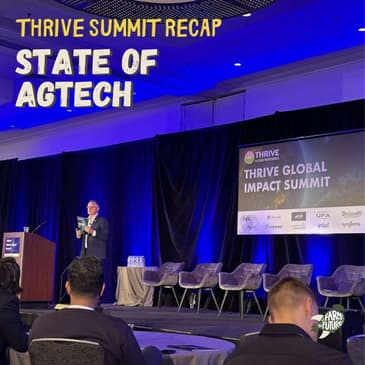
Jane Z. shares key insights and innovations from the THRIVE Global Impact Summit, exploring the intersection of technology, sustainability, and agriculture. From AI-powered pesticide reduction to lab-grown chocolate, discover how startups and major agricultural companies are tackling climate change and food sustainability challenges.
Links:
- VOTE for Chef Dr. Mike to join RJK Jr.'s health policy team
- Raw milk episode with Mark McAfee
- Joel Salatin's USDA appointment news
Key Topics Covered:
- Innovative pesticide alternatives and precision agriculture
- Dairy industry sustainability initiatives
- Cellular agriculture and fermentation technologies
- Climate adaptation in berry farming
- Carbon utilization in agriculture
- Emerging food technologies and startups
Featured Companies & Innovations:
- DeepAgro: AI-powered precision pesticide application
- Greenfield Robotics: Chemical-free weed management
- EmGenisys: AI-enhanced cow IVF
- Driscoll's: Global berry production and climate adaptation
- Kokomodo: Lab-grown chocolate
- NXW Nutrition: Algae-based milk alternatives
- Agrain: Upcycling grains from breweries
- Onego: Egg protein from fermentation
Discounts
- Get 10% off delicious local farm-fresh food delivered to your door with my link for FarmMatch: https://farmmatch.com/jane
- Get 15% off high-quality Italian olive oil with code FARMTOFUTURE: https://shop.vignolifood.com/FARMTOFUTURE
- Get 40% the CircleDNA’s Premium DNA test with code JANEZHANG: https://circledna.com/premium
Connect with Jane Z.
- Instagram: @farm.to.future
- Email: jane@farmtofuture.co
- Website: farmtofuture.co
[00:00:01] I'm Jane Z, and this is Farm to Future, the podcast all about eating better for the planet.
[00:00:09] So I flew into the Bay Area last week to attend the THRIVE Global Impact Summit, and I left super energized about farming, technology, and the future of food.
[00:00:19] It was also really refreshing to spend the day after the U.S. election in a room full of scientists and startups and innovators,
[00:00:28] really techno-optimists who are rolling up their sleeves and solving specific problems in climate-related food sustainability.
[00:00:36] The day was packed with panels and startup pitches about everything from AI to dairy to soil health, and generally innovation in agriculture technology.
[00:00:47] I learned a lot about fertilizer and precision application to cow IVF. Yes, that's a thing, I'll get into it.
[00:00:55] And I met a ton of great people, some of whom you will hear on this podcast in the coming weeks and months.
[00:01:01] So today I'm going to cover my key takeaways from the conference. I'll go over who was there, what I learned, what I'm excited about, and my feedback on the conference.
[00:01:10] Before we get started, I have a quick PSA and request for you all. Chef Dr. Mike, our resident culinary medicine expert,
[00:01:18] has been nominated to potentially work with Robert F. Kennedy Jr. as part of the new administration.
[00:01:24] That's super exciting. If you are new to the podcast, Michael S. Fenster, M.D., better known as Chef Dr. Mike,
[00:01:31] is the only interventional cardiologist and professional chef in the country.
[00:01:36] He teaches culinary medicine at the University of Montana, and he's an expert on ultra-processed foods,
[00:01:43] all of which sets him up perfectly to advise on public health.
[00:01:47] And Mike needs your help. Part of the selection process involves a public vote,
[00:01:51] so go to the link in the show notes. It takes 30 seconds to sign up and vote. Let's get Chef Dr. Mike onto the team.
[00:01:58] All right, so let's get into the Thrive Summit. So this was an ag tech conference, which means most of the people I met there were
[00:02:06] startups who were working on specific solutions, tackling climate change, food waste, etc.
[00:02:12] I used to work in the clean technology space, and it was very similar in a sense that you had all these
[00:02:18] startups working on high-tech solutions, and then you had this big ecosystem of support for these startups.
[00:02:27] When you think about selling software, it is a lot easier to build a consumer app or a kind of general
[00:02:33] software app for business and get it into the hands of customers really quickly.
[00:02:38] With ag tech, it's a little bit different because you need to develop the technology really well,
[00:02:44] but then to bring it to market, you need to know the farmers, the distributors, the retailers.
[00:02:49] Like, you need to have these connections and policymakers.
[00:02:53] And so there's all these wraparound organizations, either government agencies or incubators,
[00:03:00] and there is a lot of corporations there as well who have venture arms that specifically scout for
[00:03:07] startups, including Bayer, who's the owner of Monsanto. But let me just voice over some of the
[00:03:13] exciting startups I met. So there was a Japanese startup that's developing fungal-based pesticides
[00:03:19] where they can grow specific strains of fungus for a specific crop. And I noticed that in the
[00:03:26] public conversation on social media, a lot of times when it comes to chemical fertilizers and
[00:03:31] pesticides, the conversation's really around, like, let's get rid of these single ingredients.
[00:03:37] Like glyphosate or dicambria that have, like, toxic impacts on the environment and on human health.
[00:03:42] And what I learned here is that there's so much nuance to the solutions that we have on hand.
[00:03:48] You can have fungal-based pesticides. You can have biodegradable pesticides. You can have precision
[00:03:54] application. You can have ways of getting rid of weeds without chemicals. And there was a startup
[00:04:01] called Deep Agro that said in their pitch that 70% of chemicals applied to crops are wasted because only
[00:04:09] 30% of those actually hit the weeds that they're trying to target. And so they've developed an AI and
[00:04:15] robot system that can detect weeds in the field and spray only on the weeds. There's another company
[00:04:22] that was there, Greenfield Robotics, that does something similar, but it doesn't even use chemicals.
[00:04:27] It actually cuts the weeds. So it uses an AI to identify where the weeds are, cuts it out, and,
[00:04:33] you know, does all that without spraying chemicals. That is pretty cool. And all this helps reduce the
[00:04:39] amount of water used, chemicals, carbon emissions as part of the chemicals, leaching into the soil and
[00:04:46] the crops, etc. So that's all pretty cool. I think I'll have someone from the fertilizer space on the
[00:04:52] podcast soon to do a deep dive into this. So originally I was most excited to rub shoulders
[00:04:59] with some of the folks from Big Ag. They had two people from Bayer there, along with other big
[00:05:05] companies like BASF, Syngenta. And like I mentioned, in this sort of ag tech innovation ecosystem,
[00:05:11] a lot of times these big companies will do R&D in-house, but they'll also be scouting for startups that
[00:05:19] are already building the solutions in order to eventually acquire them. I think that was pretty
[00:05:25] clear. It wasn't like a, ooh, hush-hush thing. It's pretty explicit in the ag tech space. One of the big
[00:05:31] companies I did get to chat with was Scott Kumar from Driscoll's Berries. He's the VP of Global R&D.
[00:05:39] In his presentation, he pulled up a world map showing all the locations of their dozens of test farms
[00:05:45] around the world, literally on every continent except Antarctica. So they're an example of doing
[00:05:50] that R&D in-house. So their sustainability mantra is more berries, less resources. Makes a lot of sense,
[00:05:58] right? Raise your production while using less inputs. At the same time, their positioning as a
[00:06:04] brand in the market is win with flavor. So as a global berry producer, they're working with all these
[00:06:12] different farmers to produce the best, most flavorful berries with less resources. But they are running
[00:06:17] into a ton of climate challenges from heat spikes in the UK to flooding and thrips in China to floods in
[00:06:25] California to extreme temperatures in South Africa. They are really feeling the heat, so to speak.
[00:06:32] And in the farming industry, it almost doesn't matter how big a company you are or how much resources
[00:06:38] you have, you're still beholden to Mother Nature at the end of the day. Unless you're doing something
[00:06:44] indoors like hydroponics or aquaponics. But even then, you do have outside inputs like electricity
[00:06:50] and water, etc. There was a woman from the ICL group, Haydar Sotovsky. She's the VP of Corporate
[00:06:58] Investments. So she had mentioned this term carbon utilization, that instead of only thinking about
[00:07:05] carbon sequestration, we need to focus on carbon utilization. Where is that carbon going? Because
[00:07:10] you can use carbon for heating, for different types of things, and that's where the commercial
[00:07:17] opportunity is. For example, when I did my tomato study back in undergrad, I was looking at urban
[00:07:24] agriculture and comparing tomatoes grown in an urban greenhouse versus a regional commercial greenhouse
[00:07:30] versus field grown tomatoes in Florida. And I was comparing resource usage across water, energy,
[00:07:38] carbon, and land. And the regional greenhouse, so Savora is the name of the brand. We actually still
[00:07:45] buy Savora tomatoes. They're great. They have a regional greenhouse outside of Montreal, and they are
[00:07:52] situated right next to a landfill. And they actually pump methane gas from the landfill into the greenhouse in
[00:07:59] order to heat it. And so they save a ton on heating costs, as well as, you know, that's directly utilizing
[00:08:05] the carbon from the landfill. That's not only sequestration, but you're literally using it to grow the
[00:08:11] tomatoes. So instead of thinking of carbon only as an output, you can think of it as a valuable resource
[00:08:17] in this circular economy. The dairy panel kind of mentioned this too, where globally, 11% of our
[00:08:24] greenhouse gases come from livestock. And in the U.S., livestock represents 4% of carbon emissions.
[00:08:30] And they were saying that, you know, methane is this potent greenhouse gas, but it is short-lived.
[00:08:36] And there are many ways you can actually reduce methane gas in livestock. So a couple of the
[00:08:42] methods they mentioned were, one, putting a methane inhibitor in their feed, breeding, so you can breed
[00:08:48] for cows that emit less methane. You can manage manure. And someone on the panel said that we have the
[00:08:55] ability to reduce methane gas by 40 to 50% with livestock, which would make the whole industry
[00:09:01] climate neutral or even climate positive by having the farm industry sequester carbon, which is all about
[00:09:10] what regenerative agriculture is about. And speaking of cows and dairy, I spoke with some folks from
[00:09:17] Lely, L-E-L-Y. They provide machinery and equipment for robotic milking. So everything from the milking
[00:09:23] process to the feeding process to housing and caring for cows in the barn. And I asked them what they
[00:09:29] thought of raw milk because that wasn't brought up on the panel. And one of them said he grew up on a
[00:09:35] dairy farm drinking raw milk, like no questions asked. But one time one of the cows got sick and his
[00:09:41] sister did get E. coli. And we sort of talked about that. That's the thing with raw milk is no one's really
[00:09:46] contesting the benefits of the milk itself. It's liquid gold in terms of nutrition and probiotics
[00:09:53] and all the benefits you get from it. But getting access to good, clean, raw milk is actually really
[00:09:59] hard as a supply chain problem. In our household, we've been buying direct from Prairie Foods, which is
[00:10:05] an Amish farm through farmmatch.com, and we get it delivered. And even then in the summertime, I've had a
[00:10:11] bottle or two that have spoiled on the way here. And with raw milk, you really, really have to keep
[00:10:17] the cows super clean and healthy. And you've got to keep the milk cold throughout the entire supply
[00:10:22] chain. I did a whole episode on raw milk with Mark McAfee, who trains dairy farmers on clean raw milk
[00:10:29] systems. So I'll link that in the show notes and you can check it out. One of the startups I want to
[00:10:34] have on is called MGenesis. They're using AI to improve cow IVF. I know, cows do IVF? It's sort of,
[00:10:43] I would describe it as like natural selection by capitalism. But basically, they take cows that
[00:10:49] produce the most amount of milk, harvest their eggs, fertilize them, and then stick those embryos in like
[00:10:56] 200 other cows to breed high production cows. It sounds a little bit like, ooh, is that ethical? But I guess
[00:11:02] we do the same things with plants. So currently with IVF, about 50% of the pregnancies are successful,
[00:11:09] which means 50% of the impregnated cows don't end up having babies. And that's a lot of unnecessary
[00:11:14] suffering for the cows and also wasted time and money with the IVF process. So Kara Wells,
[00:11:21] she's the founder of MGenesis and she's a reproductive physiologist. She developed this technology
[00:11:27] using computer vision to scan videos of the embryos to make sure they're viable before they even go
[00:11:34] into the cows. It's pretty smart. I think Kara would be great to have on the podcast to talk about the
[00:11:39] whole dairy cow industry, how cow breeding works, and all of that. There is also some interesting food
[00:11:45] startups. So Kokomoto is an interesting startup. They're growing chocolate in a lab in days, not years.
[00:11:52] So they use a cellular agriculture process, which I'm assuming means like in petri dishes, where you can
[00:11:58] grow cacao strains in the lab and then customize the flavor, the fat, the protein amounts. It's pretty wild.
[00:12:05] In general, I'm a little skeptical of lab grown foods, particularly meat. But I think when it comes to
[00:12:11] plants, there's a lot of potential for meeting the demand for cacao, but doing it in a climate resilient
[00:12:18] way. There were quite a few startups using fermentation for different food products. So
[00:12:23] a grain is using leftover grains from beer production to make things from flour to crackers
[00:12:30] to chips. There's another startup called Onego that makes egg protein from fermentation. So they're
[00:12:37] producing real egg white protein entirely without animals using precision fermentation. Very curious to
[00:12:44] learn more about that. There was a startup called NXW nutrition from water that's using microalgae to
[00:12:51] make protein powder that they're selling as a milk alternative. And it is actually a white powder.
[00:12:56] It's not green. So it looks like milk, which all sounds fine and dandy, but the founder framed it as,
[00:13:02] Oh, milk is getting so expensive, especially in the global South. They can't afford cow's milk. So let's
[00:13:09] give them algae instead. And that just ethically didn't quite sit right with me. And that sort of
[00:13:14] segues into my first critique of the conference, not, not even critique, more just an observation.
[00:13:20] You know, I've spent a lot of time with scientists at, you know, conferences like this, and sometimes
[00:13:25] you can get so deep into the nuts and bolts of the science or the technology that you can forget the
[00:13:33] human side a little bit. For example, at the summit, we talked a lot about AI, but how many farmers
[00:13:39] actually want to adopt AI? Like how open are they to new technology? I'm sure there's early adopters
[00:13:46] out there and there were case studies presented, but it's probably going to take a while, several years,
[00:13:52] maybe decades before we see the real promise of some of these technologies delivered. And I guess my
[00:13:58] bias I'll call out is that I come from the marketing and go to market side. That's my day job. That's been
[00:14:04] my profession the last 10 years. I'm kind of interested to see how farmers would actually
[00:14:09] use the technology. Is the promise really working in the field? And also when it comes to food,
[00:14:16] you know, how safe and also how tasty are these new food products that are supposed to replace
[00:14:21] good old real food? A few people asked about my podcast and who I've had on, and I was surprised
[00:14:26] to learn that no one I spoke to knew who Joel Salatin was. I was like, do y'all not know that he's
[00:14:32] been tapped by the USDA, which is very exciting news by the way. And also I noticed that no one
[00:14:38] really seemed to use the term regenerative agriculture. They would use modern agriculture
[00:14:43] or precision egg. And I think that's for a number of reasons. One, I think, you know, these terms are
[00:14:50] more attractive to investors who are focused on the technology and to modern or precision is less
[00:14:58] political. Apparently regenerative agriculture can be political. Here I was thinking it was just a
[00:15:04] collection of practices good for soil health, but you know, there is this whole grassroots movement
[00:15:09] around it and now it's tied to political campaigns. I could see the desire to use more neutral terms.
[00:15:17] Okay. So that pretty much sums up my quick state of the ag tech industry from kind of a lay person's
[00:15:25] perspective. But yeah, those are my quick thoughts on the conference. I definitely took a lot away and
[00:15:31] you'll be hearing more from me and the folks at the Thrive Summit in the coming weeks and months.
[00:15:37] I would love to hear from you if you have questions or want to chat about anything I covered. You can find
[00:15:42] me on Instagram at farm.to.future or you can email me at janeatfarmtofuture.co.
[00:15:49] And that's a wrap. Thank you so much for tuning in. Remember to nourish your body and I'll talk to you next time.